
Staff from Nigeria’s premier horticultural research institute receive training on plantain and banana production
October 13, 2018
As part of efforts to build the capacity of national research systems, IITA scientists provided a 2-week training from 10 to 21 September for 10 scientists and technical staff of the National Horticultural Research Institute (NIHORT). The training which was organized by the IITA Plantain and Banana program, in collaboration with the IITA Capacity Development Office and the IITA West Africa Hub Directorate, focused on imparting hands on skills to the trainees in the areas of tissue culture, macropropagation, and field evaluation/management techniques for plantain and banana.
 Speaking at the opening meeting, the Head of Genetic Resources Unit, NIHORT, Dr Dorcas Ibitoye commended IITA for organizing the training. “Being an IITA alumnus, I know that IITA is a leading research institute that has proven its credibility in Africa and beyond in this field. I felt the need to request IITA to train our staff on this mandate crop because I knew they have up-to-date information, facilities, and technical skills that could add value to what we already have at NIHORT. With this training, we are in a better position to offer solutions that will drastically reduce poverty and malnutrition in Nigeria and beyond,” she said.
Corroborating her statement, Head of Genetic Resources Center and Deputy Director of IITA West Africa Hub, Michael Abberton said: “IITA will continue to build up the capacity of NIHORT to ensure efficient delivery of their mandates. One of the ways we can achieve this is by effective communication and strengthening the existing partnership.” Of the 10 participants who attended the training, three received training on tissue culture, four on macropropagation, and another four on field evaluation and management techniques.
[su_quote]“We are positive that with this training in these three key areas of banana and plantain production, you will be able to lead NIHORT’s work to develop sustainable production and utilization of this crop in Nigeria. It is also IITA’s hope that you help build the capacity of your colleagues who did not attend this training,” noted Delphine Amah, IITA Regional Breeding Manager, Plantain and Banana program.[/su_quote]
At the end of the training, participants gave feedback about the training and how it had enhanced their skills. Omolara Aderonmu, a tissue culture trainee, stated: “Being a tissue culture technician, I never knew how to go about banana tissue culture, but now I have been exposed to the various modern ways of culturing and managing tissue culture plants.” Another trainee, Uterdzua Orkpeh who was trained on field management techniques said that the most unique thing he learnt was managing plantain and banana field in a flooded area.
In her closing remarks, Dr Ibitoye expressed profound gratitude to IITA and boldly stated that “This is a mission accomplished!” She also affirmed a stronger collaboration in future between the two organizations.
Speaking at the opening meeting, the Head of Genetic Resources Unit, NIHORT, Dr Dorcas Ibitoye commended IITA for organizing the training. “Being an IITA alumnus, I know that IITA is a leading research institute that has proven its credibility in Africa and beyond in this field. I felt the need to request IITA to train our staff on this mandate crop because I knew they have up-to-date information, facilities, and technical skills that could add value to what we already have at NIHORT. With this training, we are in a better position to offer solutions that will drastically reduce poverty and malnutrition in Nigeria and beyond,” she said.
Corroborating her statement, Head of Genetic Resources Center and Deputy Director of IITA West Africa Hub, Michael Abberton said: “IITA will continue to build up the capacity of NIHORT to ensure efficient delivery of their mandates. One of the ways we can achieve this is by effective communication and strengthening the existing partnership.” Of the 10 participants who attended the training, three received training on tissue culture, four on macropropagation, and another four on field evaluation and management techniques.
[su_quote]“We are positive that with this training in these three key areas of banana and plantain production, you will be able to lead NIHORT’s work to develop sustainable production and utilization of this crop in Nigeria. It is also IITA’s hope that you help build the capacity of your colleagues who did not attend this training,” noted Delphine Amah, IITA Regional Breeding Manager, Plantain and Banana program.[/su_quote]
At the end of the training, participants gave feedback about the training and how it had enhanced their skills. Omolara Aderonmu, a tissue culture trainee, stated: “Being a tissue culture technician, I never knew how to go about banana tissue culture, but now I have been exposed to the various modern ways of culturing and managing tissue culture plants.” Another trainee, Uterdzua Orkpeh who was trained on field management techniques said that the most unique thing he learnt was managing plantain and banana field in a flooded area.
In her closing remarks, Dr Ibitoye expressed profound gratitude to IITA and boldly stated that “This is a mission accomplished!” She also affirmed a stronger collaboration in future between the two organizations.
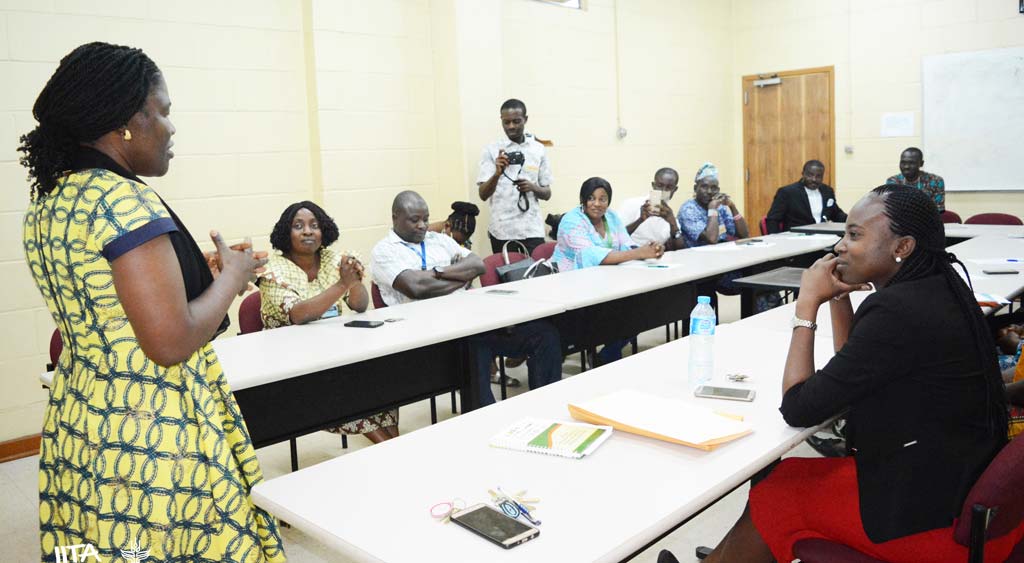
Delphine Amah, IITA Regional Plantain breeder, addressing the trainees.
Contributed by
Recent stories
No items found