
The IITA-developed aflatoxin biocontrol technology, Aflasafe, has won the Best Innovative Research Project at the World BioProtection Awards 2022. The dry spore innovation, one of the Institute’s technologies for solving the problem of aflatoxin contamination in crops such as maize, soybean, and groundnut, won the award in a category shortlisting 38 finalists from 32 different organizations.
With the generic name Aflasafe, the dry spore innovation has maximized opportunities for the private sector in countries like Nigeria, Senegal, and Tanzania. It has allowed hundreds of thousands of hectares of commercially produced crops in 12 African countries to be treated against aflatoxin. African smallholder farmers are now harvesting tons of aflatoxin-safe crops and producing high-quality crops that meet the most stringent food safety standards.
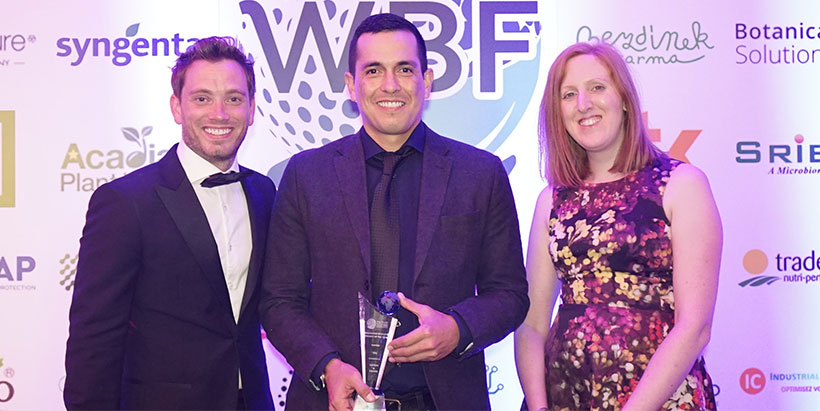
In recognition of these outstanding contributions to agriculture, the IITA Aflasafe won the World Bioprotection Forum (WBF)-organized award, which celebrates remarkable biocontrol and biological agriculture achievements.
According to IITA Plant Pathologist Alejandro Ortega-Beltran, who was in the United Kingdom to receive the award on behalf of IITA, the WBF hosts many bioprotectant industries leaders across the world: Syngenta, FMC Corporation, UPL Limited, Koppert, among others.
Setting up aflatoxin biocontrol manufacturing facilities in Africa has been challenging despite the availability of effective and registered products. However, IITA and partners have developed well-planned, commercialization strategies that improve the technology archetype, making it easier for manufacturers to produce biocontrol products that are affordable for smallholder farmers without compromising effectiveness.
Aflasafe manufacturers now use IITA’s dry spore technology in Nigeria, Senegal, Tanzania, and Mozambique without constructing a laboratory to produce fresh spores of the active ingredients. This means a reduction in construction, capital investment, and running costs, thus making the biocontrol product cheaper for the manufacturers and farmers.
On the future of Aflasafe, Ortega-Beltan said, “Aflasafe currently has activities in 21 African countries and supports aflatoxin management programs in various countries in the Americas, Asia, and Europe. We look forward to expanding our activities and contributing towards greater impact in food safety in additional countries in Africa and beyond.”
IITA also received a nomination for the Industry Collaboration award category with Harvestfield Industries Limited (HIL). “Although the Industry Collaboration award was given to other nominees, it was great that our collaboration with HIL was showcased during the WBF. Participants realized the significant efforts by IITA to protect the safety and nutritional quality of foods and feeds by mobilizing private sector investment and action to scale aflatoxin biocontrol in several African countries. The collaboration demonstrates that it is possible to have research products implemented for practical use by smallholder farmers in African countries despite political, infrastructural, cultural, climatic, and agricultural challenges,” said Ortega-Beltran.
The award is coming at a time when global efforts are focused on developing innovations, technologies, and systems that will provide solutions for the challenges of hunger, reducing climate change impact on the planet, malnutrition, poverty, and natural resource degradation. These objectives are part of the considerations shaping the One CGIAR transformation process in Africa and globally, repositioning to solve the present and future interconnected food, land, water, and climate crises.
Contributed by Timilehin Osunde
Contributed by
Recent stories