
IITA NEWS

How IITA discovered the fall armyworm
January 31, 2020

Isn’t it interesting how seemingly unrelated events in two countries can lead to the same outcome? The story of identifying the fall armyworm in Africa is as intriguing as the pest itself.

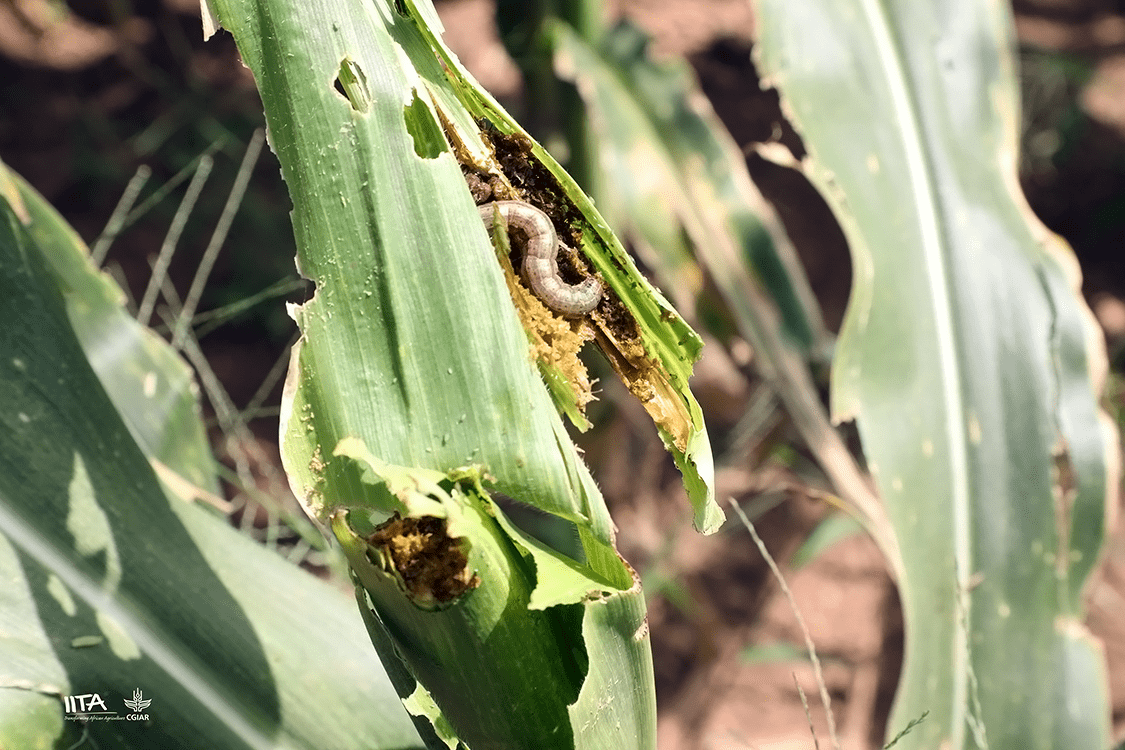
In 2015 Ylva Hillbur, IITA’s former Deputy Director General (DDG) Research for Development was in talks with a Swedish team of researchers at the Swedish University of Agricultural Sciences who were interested in studying the African armyworm. Hillbur requested for samples of the moth from Georg Goergen, the entomologist who heads IITA’s insect Biodiversity Center in Cotonou, Benin. “I kept an open eye so that if ever we saw the moths, we’d send some to the DDG,” Georg says. We knew it would only be a matter of time since the African armyworm is a seasonal insect, which only appears in the first rains after a very long dry spell. We were also aware that it never stays long in the same place, usually a week or two, and it leaves behind only one generation in any given place before moving to the next location,” says Georg an entomologist with ample field experience.
How IITA discovered the fall armyworm

March 2016

While the team in Cotonou was on the lookout, the farm manager at IITA-Ibadan, Nigeria was going on about his daily work of inspecting maize fields and spraying any pests. This was in March 2016. After the usual spraying, the farm manager noticed that this particular insect was not dying. The more they sprayed, the more the insects multiplied, and they fed audaciously. This strange insect that didn’t respond to pesticides alarmed the farm manager, so he alerted Lava Kumar, IITA’s virologist. Kumar informed an entomologist—Abou Togola based at IITA’s Kano Station in northern Nigeria. Togola went to Ibadan and immediately recognized that this moth was different from other native African species. This is when samples were sent to IITA’s biocontrol center in Cotonou for Georg to identify.

Georgen was excited to receive the samples thinking it must the African armyworm that the DDG had asked for. However, when the specimen arrived, he was surprised. “It was different from what I knew! Surely, it was a species belonging to Spodoptera but there are over 30 species of Spodoptera although Africa had eight species by then,” he says. “We first received caterpillars (larvae) and the adults (moths) came later. Based on the genitalia, we identified the moths as the fall armyworm—at this point excitement reached fever pitch.” Why were you excited, I asked? “New information is always exciting. We knew it to be an important pest that required us to move fast. However, you can only publish such information when you are 200% sure. If one is wrong, one can ruin their own and the institute’s reputation,” Georgen responded. In ensuring that he was 200% sure, Georg asked Kumar, the virologist, to DNA barcorde the samples and they matched the barcodes of genomic databases in the US. By early June 2016, they were absolutely certain that it was indeed the FAW. The scientists notified the Nigerian Agricultural Quarantine Service (NAQS) about new pest, and with their consent, made this information public by publishing it in a journal in October 2016. It took 16 months from when the paper was published to the first major outbreak on the continent. “The first outbreaks were seasonal and contained. However, we knew that this would be a long-lasting problem—when the fall armyworm gets a foothold on the continent, there is nothing you can do to stop it because it’s a migratory insect, which can fly over 50 km per night. That explains how such a tiny insect can colonize an entire continent in a short time.”

While FAO decided to take an active role in coordinating partners’ activities and plans to provide sustainable solutions to the FAW challenge, a series of awareness workshops organized by IITA, CIMMYT, and USAID were conducted in various western, eastern, and southern African countries. It soon became clear that there is no single solution to control the new pest, which called for an Integrated Pest Management approach. At IITA, efforts currently include biological control using natural enemies and developing biopesticides, advocacy and awareness raising, the development of an App for early detection of FAW by farmers as well as breeding for resistance in support of efforts led by CIMMYT.

2018

In 2018, the outcry from farmers was less vibrant than the two preceding years, so one can wonder why? “FAW is still with us but is less pervasive as initially conditions for outbreaks were particularly conducive. Today moth populations are still important, but farmers no longer panic when their maize is damaged and have learned from past seasons how to minimize damage.” However, both Kumar and Georg agree on one thing, “The fall armyworm is bound to stay and become a lasting threat in the newly invaded regions. We need to use an integrated pest management strategy. Pesticide application is one of them, but it is not sustainable. Not all farmers can afford pesticides since they are expensive and if used excessively, they induce pesticide resistance, destroy the environment, kill beneficial insects, and make our food unsafe since overuse leads to pesticide residue in food. Pesticides should be used only when necessary, we should look at environmentally compatible options like biocontrol—the use of natural enemies,” Georg advises.

Contributed by

Related news

No items found

Leave a Reply

Your email address will not be published. Required fields are marked *

Scroll to Top
Olaosebikan, Olamide

Olamide Deborah Nwanze is a Senior Research Associate specializing in gender mainstreaming research to inform participatory and inclusive breeding, variety development, and seed systems policies regarding root, tuber, and banana (RTB) crops in the International Institute of Tropical Agriculture Headquarters, Ibadan, Nigeria. She is a PhD candidate at the University of Ibadan and holds an MSc and B. Agric in Agricultural Extension and Rural Development. Olamide is a fellow of the African Women in Agricultural Research and Development – Gender Responsive Agricultural Systems Policy (AWARD-GRASP) and the Gender Responsive Researchers Equipped for Agricultural Transformation (GREAT). She seeks to apply her gender-mainstreaming learnings, gender-responsive research, and policy development, and review expertise to facilitate women, youth, children, and vulnerable social group’s access to and adoption of agricultural Innovations that guarantee food, nutrition, income, and livelihood security in Africa. Her current roles include mentoring research fellows, development of guides and training manuals, implementation and adaptation of gender frameworks and tools, value chain actors’ engagement as citizen science partners, policy review and redesign, data management, and analysis. Her current research explores mixed methods and participatory and interdisciplinary approaches to capture and highlight gender dynamics, needs, preferences, and challenges stakeholders face within the agricultural livelihood value chain to prioritize gender-inclusive strategies in breeding programs, policy design, and implementation.

At IITA, she contributes to the implementation of the CGIAR Accelerated Breeding Initiative and Genetic Innovation Programs; participatory and gender research within the NextGen CassavaHarvestPlusRTBFoods, and Tricot-ClimMob 1000Farms Projects; and gender knowledge communication via the G-LENS webinar series, video documentary, policy briefspublications, and blogs.


Recent publications

de Sousa, K., van Etten, J., Manners, R. Bello, A., Teeken, B., Olaosebikan, O., et al. 2024. The tricot approach: an agile framework for decentralized on-farm testing supported by citizen science. A retrospective. Agron. Sustain. Dev. 44, 8. https://doi.org/10.1007/s13593-023-00937-1

Madu, T., Onwuka, S., Nwafor, S., Onyemauwa, N., Ejechi, M., Ofoeze, M., Ukeje, B., Eluagu, C., Olaosebikan, O., Okoye, B., 2024. Gender-Inclusive Consumer Studies Improve Cassava Breeding in Nigeria in: Frontiers in Sociology, volume 9, number: 1224504, doi: 10.3389/fsoc.2024.1224504

Olaosebikan, O.; Bello, A.; Utoblo, O.; Okoye, B.; Olutegbe, N.; Garner, E.; Teeken, B.; Bryan, E.; Forsythe, L.; Cole, S.; Madu, T. 2023.  Stressors and Resilience within the Cassava Value Chain in Nigeria: Preferred Cassava Variety Traits and Response Strategies of Men and Women to Inform Breeding. Sustainability 15, 7837. https://doi.org/10.3390/su15107837

Okoye, B., Ofoeze, M., Ejechi, M., Onwuka, S., Nwafor, S., Onyemauwa, N., Ukeje, B., Eluagu, C., Obidiegwu, J.*, Olaosebikan, O., Madu, T.* 2023. Prioritizing preferred traits in the yam value chain in Nigeria: a gender situation analysis in: Frontiers in Sociology, volume 8, number: 1232626, pages 1 – 9, ISSN 2297-7775, 2023. https://www.frontiersin.org/articles/10.3389/fsoc.2023.1232626/full

Olaosebikan, O., Bello, A. A., de Sousa, K., Ndjouenkeu, R., Adesokan, M., Alamu, E. O., Agbona, A., van Etten, J., Kegah, F. N.*, Dufour, D., Bouniol, A., Teeken, B. 2023. Consumer acceptability of cassava gari-eba food products across cultural and environmental settings using the triadic comparison of technologies approach (tricot) in: Journal of the Science of Food and Agriculture,

Teeken, B., Olaosebikan, O., Bello, A. A., Madu, T.*, Cole, S. M. 2023. Qualitative assessment on the positionality and preferences of dyads in relation to cassava-related activities: working with tricot trial citizen scientists https://hdl.handle.net/10568/138326 Type: Manual

Bouniol, A., Ceballos, H., Bello, A. A., Teeken, B., Olaosebikan, O., Owoade, D., Agbona, A., Fotso Kuate, A., Madu, T.*, Okoye, B.*, Ofoeze, M.*, Nwafor, S.*, Onyemauwa, N.*, Adinsi, L.*, Forsythe, L., Dufour, D. 2023. Varietal impact on women’s labour, workload and related drudgery in processing root, tuber and banana crops: focus on cassava in sub-Saharan Africa in: Journal of the Science of Food and Agriculture, pages 1 – 25, ISSN 0022-5142,

Bello, A. A., Agbona, A., Olaosebikan, O., Edughaen, G., Dufour, D., Bouniol, A., Iluebbey, P., Ndjouenkeu, R.*, Rabbi, I. Y., Teeken, B. 2023. Genetic and environmental effects on processing productivity and food product yield: drudgery of women’s work in: Journal of the Science of Food and Agriculture, pages 1 – 32, ISSN 0022-5142, 5

Cavicchioli, M., Zimbiti, T., Teeken, B., Nwanze, D.O., Liani, M., Parkes, E. & Bello, A. 2023. IITA-Gender Responsive Breeding Training Report. Genetic Resources Center, IITA-HQ, Ibadan, 21-23 September, 2022. Ibadan, Nigeria: IITA, (34 p.).https://hdl.handle.net/10568/131368

Agbona, A. Peteti P., Teeken B., Olaosebikan O. Bello, A. A., Parkes, E., Rabbi, I. Y., Mueller, L., Egesi, C., Kulakow, P. 2022. Data Management in Multi-disciplinary African RTB Crop Breeding Programs. In: Williamson, H.F., Leonelli, S. (eds) Towards Responsible Plant Data Linkage: Data Challenges for Agricultural Research and Development. Springer, Cham. https://doi.org/10.1007/978-3-031-13276-6_5

Lora Forsythe, Pricilla Marimo, Sarah Mayanja, Olamide D. Olaosebikan, Esme Stuart, Bela Teeken, Benjamin Okoye, Tessy Madu, (2021). Cross-product Gender Analysis of RTBfoods Step 2 Gendered Food Mapping on RTB Products. Understanding the Drivers of Trait Preferences and the Development of Multi-user RTB Product Profiles, WP1. London, UK: RTBfoods Field Scientific Report, 30 p.

Teeken, B., Garner, E., Agbona, A., Balogun, I., Olaosebikan, O., Bello, A., Madu, T., Okoye, B., Egesi, C., Kulakow, P. and Tufan, H.A. 2021. Beyond “Women’s Traits”: Exploring How Gender, Social Difference, and Household Characteristics Influence Trait Preferences. Frontiers Sustainable Food Systems 5:740926. https://doi.org/10.3389/fsufs.2021.740926

Teeken, B., Agbona, A., Bello, A., Olaosebikan, O., Alamu, E., Adesokan, M., Awoyale, W., Madu, T., Okoye, B., Chijioke, U., Owoade, D., Okoro, M., Bouniol, A., Dufour, D., Hershey, C., Rabbi, I., Maziya‐Dixon, B., Egesi, C., Tufan, H. and Kulakow, P. (020. Understanding cassava varietal preferences through pairwise ranking of gari‐eba and fufu prepared by local farmer–processors. Int J Food Sci Technol. https://doi.org/10.1111/ijfs.14862

Bela Teeken, Olamide Olaosebikan, Ireti Balogun, Benjamin Okoye, Tessy Madu, Steven Cole, Abolore Bello, Elizabeth Parkes. (2020). Piloting the G+ customer and product profile tools for gender-responsive cassava breeding in Nigeria. Nigeria: International Institute of Tropical Agriculture (IITA). https://hdl.handle.net/20.500.11766/13000