
MEDA partners with IITA to improve food systems
11 August 2022
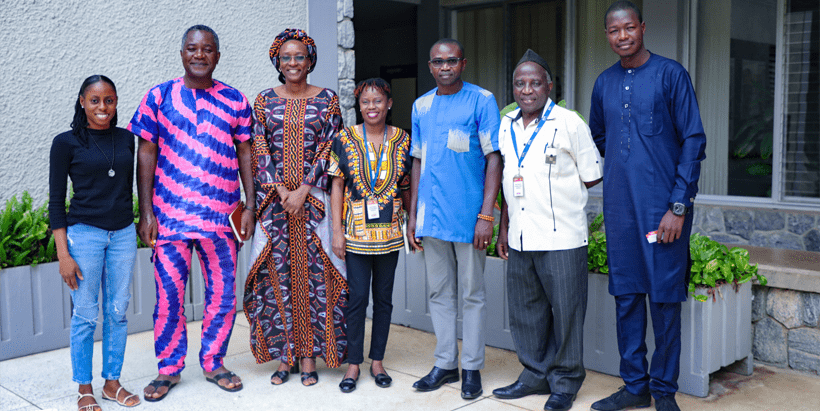
The Senior Regional Director of Mennonite Economic Development Associates (MEDA), Dr Pierre Kadet, and his Country team visited IITA–CGIAR headquarters on 22 July. The purpose of the visit was to explore values chains of some IITA crops, such as soybean, and request support and linkages on other non-IITA mandate crops like rice and groundnut.

Giving the welcome address, Chrysantus Akem, Technologies for African Agricultural Transformation (TAAT) Program Coordinator, introduced the team to IITA’s activities, including the Research for Development (R4D) and Partnerships for Delivery (P4D) programs. He also highlighted some of TAAT’s achievements, mentioning IITA as the lead executor of the program. “IITA and MEDA can work together to make a difference,” he said.
Dr Kadet, stated that IITA and MEDA have an overlapping interest in agri-food systems and P4D. He gave an update of their “Global strategy plan” mission, which strongly emphasizes improving food systems and creating and sustaining 500 employment opportunities for women and youth in sub-Saharan Africa. He further shared their expectations, including the types of crops that will meet domestic needs and having robust industrialization to reach local and global markets.
Grace Fosen, Country Project Manager, spoke about MEDA’s Women Entrepreneurship and Youth Empowerment Program (WAY). She mentioned that the program’s objective is to support women and youth with capacity building on gender and environmentally sustainable machines to process soybean, rice, and groundnut. Fosen also shared the different intervention processes on how they have supported youth and women with technologies, transforming agricultural waste into briquettes—a compressed block of coal dust or other combustible biomass material used for fuel. She requested that IITA shed light on the implementation strategies used for projects.
In response, Akem clarified the importance of technologies, explaining that one of the first strategies to adopting new technology is “identifying the best technology.”
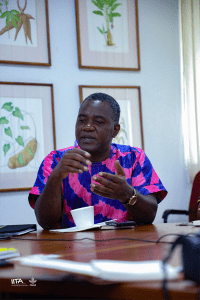
In addition, Godwin Atser, Digital Extension, and Advisory Services Specialist, expatiated on how IITA has developed appropriate processing machines that are adaptable to local vicinities through the P4D arm of the Institute. “This has stimulated extension activities and created employment opportunities in the process,” he said.
Wrapping up, Akem said MEDA would be linked to the youth program of IITA, and some of IITA projects, including Africa Rice, Feed the Future, and TAAT, to enlighten and work with them on the identified crops.
Atser suggested they include cassava and maize as part of their crops since they both have local and industrial potential. To support his suggestion, he shared how IITA uses the bottom-up approach to identify farmers’ problems, birthing successes in the Building an Economically Sustainable and Integrated Cassava Seed System (BASICS) and GiZ projects.
Fosen appreciated the IITA management team for the insightful discussions, adding that he and his team would follow up on the discussions for implementation.
MEDA is an international organization focusing on employment and improvement of agricultural food systems and women and youth in rural communities. The organization provides business solutions and turns new technologies into marketable products for smallholder farmers and the entire food system around the ecosystem.
Contributed by Anita Akinyomade
