
Study: Resilience capacity beats climate shocks toward food security
17 November 2023
Resilience, as Jean Chatzky aptly points out, is not a single skill but a mix of skills and coping mechanisms. It is the ability to bounce back from challenges and setbacks while focusing on the positive. It explains the importance of resilience capacity to global climate change adversity and socioeconomic shocks affecting many African countries’ farming households and food systems dependent on rain-fed irrigation. According to Smith and Frankenberger (2018), resilience capacity is a set of conditions, attributes, or skills that enable households to achieve resilience in the face of shocks.
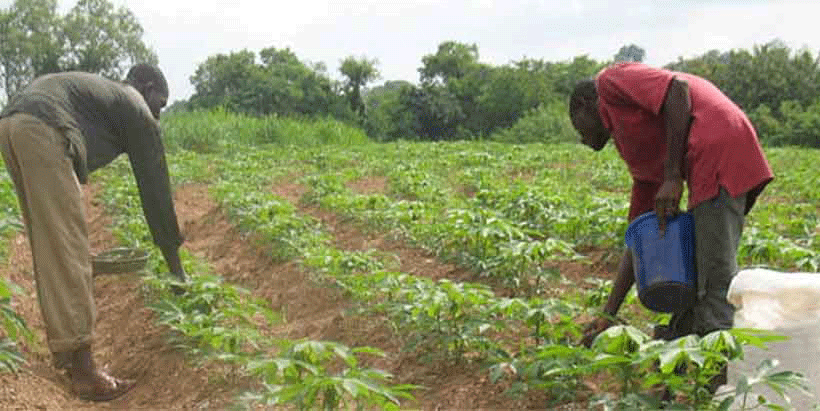
A recent study, “Mediation and moderation roles of resilience capacity in the shock–food-security nexus in northern Ghana,” conducted in Ghana by researchers from IITA–CGIAR in collaboration with the University for Development Studies and International Food Policy Research Institute (IFPRI) reveals that the resilience capacity lessens or mediates the negative effects of heat stress and drought on food security. The study investigated how resilience capacity influences the connection between weather shocks and household food security.
“The study shows that during heat stress, food consumption in households drops by 0.71 Standard Deviation (SD) while being resilient moderates the consumption by 0.61 SD. During droughts, household food consumption is reduced by 0.67 SD, but resilience capacity effectively dampens this negative effect by approximately 0.60 SD,” explained University of Development Studies researcher Isaac Ansah.
Ansah noted that the study discovered that a big part of how heat stress affects the amount of food people eat depends on resilience; thus, it is important to build resilience, like using sustainable farming methods, to improve food security in northern Ghana.
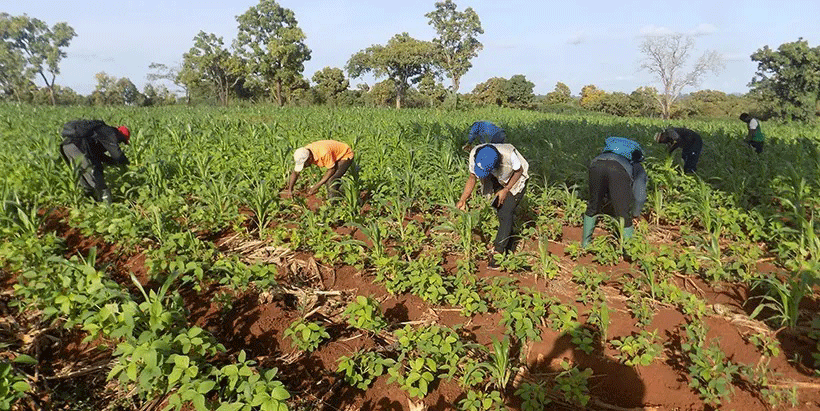
“The role of resilience capacity is to serve as the channel through which shock impacts are transmitted to food security by absorbing the negative impacts, modifying them, and then transmitting the residual effect to food security. However, the mediation role of resilience capacity is only partial, implying that there are other mediators the study has not captured,” added IITA Economist Bekele Kotu.
What sets this study apart from others is its ability to quantify the extent to which resilience capacity mediates the relationship between shocks and food security. It reveals that heat stress has a more substantial impact than drought on food security outcomes, aligning with other reports noting that high temperatures directly threaten food production and availability.
The research team’s recommendations call for policy measures to scale up locally suitable Sustainable Intensification Practices, such as promoting heat- or drought-tolerant crop varieties and moisture conservation methods among smallholder farmers, which can bolster resilience capacity. Furthermore, efforts to enhance farmers’ understanding of weather patterns and their potential impact on livelihoods are crucial. This involves providing accurate and timely weather information and early warning systems using affordable and efficient dissemination methods.
Considering that many communities involved in the study have limited access to infrastructure and markets, a comprehensive strategy to improve resilience can bring about more sustainable and positive changes in household food security outcomes. Bekele advises that this holistic approach is vital for addressing the challenges faced by these communities.
Contributed by Gloriana Ndibalema
