
IITA Ghana host the West Africa and Sahel Regional Hubs annual retreat
28 March 2025
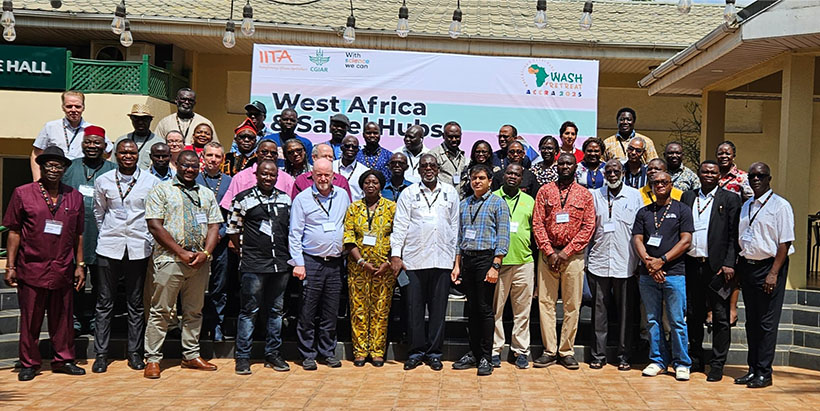
More than 40 scientists from the IITA–CGIAR gathered in Accra, Ghana, for the annual retreat of the West Africa and Sahel Regional Hubs (WASH) recently. From 18 to 21 March, the four-day event served as a crucial platform to assess past achievements, refine strategies, and strengthen efforts toward advancing nutrition, food security, breeding, and agricultural innovations across the region.
Speaking during the retreat, Director IITA Sahel Hub, Dr Abdoulaye Tahirou said, “The 2025 WASH annual retreat aimed to discuss IITA’s new strategies, strengthening collaboration among scientists and exploring county-specific programs”.
Opening the retreat on the first day, IITA Country Representative for Ghana – host country for the retreat – Dr Richard Asare during his welcome remarks said IITA station in Tamale will ensure the participants have a memorable experience. Adding that the Tamale station is being designed to serve as a technological park and a unit hub. He delivered a presentation on the Research for Development (R4D) and Partnership for Development (P4D) in Ghana with a focus on the BBEST, Cocoasoils, AICCRA, PROSSIVA, Akilimo, SSPiNG and EU Food projects. During the retreat, each country presented its programs and innovations, and discussions were held on scaling innovations, policy innovations, food security, climate-smart agriculture, and breeding programs. A strategic document was developed for the institute’s discussion to enable a smooth engagement with government and policymakers. TAAT showcased its E-catalog and invited scientists to use it in their work.
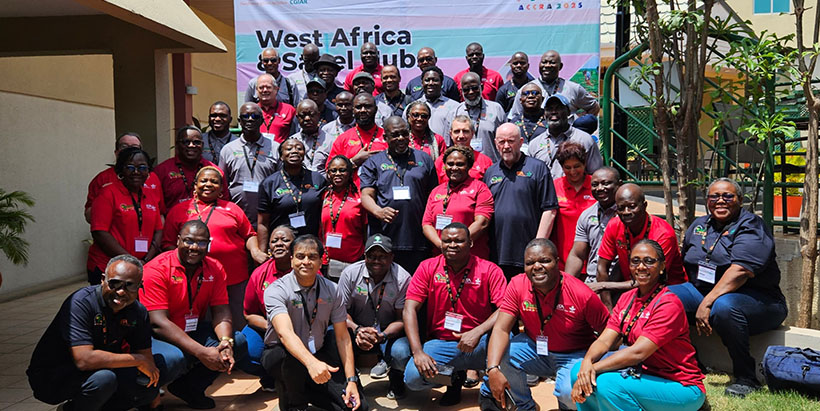
Scientists from both hubs engaged in interactive team-building exercises, including memory games, team bonding activities, and identification of IITA KPIs and a concept note development around the following concepts:
- Climate-smart innovations in the Sahel: Boosting the adaptive capacity of smallholder farmers,
- Sowing seeds of change (SSC): Empowering youth and women in agriculture,
- Unleashing the potential of underutilized crops to feed drought-prone areas of Africa,
- Digital marketplace for African opportunity crops.
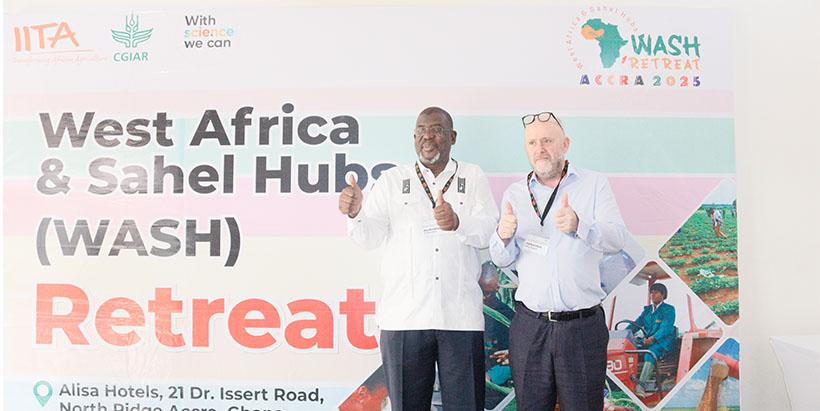
Prof Michael Abberton, Director of the West Africa Hub, and Dr Tahirou Abdoulaye, Director of the Sahel Hub, assessed the concept note.
Together, scientists underlined some of the challenges the hubs face and highlighted recommendations to address these challenges.
Challenges
- Resource mobilization
- Internal communication
- Non-utilization of the IITA germplasm
- Poor internal communication
Recommendations
- Create an enabling environment for scientists to work and thrive.
- Mentor young scientists and postdoc fellows
- Develop a succession plan, as some scientists will be retiring in the next few years
- Improve internal communication
- Utilization of IITA germplasm
The hub directors and scientists in the two hubs reiterated their commitments to strategic partnerships, supporting each other and aligning efforts toward achieving IITA’s mission to transform African agriculture.
Contributed by Francisca Ocloo
