Reviving Liberia’s coffee sector through best practices
22 September 2025
For decades, coffee has been more than just a crop in Liberia, it has been part of the country’s heritage and an important contributor to rural livelihoods. Once a key export commodity, coffee production has dwindled over the years due to weak extension services, outdated farming practices, and limited access to improved technologies. Smallholder farmers, who form the backbone of Liberia’s agricultural economy, have struggled to meet both household needs and market demand.
Yet, coffee still holds enormous potential. Experts believe that with the right support, smallholder farmers can transform the sector into a driver of inclusive growth. The introduction of climate-smart agroforestry and intercropping systems offers a pathway to higher yields, healthier soils, and diversified incomes—all while strengthening resilience against climate change.
It is against this background that IITA–CGIAR, through the European Union (EU)-funded Seeds4Liberia Project, convened a four-day Training of Trainers (ToT) workshop in Suakoko, Bong County, from 26-29 August 2025. This is following a seedling distribution exercise in April this year, as part of IITA-CGIAR’s broader agenda to empower farmers, improve seed systems, and drive economic growth through strategic crop value chains.
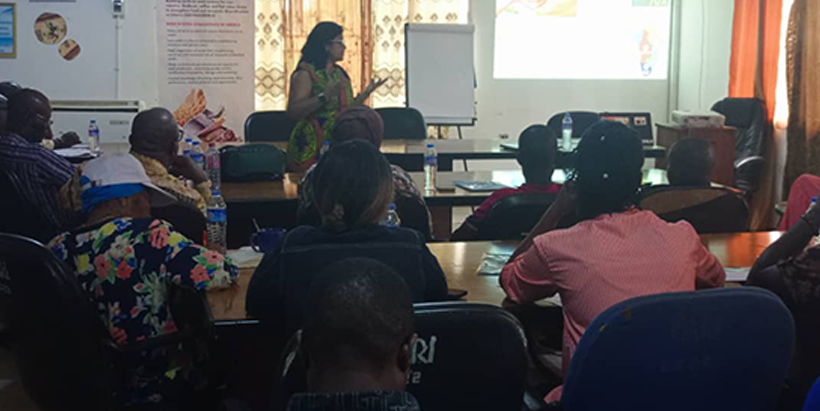
The workshop, themed “Good Agronomic Practices, Climate-Smart Coffee and Agroforestry Systems for Sustainable Coffee Production in Liberia”, brought together about 30 extension officers and advanced farmers from five coffee-growing counties. Organized in partnership with the Central Agricultural Research Institute (CARI), the training blended classroom sessions with hands-on demonstrations in the field.
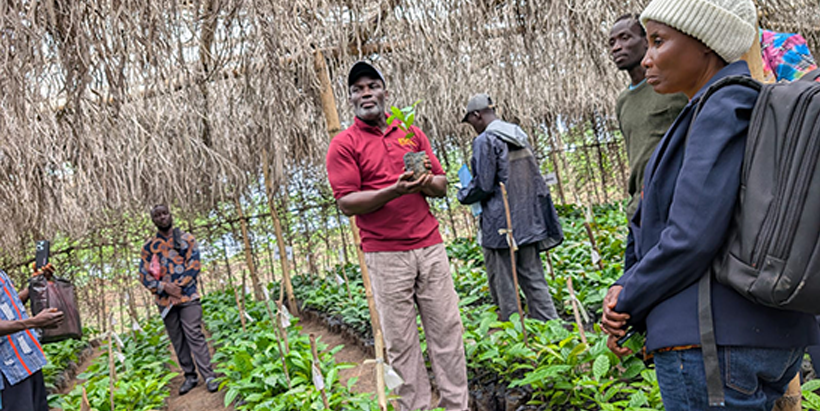
Participants learned practical skills such as proper planting hole sizes, pruning techniques, fertilizer and insecticide application, soil fertility management, and pest and disease control. They also explored agroforestry approaches, including growing compatible trees alongside coffee and integrating short-duration crops like cowpea and soybean to improve soil health and moisture retention through training provided by Dr Richard Asare, IITA Senior Scientist and Agroforestry Specialist and Dr Samuel Mesele, IITA Soil Scientist.
Dr Ranjana Bhattacharjee, IITA Senior Scientist and one of the lead facilitators, emphasized that the purpose of the training was not just to build technical knowledge but to create a multiplier effect, “Each participant is expected to train at least ten farmers in their county. This creates a chain reaction of knowledge transfer that ensures that impact spreads far beyond the workshop itself.”
She highlighted that Liberia currently contributes less than 2% of the world’s coffee, and youth participation in the sector remains low because most benefits are only visible three to four years after planting. By making coffee farming more sustainable and integrated into agribusiness, she explained, the project hopes to attract young people while addressing productivity and deforestation challenges.
For Liberia, strengthening extension services is critical. The country faces overwhelming reality, while international standards recommend one extension officer for every 600 farmers, Liberia has an average of one officer serving nearly 35,000 farmers. This gap severely limits farmers’ access to technical support, improved seeds, and best practices.
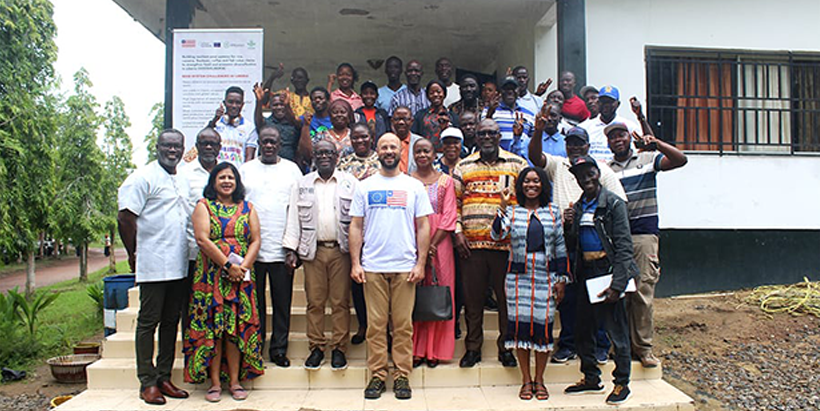
The ToT model is designed to bridge this gap. By training extension officers alongside selected smallholder farmers, the workshop ensures that knowledge can reach deep into farming communities where it is needed most. A dedicated WhatsApp group has been created to provide ongoing support, answer questions, and share experiences across counties.
The event was attended by high-level representatives, including the Deputy Minister of Technical Services, Honorable Solomon Hedd-Williams, officials from CARI including Director General Dr Arthur Karnuah, the Liberia Agricultural Commodity Regulatory Authority (LACRA), the Seed Distribution and Certification Agency, the Farmers Union Network of Liberia, and EU donor representatives.
The Seeds4Liberia Project itself is jointly implemented by three CGIAR centers – AfricaRice, IITA, and WorldFish in collaboration with the Liberia Ministry of Agriculture, CARI, NaFAA, and LACRA. With objectives going beyond coffee: to strengthen seed systems, improve extension delivery, increase productivity, and ultimately enhance the livelihoods of Liberia’s smallholder farmers.
Follow-up sessions will focus on tree management and post-harvest handling, areas where Dr Bhattacharjee noted significant gaps. Currently, poor handling practices such as drying beans on the ground expose coffee to contamination and losses. The training will introduce improved post-harvest techniques to ensure higher-quality beans for both the local and international markets.
For the 30 participants, the workshop was not only a learning experience but also a responsibility to become ambassadors of climate-smart practices and champions of sustainable coffee in the country. For Liberia, it represents another step toward reclaiming the crop’s potential as both an economic and cultural asset.
Through initiatives like the Seeds4Liberia Project, Liberia is investing in its people – the extension officers and smallholder farmers whose skills, resilience, and innovation will drive agricultural transformation.
Coffee may be a traditional crop for Liberia, but with modern approaches like good agronomic practices, and clean seeds, it can become a driver of economic growth and development.
Contributed by Timilehin Osunde
