Young VACS breeders strengthen skills in breeding optimization and market intelligence
22 May 2026
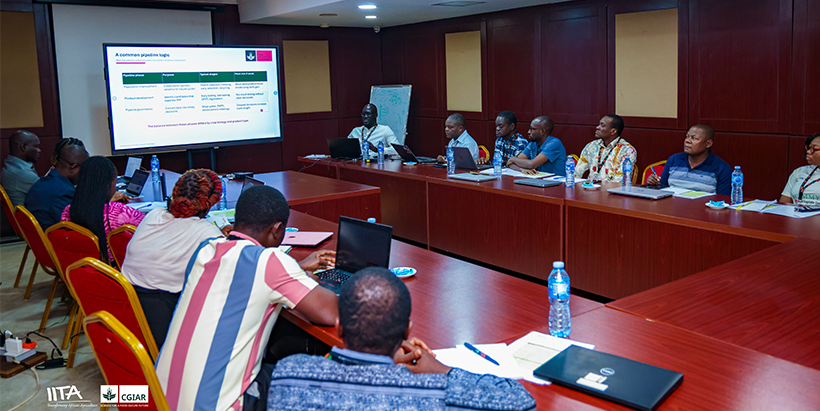
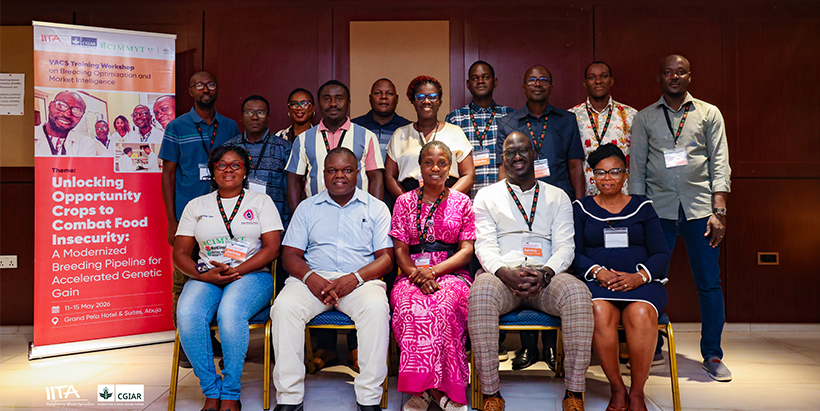
Young breeders participating in the VACS program have completed an intensive five-day Breeding Optimization and Market Intelligence training organized by IITA and CIMMYT in Abuja on 11 to 15 May.Held under the theme, “Unlocking opportunity crops to combat food insecurity: A modernized breeding pipeline for accelerated genetic gain,” the training brought together emerging scientists and breeding professionals to strengthen their understanding of modern breeding systems and data-driven decision-making for crop improvement.
The training covered key components of breeding pipeline optimization, including market intelligence, Target Product Profiles (TPPs), Target Population of Environments (TPEs), breeding schemes, trial network optimization, phenotyping and SOPs, genomic selection, trait trade-offs, stage-gate systems and Product Advancement Planning Meetings (PAPM).
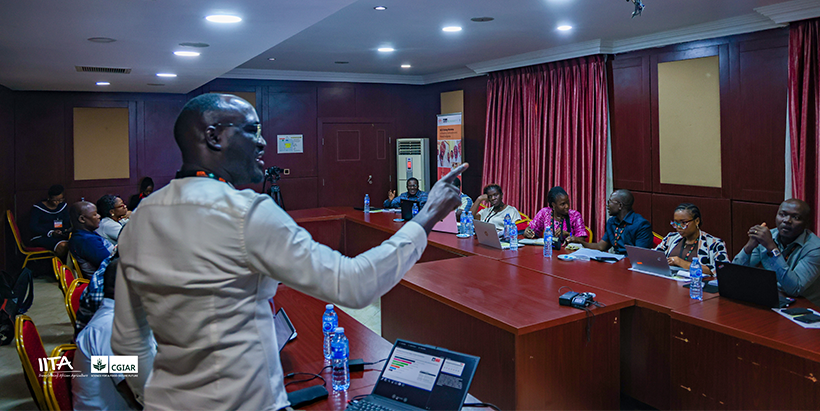
Dr Adama Seye, Quantitative Geneticist for the Breeding for Tomorrow Program, guided participants through practical approaches for designing breeding systems that respond to market needs while improving efficiency, selection accuracy, and long-term genetic gain.
He emphasized the breeder’s equation as a central framework for accelerating genetic gain, highlighting factors such as selection intensity, selection accuracy, useful genetic variation, and breeding cycle length.
Dr Hapson Mushoriwa, IITA Head of Breeding, noted that while genetic variation remains important, reducing breeding cycle length is one of the most effective ways to accelerate genetic gain. “There is a direct link between the proportion of selection and genetic gain,” he explained during one of the technical sessions, which also explored trade-offs in cost, diversity, risk, and feasibility within breeding programs.
Participants examined how Genotype-by-Environment (GxE) interactions influence breeding decisions and product development strategies. Using practical examples, Dr Seye demonstrated the importance of refining TPEs to ensure improved varieties are matched to the environments where they are most likely to succeed.
He stressed the importance of environment-specific breeding decisions, explaining that a product that performs well in one country may not necessarily be suitable for release in another due to varying environmental conditions and production realities. He also underscored the value of strategic partnerships for germplasm sharing, collaborative research, and resource management, especially under limited funding and infrastructure.
“If drought is important in the TPP, then breeding programs must ensure drought resistance is reflected within the target production environment,” he noted while discussing TPE refinement and product advancement considerations. Throughout the training, participants engaged in group work, trial design exercises, and discussions on improving breeding pipelines for self-pollinated, clonal, and hybrid crop systems. Sessions also focused on identifying bottlenecks in breeding operations and proposing practical interventions to improve efficiency and decision quality.
The young breeders expressed appreciation for the depth of knowledge shared and the opportunity to interact with experts in the breeding field. As part of the training outcomes, participants developed draft optimized breeding schemes for their crop systems, reflecting the program’s emphasis on practical application and real-world impact.
The VACS fellowship training reinforces IITA’s commitment to building the next generation of breeders equipped with modern tools and approaches to combat food insecurity and strengthen agricultural resilience across Africa.
Contributed by Folake Oduntan
