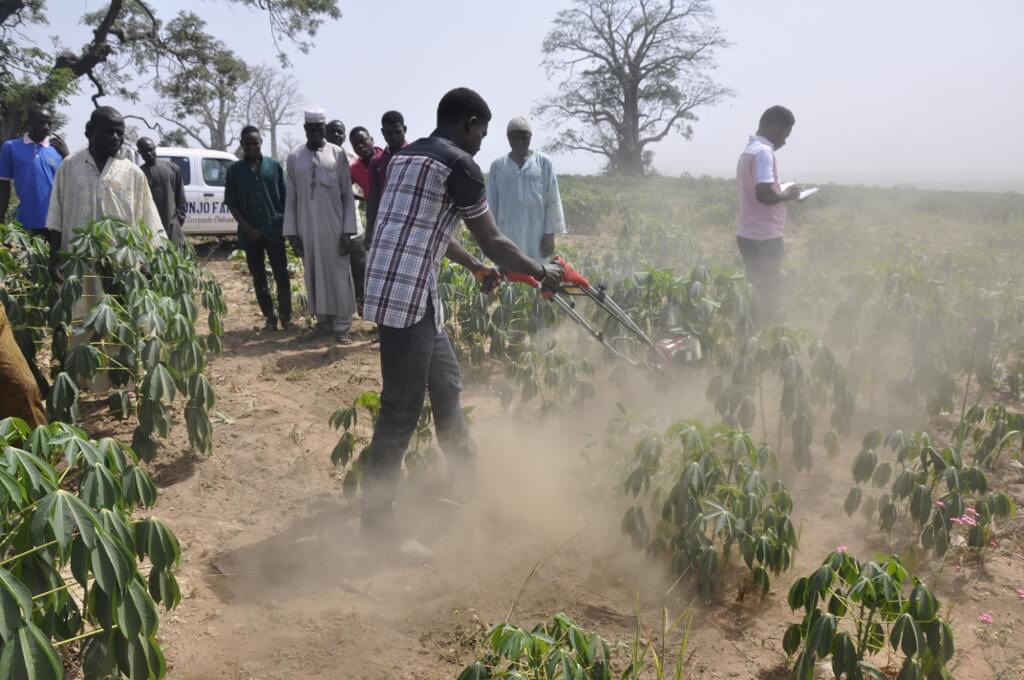
Young cassava farmers and outgrowers of Arogunjo Farm Limited, in Kwara State, Nigeria, were given a cassava weeding machine last December 2015 to ease the back-breaking work of removing weeds from their fields. The machine was donated by the IFAD/IITA High Quality Cassava Flour (HQCF) Project in collaboration with the IITA Cassava Weeds Management Project.

Picture of IITA’s Uchenna Ene demonstrates the use of the cassava weeding machine to training participants.

IITA’s Uchenna Ene demonstrates the use of the cassava weeding machine to training participants.

During the presentation of the machine, over 20 youths and outgrowers including women, were trained were trained on how to use the machine. Bamidele Alenkhe, IFAD/IITA HQCF Project coordinator, advised the youth to maintain the machine properly and also tasked the recipients to appoint a custodian of the machine.

The training highlighted the efficiency, maintenance, and guidelines in the use of the weeder to avoid destroying cassava stems. IITA weed management technician Uchenna Ifeanyi Ene skillfully demonstrated the use of the weeder to uproot the weeds without harming the cassava, and let the training participants try using the machine.

The participants expressed awe at seeing such a machine that could remove weeds growing between cassava plants.

Abdul-Rasaque Alabi, one of the youths, said that the machine was easy to handle. “This machine is very easy to use. If I have the opportunity of buying one, I can plant more cassava on my farm and get very good yields at harvest time, because I know from experience that weeds disturb the root quality of our cassava.”

Another youth, Sadu Jimoh, said that IITA should provide more machines and create further awareness about the weeder because it makes farming easier for the farmers“If farmers like me can be given this machine for free, and combined with the training that IITA has given me on land preparation and the use of improved cassava varieties, then my productivity will increase year in, year out.

The training and demonstration did not hinder women from participating, Catherine Imola and Mariam Olaoye also tried their hand using the machine. After the demonstration Imola said “I like the machine. I handled it easily, without stress; with this women’s participation in farming will increase and and we will not wait for men to help us uproot weeds in our farm again.” On the other hand, Olaoye said the machine was a little heavy for her to handle. “Manufacturers should make provision for smaller or lighter machines. If I see something that is a little smaller; I will be fine with it,” she said.

Nteranya Sanginga

Picture of Nteranya SangingaThank you all for your hard work and dedication in 2015. Over the past four years we have worked together as a team and this approach will continue to be the major factor in our continued progress and success. Challenges lie ahead as always but as we embrace change and adapt, we have a bright future ahead.

As we continue in our strength of delivering improved knowledge and technologies through partnerships to the end users, we will be evaluated on how people’s lives are being improved and we must be able to provide the clear evidence that we are achieving impact at scale. Demonstrating this impact by working with private and public partners will determine our future. Being successful in both these areas is a priority and it is critical that the organizational structure of IITA supports our ability to achieve both of these major objectives.

 One important area that IITA will focus on in 2016 is helping the African Development Bank in achieving its vision for Africa by modernizing agriculture.

African leaders had met at a conference, Feeding Africa – An Action Plan for African Agricultural Transformation, in October 2015 in Dakar, Senegal, to kick-start agriculture as an engine of growth.

A roadmap was developed that involves a two-pronged approach based on raising food productivity and reorganizing markets to create greater incentives and better trade conditions.

The creation of the Business Incubation Platform (BIP), the newly added cassava and soybean processing centers, and the Youth Agripreneurs at IITA have all made a significant contribution to Nigeria’s quest to diversify its economy by accelerating the agricultural development sector. Many of these IITA innovations are being replicated and expanded in countries like DRC, Tanzania, and Zambia.

I believe my role in the future of IITA will be more in the area of achieving impact at scale by working with private and public partners and especially the youth. I am working to help IITA become the organization that all the other organizations working to improve agriculture in Africa want to partner with.

Let’s work together on this. I wish all staff the best for 2016.

Kenton Dashiell
Picture of Kenton Dashiell First, I want thank you all for your contributions to the progress of building strong partnerships and increasing our capacity development activities last year. As we enter 2016, let’s build on our achievements, especially now that the Business Incubation Platform is fully operational and getting increasing demands for Aflasafe, Nodumax, and breeders seeds of all our major crops.

Also, the success and expansion of our IITA Youth Agripreneurs (IYA) model is helping to raise IITA’s profile and visibility throughout Africa.  With your strong dedication to work and commitment to improving agriculture we will continue to establish new partnerships with all levels of government and with the private sector in pursuance of IITA’s goals. I wish everyone a fruitful year ahead.

Ylva Hillbur
Picture of Ylva Hillbur I want to express my sincere gratitude for the contribution you have all made in 2015 to the continuing achievements of IITA. The teamwork of staff at all levels and across all units has meant that IITA has continued to succeed in a time of financial problems for CGIAR.

The quality of our science remains the bedrock on which this success is based and a major foundation of the impact of IITA on the lives of the people of Africa. I am sure that your efforts will continue just as strongly in 2016, which is the year of open access and E-Research in IITA. I enjoin everybody to support the implementation of open access and E-Research initiatives and ensure that the Institute becomes fully open access-compliant by 2018.

Kwame Akuffo-Akoto

Picture of Kwame Akuffo-Akoto As we enter the new year, I would like to commend you all for your hard work and dedication throughout 2015 – we have worked well together to keep IITA strong and healthy despite challenges and difficulties. We have coped with the challenges and they have only served to make us stronger and more resilient. We are confident that the coming year will bring us opportunities to work harder and more efficiently towards achieving success, both in our personal lives, and towards the mission of IITA.

Wishing you and your families peace, prosperity, and happiness and all the best for 2016. Happy New Year! Bonne Année!

Shalewa Sholola
Picture of Shalewa ShololaIt’s that period again when we take stock of our accomplishments and challenges during the year. The year 2015, no doubt, is full of excitement – successes and failures; positive and negative occurrences; drawbacks and breakthroughs, etc. The year has not been all rosy globally, and for donor-dependent institutions like ours, the financial crisis proved very turbulent.

Many of our sister CGIAR centers felt the impact of the wave occasioned by the duo budget cuts during 2015. However, IITA weathered the storm, looking even stronger as evidenced by IITA’s current top rank among other CGIAR centers in terms of funding; and also probably one of the few Centers managing a pay raise in the ongoing financial crisis. This was because we held together, like the Finance Directorate slogan says – Together we are stronger!

My humble message to you all is of gratitude to all that made it happen. I would like to appreciate all IITA staff members for your continued hard work and strong belief in what you do to deliver on IITA’s mission and strategy. My deep appreciation goes to your spouses, our partners, and other stakeholders for their contributions and unalloyed support to IITA.

I take this opportunity to wish you all a healthy, prosperous, and successful 2016. We look forward with hope for greater accomplishments in 2016.

IITA and its partner, the Corporate Farmers International (CFIL), organized a press conference at IITA headquarters in Ibadan in December 2015 to announce plans for Nigeria’s first agribusiness television reality show.

Picture of Dr Nteranya Sanginga speaks at the press conference in IITA

Dr Nteranya Sanginga speaks at the press conference in IITA.

The reality TV show aims to promote and attract youths to get actively involved in agriculture and agribusiness using the reality show platform as a means of engagement.

In his welcome address, Kenton Dashiell, IITA Deputy Director General, Partnerships and Capacity Development, said that the reality show will expose the various opportunities inherent in agriculture. He said that the right platform can help agriculture become a sector for development that will actively engage youth.

During his keynote address, IITA’s Director General, Nteranya Sanginga, said now is the time for everybody to embrace agriculture with the dwindling price of crude oil in Nigeria and other parts of the world. He said the best way to revive the agriculture sector is to actively involve the youth who have the techniques and skills to bring the needed change in the sector.

He added that IITA has experimented with this approach in the last three years and will not hesitate to support others who want to use the IITA model.

Picture of Boason Omofaye of CFIL explains the rationale behind the reality TV show.

Boason Omofaye of CFIL explains the rationale behind the reality TV show.

The head of communication and strategy at CFIL, Boason Omofaye, said the show will provide answers to where and how to engage the youth in agriculture. He added that the concept of the show will attract the corporate world to invest in young farmers.

Also Seyi Ifelaja, an agribusiness consultant with CFIL, emphasized that the show will use the IITA Youth Agripreneurs as a case study for the show. The show is expected to commence within the premises of IITA in the second quarter of 2016. The winner of the first season will go home with a grand prize of about $25,000.

The Director General of IITA, Nteranya Sanginga and the IITA Youth Agripreneurs (IYA) joined other well-wishers to celebrate with Akinwumi Adesina, President of the African Development Bank (AfDB), the conferment of honorary doctorate degrees of science award (D.Sc., honoris causa) by the Obafemi Awolowo University (OAU) Ile-Ife, Osun State and Adekunle Ajasin University Akungba (AAUA) in Ondo State on12 and 19 December, respectively.

Picture of Dr Akinwumi Adesina receiving his cap and gown during the conferment ceremony.

Dr Akinwumi Adesina receiving his cap and gown during the conferment ceremony.

OAU recognized Adesina’s contribution to the development of science and research in Africa. Adesina is a former researcher at IITA, where he worked from 1995 to 1998.

Other people who were honored by the institution were the Emir of Nupe, Alhaji Yahaya Abubakar, who became the 8th Chancellor of the University; Prof Jacob Kehinde Olupona, Director, African and African-American Studies at Harvard University who bagged the honorary doctorate award of Letters (D.Litt.); and a successful lawyer, Barrister of Law and Solicitor of the Federal Supreme Court of Nigeria, Chief Alex Duduyemi, who was also awarded a Doctor of Business Management (DBM).

Responding on behalf of the awardees, Adesina thanked the University for building the foundation of what he has become in life. Adesina is an alumnus of the University, graduating from the Department of Agricultural Economics with first class honors in 1981. Reminiscing about his journey in life so far, Adesina said the core values of education and character being impacted by the University is world class, and cannot be compared to any other University in the world.

Adesina urged the 2015 graduating PhD students of the university to be worthy of character and not forget the values imparted to them. He stressed the need for them to preserve their integrity and that of the institution at all times and urged them to contribute to society’s development.

“Go out, compete, and win. Failure is not an option. We have faith in you, so rise up, and shine. In the course of doing this, do not forget those who helped you along the way especially your parents and teachers. Their reward should no longer be in heaven”, he said.

Also at the ceremony, the Executive Secretary of the National Universities Commission, Julius Okojie, who represented President Muhammadu Buhari, congratulated the awardees and the graduating students.

He said the government has mapped out strategies to review agriculture policies that will provide employment for youth in the agricultural sector. He said that with the dwindling price of crude oil, agriculture should become the backbone of the economy. He added that the development of farm implements that will make agriculture attractive to youth and also help farmers.

The IITA Youth Agripreneurs made use of the opportunity to showcase their products at an exhibition stand during the event.

Meanwhile, speaking at the AAUA convocation during the institution’s 6th convocation ceremony, the Governor of Ondo State, Olusegun Mimiko, stressed the need for partners to invest more in education to enhance research and productivity in tertiary institutions. He commended the University for being recognized as the best state university in Nigeria.

Presenting the graduating students to the governing council of the university, Vice Chancellor Igbekele Ajibefun urged the students to remain good ambassadors. He stressed that the university has resolved to continue to produce globally competitive, technology savvy, entrepreneurship-driven, and socially responsible graduates who are problem solvers in a resource-challenged world.

He also urged the awardees to help ensure that the society becomes a better place for younger generations.

Other awardees include Oba Fredrick Obateru Akinruntan, the paramount ruler of Ugbo Kingdom in Ondo State who was honored with the Doctor of Letters and chief Bisi Ogunjobi, the former AfDB vice president who was also honored with a Doctor of Science.

Photo of DG Sanginga Speaking at the press conference
DG Sanginga speaking at the press conference expresses confidence in African youths.

The Corporate Farmers International Limited (CFIL), in collaboration with the International Institute of Tropical Agriculture (IITA), is pioneering the first Agribusiness and Agro-tainment Reality TV show in Nigeria and Africa titled CORPORATE FARMERS REALITY TV SHOW. The Reality TV show would take place within the premises of IITA in 2016.

The program is aimed at promoting and attracting Nigerian youth to agriculture.

This concept was developed by Corporate Farmers International Limited collaboration with IITA — one of the world’s leading research partners in finding solutions for hunger, malnutrition, and poverty based in Ibadan, Oyo State, Nigeria— to showcase opportunities for business and research as well as solutions to the challenges in agriculture, while providing information and knowledge sharing opportunities in agriculture and agribusiness in an entertaining form. The IITA Youth Agripreneurs (IYA) based in IITA, Ibadan, Oyo State, Nigeria, is the host and technical partner in the project.

The event will select 20 contestants within the 6 geo-political zones through an audition. Contestants will compete with each other on various agricultural enterprises for a period of six weeks in a farm house. At the end of the show, only one winner will emerge as the Corporate Farmer who will be Nigeria’s first Agriculture Ambassador that has gone through training and passed the eviction process in the first season.

This Reality TV show promises to attract viewers of all ages and spur active participation of potential stakeholders through investments generation for increased involvement in agribusiness.

Using various media (television, radio, magazines, and social media), we will deliver world-class ‘agro-tainment’ through a Reality TV show, documentaries, and news programming. We will engage a media partner with a strong coverage in disseminating information, and through the show, create a passion for agriculture that would aid the youth in going into farming as a worthwhile business activity. The ultimate goal is to create employment and promote urban-rural migration, with investment for and in agribusiness in the rural areas.

This project aims to influence Nigerians to see agriculture beyond food as we take them on a journey that provides a window of opportunity on agricultural business and areas of investment. We want to encourage both the public and private sector to invest in agriculture and to see it in terms of five pillars: BUSINESS, ENERGY, EDUCATION, FINANCE, and HEALTH.

We urge both the Government and Private Sector to support this initiative to help secure the future of Nigerian and African youths and help bring down the unemployment rate in the country; because if Nigeria succeeds, the rest of Africa will succeed.

Contacts:

Prince Ade-Ajayi – Corporate Farmers International (CFIL), corporatefarmersnigeria@gmail.com, +234-8097291180, +234-8029110482

Katherine Lopez – International Institute of Tropical Agriculture (IITA), k.lopez@cgiar.org, +2348039784454

Evelyn Ohanwusi – International Institute of Tropical Agriculture (IITA), e.ohanwusi@cgiar.org, +2348054096374

As the twenty-first session of the Conference of the Parties (COP 21) was ongoing in Paris on 30 November to 11 December, in both Kilolo and Lushoto districts, various stakeholders came together and established the district climate change learning alliances with the aim of sharing knowledge, strengthening capacity. and pooling synergies for influencing adoption of climate change policies, plans. and budgets in the districts.

Within the Policy Action for Climate Change Adaptation (PACCA) project implementation model, district learning alliances are seen as initiatives intended to bridge policy implementation gaps between national and local levels catalyzing effective policy implementation and climate smart agriculture (CSA) investment planning.

Various partners spearheaded the establishment and launch of the Kilolo and Lushoto Learning Alliances. These included the Vice President’s Office, the Prime Minister´s Office Regional Administration and Local Government (PMO-RALG), the Ministry of Agriculture, Food Security and Cooperatives (MAFC), district officials, civil society, academia, private companies. and representatives from youth initiatives active in the districts. These partners were convened by PACCA, a CCAFS Flagship 4 project led by IITA and implemented in collaboration with CIAT, ILRIICRAFBioversity, Ministry of Agriculture and Cooperatives, and the Vice president’s Office.

As stakeholders in Kilolo, we can devise our own means of adapting to climate change impacts without necessarily waiting for the news from Paris,” the District Commissioner of Kilolo stated, emphasizing the need for collective action in his opening remarks.

Picture of Kilolo district with five distinct zones

Kilolo district with five distinct zones

Studies done in Kilolo by CIAT indicated that differences exist within the districts on the soil status but most importantly the exchangeable cations are way below (3.4 on average) the acceptable productive values (average of 8.0). The study further indicates that there are differences in perceptions of men and women regarding organizations that disseminate information to the community.

Presentations from both districts on the status and progress in addressing climate change issues did not only indicate gaps in the planning, budgeting, and implementation processes, but that different agroecological zones exist within the districts. This was later used as a basis for planning and identification of baskets of Climate Smart Agriculture options that would be locally appropriate.

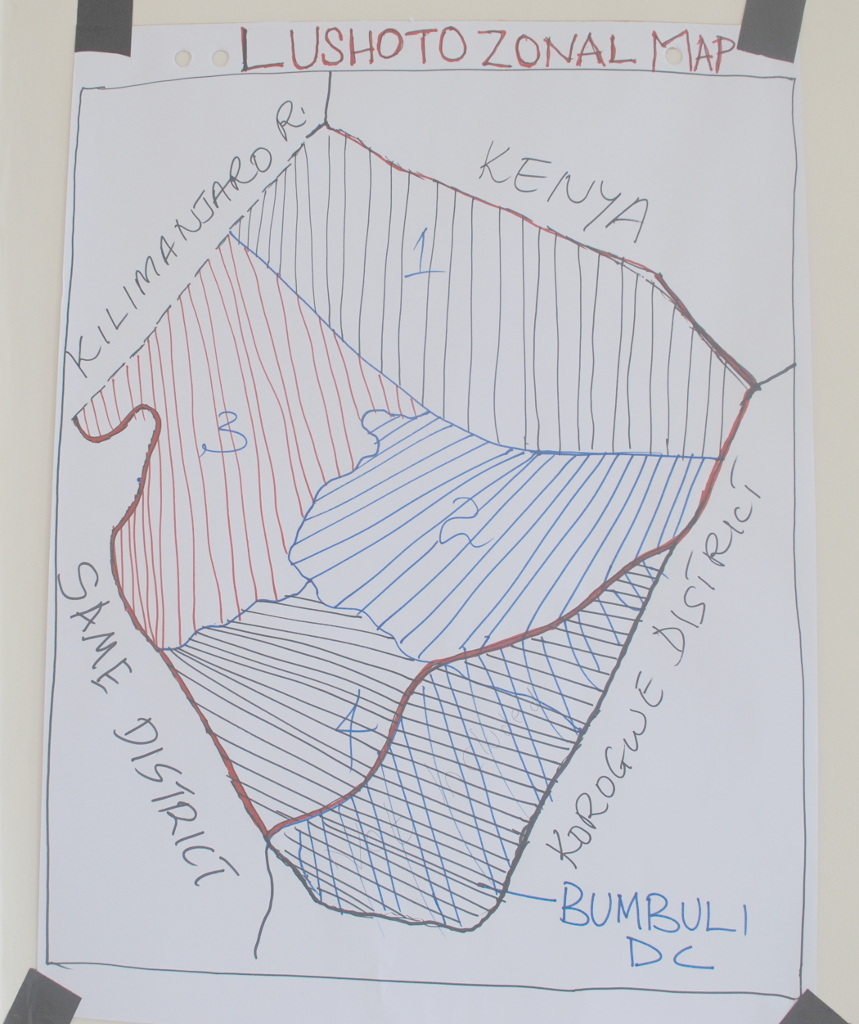
Picture of Lushoto districts with the four derived zones.

Lushoto districts with the four derived zones.

The two days of intense participatory work that occurred in each of the district resulted in the identification and description of different livelihood zones (five in Kilolo and four in Lushoto). Each zone reflected, among others, a characterization of priority sources of livelihood. For each of the priority enterprise, information was generated regarding gender and youth roles across the value chain, impacts of climate change, policy and cultural issues surrounding the enterprise, key intervening actors and their interventions, and tools used to promote adaptation and mitigation.

In her closing remarks, the Assistant Director for Economic and Productive Sectors at PMO–RALG, Lucy Ssendi, disclosed that Government has always looked for new, practical, and innovative ways to address climate change challenges and noted that the learning alliance is clearly one of those innovative ways that create a great opportunity for jointly acquiring solutions. She pledged support for the initiative both as a regional administration official and also as a member of the National Climate Change Learning Alliance.

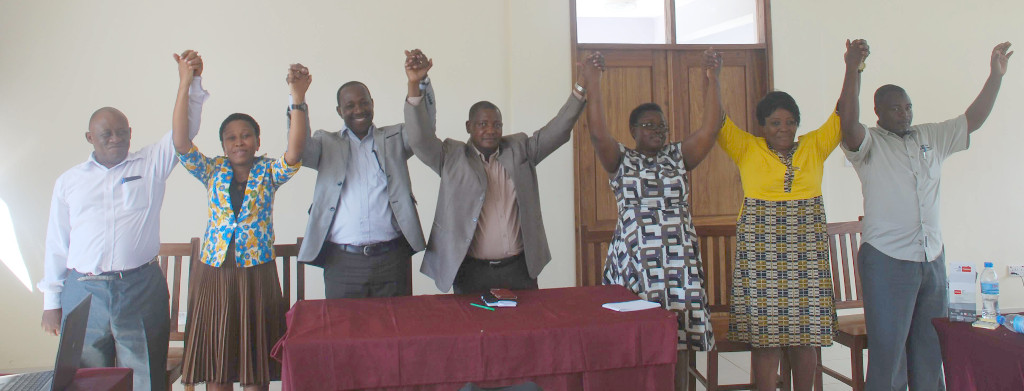
Picture of Stakeholders from Lushoto district DC, MAFC, VPO, IITA and PMO -RALG holding hands at the launching of the Lushoto district climate change Learning Alliance

Stakeholders from Lushoto district DC, MAFC, VPO, IITA and PMO -RALG holding hands at the launching of the Lushoto district climate change Learning Alliance.

With the first draft of the zonal investment plans ready, the next steps for the District Learning Alliances include the refinement of these plans, working towards prioritizing of the climate-change issues in the district development plans and budgets, in addition to creating strategic partnerships to foster climate change adaptation activities in the area.

The SARD-SC project funded by the AfDB has come out tops once again, as the members of the Bank’s Supervisory mission have unequivocally described the  project as one of the Bank’s  best managed  projects. This was the verdict of the AFDB officials who recently undertook the sixth supervisory mission to the IITA/SARD-SC project from 29 November – 4 December, in Ibadan. The team, led by Ibrahim Amadou, Task Manager, and accompanied by Usman Mohammed, Disbursement Officer; Jaffar Abba, Procurement Officer; and Olufemi Ojo-Fajuyi, Financial Management Consultant, also commended the  project team for efficient project implementation and for achieving significant outputs in project countries.

Picture of SARD-SC staff and AfDB officials during the visit to IITA, Ibadan, Nigeria.

SARD-SC staff and AfDB officials during the visit to IITA, Ibadan, Nigeria.

While welcoming the AfDB officials to IITA, Chrys Akem, Project Coordinator, explained that the  purpose of the supervision visit was “to evaluate the project’s  progress and how far it has carried out the Bank’s recommendations and also to proffer solutions to issues which may have arisen from the last Mid Term Review held in May 2015.”

During the course of the mission, the team paid a courtesy visit to Nteranya Sanginga, IITA Director General, and briefed him on the Mission’s terms of reference. The DG expressed his pleasure on the reported progress of the SARD-SC project. He assured the team of  the readiness of IITA’s senior management to do all that is necessary to ensure that  the project delivers on its planned outputs and impacts.

The members of the mission listened to project implementation presentations and held several discussions with the various management and project implementation teams from the executing agency (IITA) and the implementing institutions (AfricaRice and ICARDA). All of the staff of the Project Implementation Unit of the three key implementing institutions (IITA, AfricaRice and ICARDA) were present at the supervisory mission.

The mission activities kicked off with  presentations by the project Commodity Specialists: Marie Yomeni for cassava, Sam Ajala for maize, Sidi Sanyang for rice, and Solomon Assefa for wheat; Issaka Amadou, Monitoring and Evaluation Specialist on M&E updates; Seyi Fashokun on project accounts; and Zulfawu Yahaya on procurement.

The presentations showed progress on all the commodity components since the medium-term review in May as well as procurement and financial execution, followed by discussions with the Commodity Specialists and other officers on various aspects of project implementation and outputs.

The team made some key observations on the project implementation status, especially their satisfaction on significant improvements in project implementation across all the commodity value chains of cassava, maize, rice, and wheat; as well as within the different components (technology and innovation generation, technology and innovation dissemination, capacity building and project management). They also observed that efforts to achieve the various targets set for the different indicators show that the project is on track. While rounding off the visit, Ibrahim Amadou, Project Task manager, commended the SARD-SC project “as one of the best managed projects of the AfDB.” He therefore urged the “Project Management Unit and project team members to  continue to work hard and ensure the project has transformational impact on  beneficiaries to earn a second phase.”

The disbursement rate of the project, they noted is currently 63.55% which, the Bank officials said was a good rate for such a complex project at its current level of implementation. They expected this to increase further as the project draws to its end in 2017.

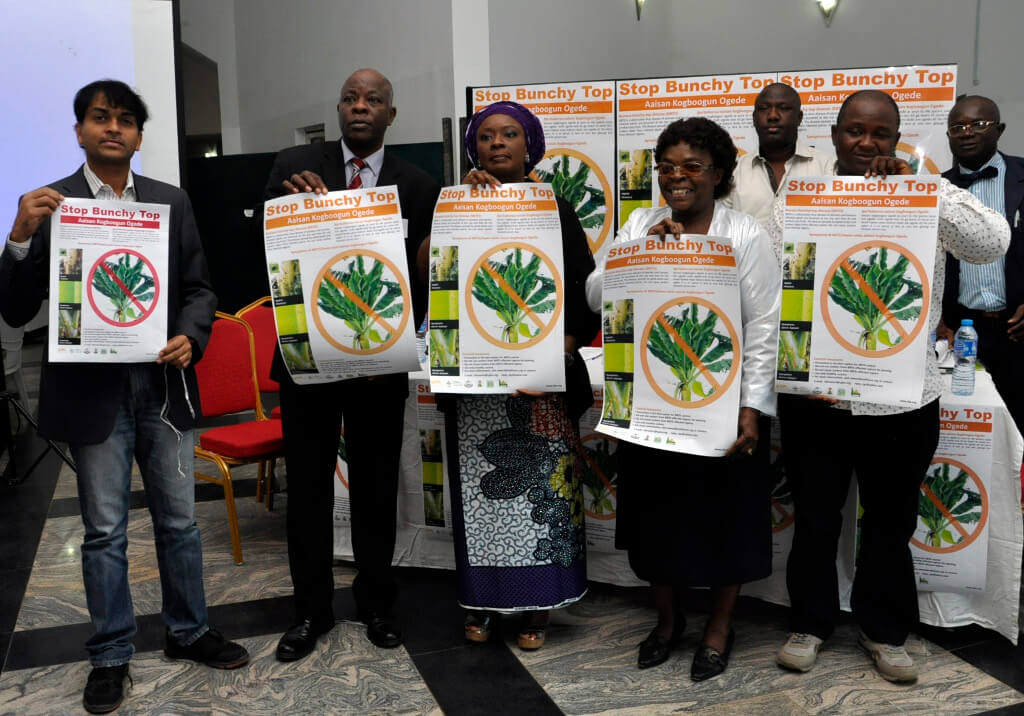
The ‘Stop Bunchy Top’ campaign to prevent the spread of the Banana Bunchy Top Disease (BBTD) in Nigeria was launched by IITA in partnership with the Nigerian Agriculture Quarantine Service (NAQS), National Horticultural Research Institute (NIHORT), and the Ogun State Ministry of Agriculture on 3 December, in Abeokuta, Ogun State. This campaign seeks to sensitize farmers experiencing the scourge of BBTD infestation and also create awareness among extension workers, policymakers, and farmers in disease-affected areas and elsewhere about the danger of BBTD and control measures, including the need to plant clean banana suckers to prevent their fields from becoming infested.

Picture of the 'Stop Bunchy Top’ campaign was launch 3 December in Ogun State, Nigeria, by IITA and partners.

The ‘Stop Bunchy Top’ campaign was launched 3 December in Ogun State, Nigeria, by IITA and partners.

The campaign was flagged off by Hon. Ibironke Sokefun, Agricultural Commissioner, Ogun State.

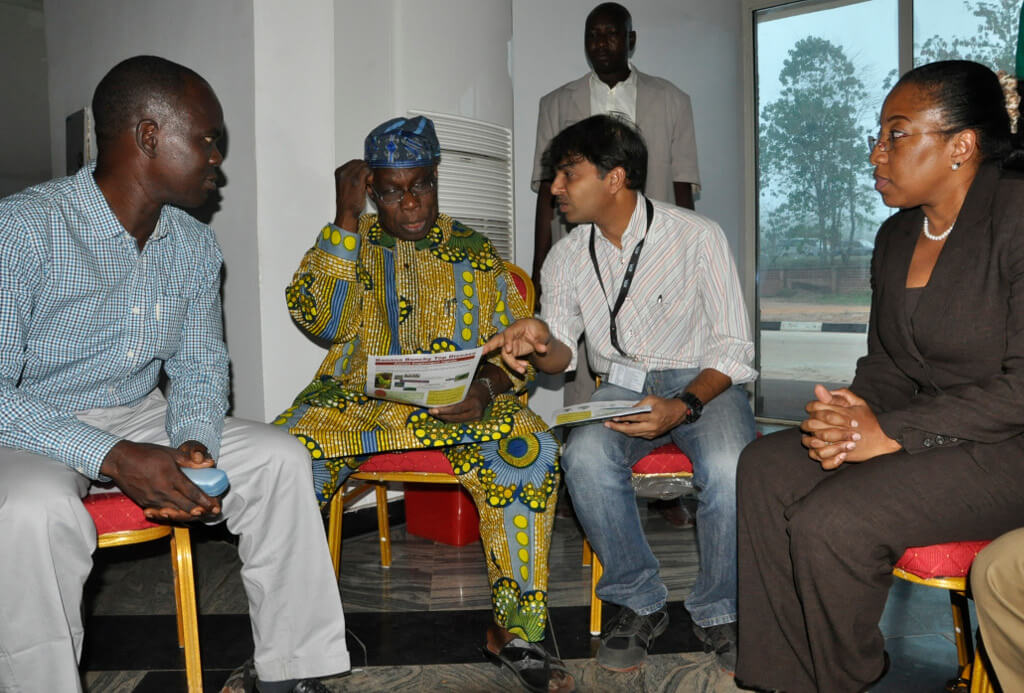
Chief Olusegun Obasanjo, former Nigerian President and IITA Ambassador, graced the event. He was concerned with the spread of the new disease in Ogun State, and inquired about the level of efforts being put into controlling the disease. He praised IITA and partners’ efforts and resolve towards salvaging infested farmlands and also challenged scientists to work assiduously in developing varieties resistant to BBTD.

Picture of President Olasegun Obasanjo (left) talking to Lava Kumar (right) about efforts to contain banana bunchy top.

President Olasegun Obasanjo (left) talking to Lava Kumar (right) about efforts to contain banana bunchy top.

According to FAO statistics, Nigeria has the largest land area cultivated to plantain in West Africa and is the second largest producer in West Africa, contributing about 2.8 million tons annually. The crop supports the livelihoods of millions of people in West Africa but has been recently threatened with the appearance of BBTD.

BBTD-affected banana stops fruiting and eventually withers. The disease is caused by the Banana bunchy top virus (BBTV), and spread by the banana aphid, Pentalonia nigronervosa.

BBTD was first discovered in Nigeria in 2012 in the Idologun community of Ogun State. Since then, IITA scientists, Lava Kumar and Rachid Hanna, have been collaborating with scientists from NIHORT and NAQS to contain the spread of the deadly disease and also refurbish the plantations of farmers whose fields had been infested.

“As part of the collaborative project with IITA, we have already trained more than 200 farmers in Ogun State and supplied about 8000 clean plantain suckers between 2014 and 2015,” said Adenike Olufolaji, NIHORT Executive Director.

“The training focused on how farmers can identify the disease and also produce clean planting materials. We have also emphasized that clean planting materials must be collected only from certified sources because this is what guarantees a clean orchard and consequently improved productivity.” Hon. Sokefun reiterated government’s commitment to support the campaign and said that it was in the interest of the farmers in the country.

“Some of the decisions resulting from this campaign will be hard for farmers to initially accept…as government, we pledge to implement the decisions from this gathering today and also continue to work with IITA, NIHORT, and NAQS for the good of farmers,” said Hon. Sokefun.

Farmers who attended the occasion recounted how their farmlands were invaded by the virus and how their yields had decreased since 2013. They added that intervention in the last two years is ushering in hope to revive production.

Thanking guests and government officials at the launch, Robert Asiedu, IITA Director. West Africa, represented by Kumar, said that IITA appreciates the reception and high level of support from government. He also pledged to intensify research to ensure effective control.

“I am very optimistic that in another two years when we meet we will share our success stories arising from this collective effort.” Kumar said.

Other guests at the launch ceremony were partners and representatives from the Ogun State Ministry of Agriculture, the Federal Ministry of Agriculture, Agricultural Development Programs as well as farmers from the State.

Crop pests and diseases cause significant yield losses to smallholder farmers within sub-Saharan Africa.

More than 16% of farm productivity losses are attributable to crop pests; this is expected to get worse with the effects of climate change in the region. What is IITA’s response to these challenges? Is the Institute already investing resources to respond to them?

The IITA Plant Production & Health Management (PPHM) Strategic Plan (2012-2020) presented by David Chikoye, Director for Southern Africa and for PPHM, is a masterplan of IITA’s response to these important questions. The Institute plans to respond by offering smallholder farmers innovative crop management options, environment-friendly pest management options, technology, and knowledge sharing as well as establishing effective partnerships through which coordinated actions can be implemented to ensure a food-secure Africa.

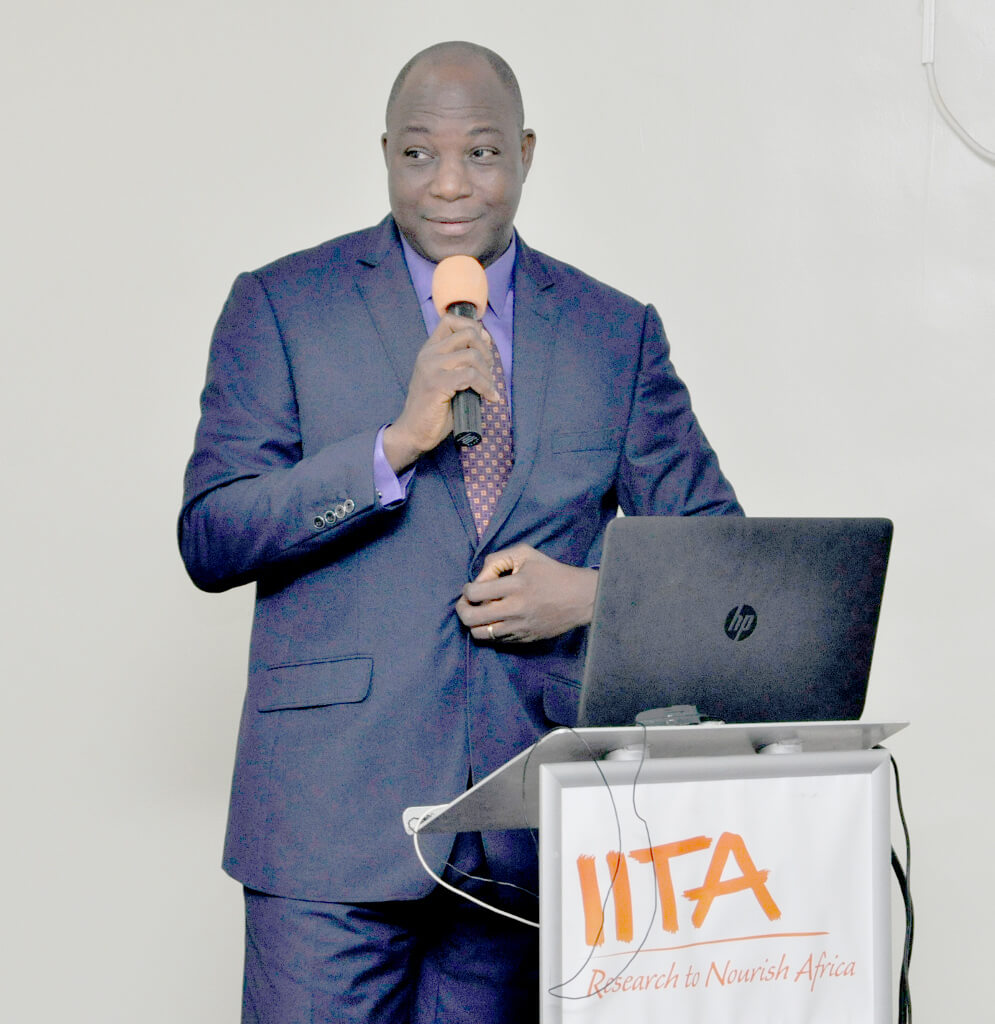
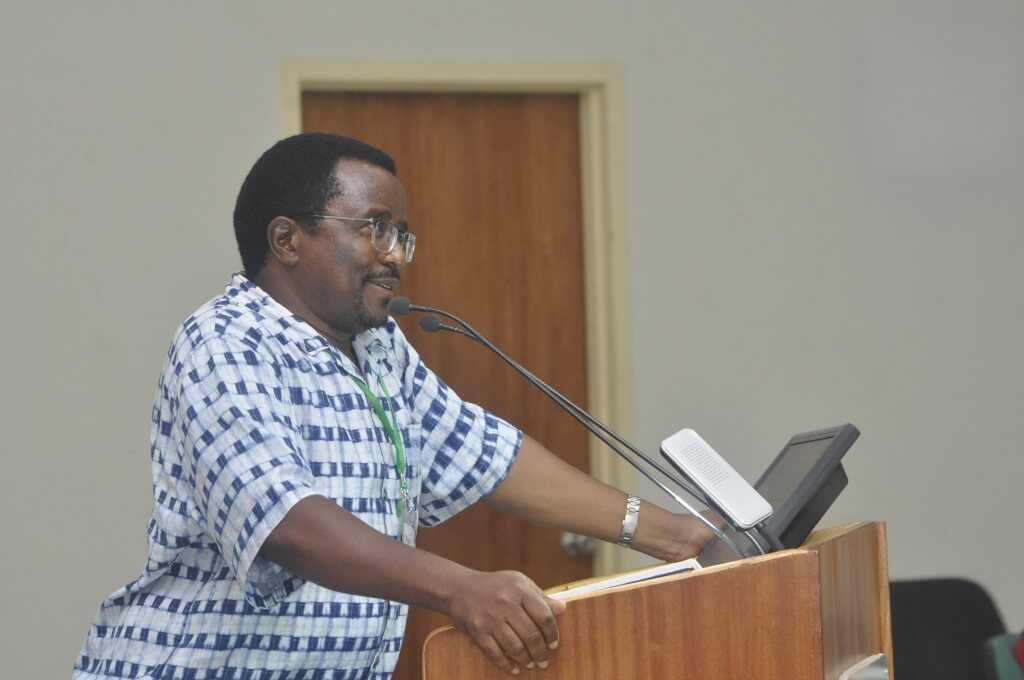
David Chikoye gives an overview on the status of research on plant production and health.

David Chikoye gives an overview on the status of research on plant production and health.

Progress is already being realized with integrated Striga management in maize, weed management in cassava systems, and aflatoxin mitigation in maize and groundnut. Some of the emerging crop pests and diseases that the IITA PPHM team have trained their sights on for future action include pesticide resistance in MarucaAlectra in soybean, maize lethal necrosis disease, banana fungal wilt (TR4), yam tuber beetles, spittle bugs on maize, and papaya mealybug (cassava).