CGIAR launches Policy Innovation Hub to strengthen evidence-based policymaking in Nigeria
15 May 2026
On 9 April 2026, Nigeria officially launched the CGIAR Policy Innovation Hub, jointly led by the International Institute of Tropical Agriculture (IITA) and the International Food Policy Research Institute (IFPRI).
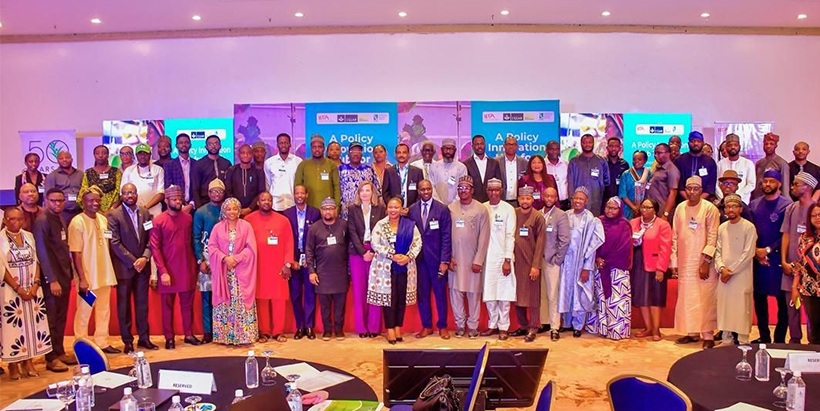
The Hub is designed as a structured, demand-driven platform that connects the long-standing divide between research evidence and policy implementation. This will ensure that research priorities guide the setting of research agendas; translate findings into actionable policy solutions; and provide support for practical testing and scaling up of those solutions. Dr Simeon Ehui, Director General of IITA and CGIAR Regional Director for Africa (represented by Dr Tahirou Abdoulaye, Deputy Director General of IITA, and Head of Partnerships for Delivery and Scaling) stated that the launching of the Policy Hub is designed to bridge the critical gap between research evidence and policy implementation in Nigeria.
Nigeria has demonstrated strong, consistent policy ambition to achieve inclusive economic development and attain high-income status. However, as implementation accelerates, policymakers are faced with very complex decision-making processes, such as how to prioritize investment; sequence reforms, and how to balance competing interests or “trade-off” objectives, for example: agricultural productivity vs. climate resiliency, inclusion vs. nutrition.

The CGIAR and Nigeria’s institutions have developed a significant body of knowledge and policy-relevant evidence to provide guidance for policies. However, there continues to be a lack of translating the evidence generated into actionable policies.
“In response to addressing existing gaps in translating evidence into policies, the CGIAR Policy Innovations Science Program is formally launching the Nigeria Policy Innovation Hub to support an interactive and demand driven process focused on actual policy questions and experiences associated with implementing policies and expanding collaborative policy research relationships among CGIAR, national research-for-development partner institutions and government agencies involved in transforming agri-food systems in Nigeria,” said Dr Tahirou Abdoulaye IITA DDG Partnerships for Delivery and Scaling, while delivering remarks on behalf of IITA Director General, Dr Simeon Ehui.
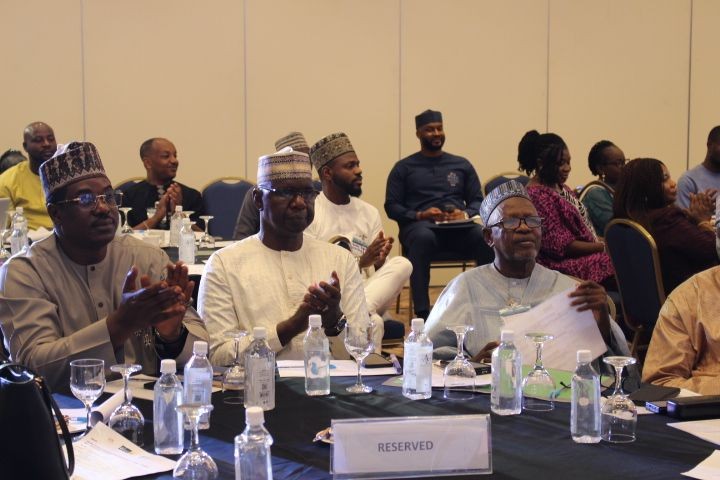 Senior government ministers, national research institutions, development partners, and civil society organizations attended the meeting. Hajiya Imaan Suleiman-Ibrahim, Honorable Minister, Federal Ministry of Women Affairs and Social Development, acknowledged that coordinated evidence and policy dialogue are needed to empower women in Nigeria beyond their current subsistence levels. This will be achieved through innovations, research, and partnerships to bridge the gap in both knowledge generation and policy decision-making in Nigeria.
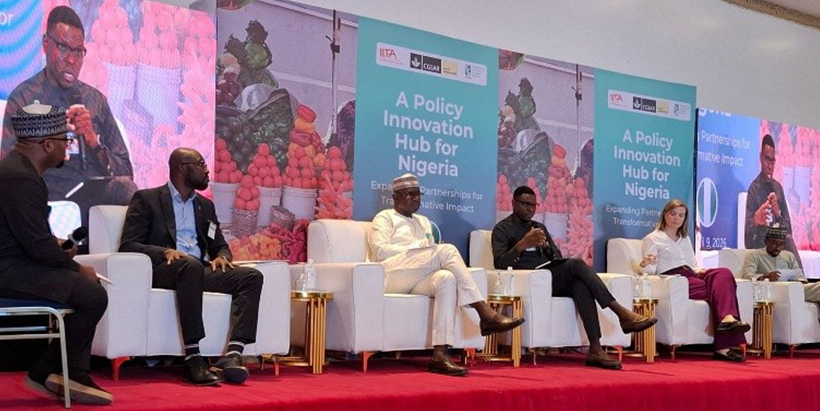 “Agriculture is not only about production, but it is also about systems that integrate value chain development, enterprise development, and social inclusion. Gender inclusion should not be symbolic or treated as an afterthought; rather, it must be incorporated from the policy design stage. The Policy Hub is expected to address these critical challenges by strengthening policy dialogue and supporting evidence-based policy making, and promoting partnerships and the co-creation of research agendas to support informed decision-making,” said Hajiya Imaan Sulaiman-Ibrahim, Honorable Minister of Women Affairs and Social Development.
Other stakeholders from the Federal Ministry of Agriculture and Food Security (FMAFS), the Agricultural Research Council of Nigeria (ARCN), the Federal Ministry of Youth Development, and development organizations, Sahel Consulting, and development partners, including GIZ, IFAD, FAO, and the World Bank, emphasized that significant challenges remain in achieving food security, food sovereignty, and agricultural transformation in Nigeria. They noted that productivity levels for many key agricultural commodities remain below global benchmarks, while persistence challenges related to climate resilience, food inflation, youth employment, and inclusive growth continue to constrain the sector.
Participants underscored the importance of coordinated action, high-quality data, and rigorous evidence to support effective policymaking and guide investments for sustainable agricultural transformation, job creation, improved food security, and resilient food systems in Nigeria.
