
Growing the future of yam farming in Nigeria
12 May 2026
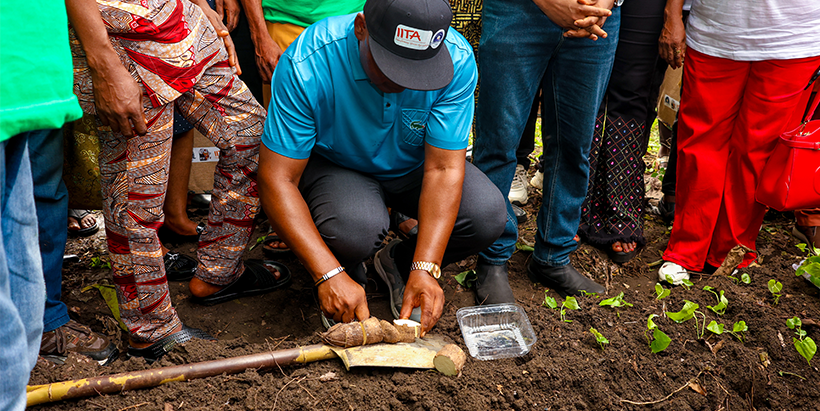
Yams are more than a staple food in Nigeria. For millions of households, they are central to food security, income, and cultural identity. Yet, many farmers continue to struggle with poor seed quality, limited access to improved farming practices, and limited market linkages.
In Cross River State, some farmers travel over 300 kilometers to Taraba State each planting season to source seeds, often facing high costs and the risk of poor quality planting materials.
To address these challenges and unlock new opportunities for farmers, IITA–CGIAR, in partnership with the Cross River State Government, organized a week-long Training of Trainers (ToT) program in Calabar focused on yam seed technologies, agronomic best practices, and agribusiness development. The training brought together farmers, extension agents, and government officials to strengthen the yam value chain and improve productivity across farming communities in 17 local government areas.

At the heart of the training was a simple message: agricultural innovation delivers impact only when farmers have the knowledge and capacity to use it effectively. Participants are expected to replicate the training in their communities through a structured step-down approach that ensures wider reach at the grassroots level.
The training serves as the first phase of a broader capacity development strategy designed to equip participants with practical skills and technical expertise in modern yam seed systems and production methods.
Speaking during the training, Dr Olugboyega Pelemo, Field and Seed Systems Specialist under the IITA Yam Improvement Program, emphasized the importance of scaling innovation through capacity development.
“Innovative technologies like the minisett, vine cutting, semi-autotropic hydroponics (SAH), and mini tubers that we developed at IITA will only become visible when they are scaled, and scaling can become impactful when the capacity of key actors is developed. At the end of the seed yam production training, farmer-beneficiaries will transfer the knowledge to farmers in their various communities across Cross River State.”
The training focused on innovative technologies and good agronomic practices (GAP) for yam production, including improved seed systems that help farmers increase yields, reduce losses, and improve the quality of planting materials.
The Cross River State Government says the initiative aligns with its broader agricultural development agenda, which aims to empower farmers and strengthen food systems across the state.
Commissioner for Agriculture and Irrigation Development, Johnson Andiambey Ebokpo, reaffirmed the government’s commitment to supporting farmers through capacity development and strategic partnerships.
“As part of the agricultural agenda, the government is committed to providing the requisite capacity and resources to support the farmers of Cross River. This training for yam farmers facilitated by IITA is the first and will be replicated across other crops like plantain.”
The collaboration reflects the importance of partnership between research institutions and government agencies in delivering innovation directly to farming communities.
Beyond improving farm productivity, the initiative also aims to strengthen agribusiness opportunities along the yam value chain. By developing community-based seed producers and improving access to quality seed technologies, the program seeks to create sustainable economic opportunities for farmers and rural entrepreneurs.
Farmers are already feeling the impact. Esther Emmanghe from Etung Local Government started sharing new techniques with fellow neighbors in her community immediately after the training.
“I told people about the minisett and vine cutting technology; many of us farmers will put together a group that will use all we learned during this training,” she added excitedly.
Dr Michael Udam, a secondary school vice principal and a yam farmer in Adagom community in the Ogoja local government, said that while he had some knowledge of vine cutting and minisett, the training provided new knowledge that he would pass to his community.
“I am happy that this training came now when some farmers have been complaining of traveling to far places like Taraba State to get seed yams to plant. With this training, I will start planting seed yams myself. I am sure some other farmers will do the same,” he said.
The IITA Yam Breeding Program under the leadership of Dr Asrat Amele continues to lead research and innovation that addresses the needs of farmers while promoting food security and rural development.
Through this initiative, IITA and its partners are working to ensure that improved technologies and knowledge reach farmers at scale and contribute to building a more resilient and profitable yam sector in Nigeria.
Contributed by ‘Timilehin Osunde
