
Harnessing roots and tubers to strengthen Malawi’s economy
9 May 2025
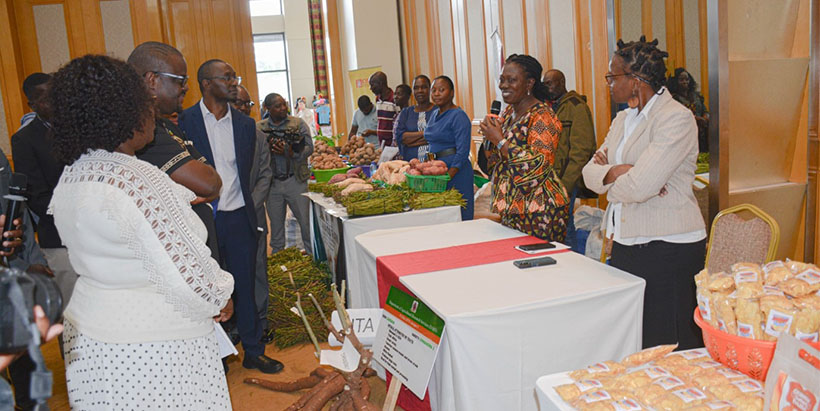
At the dissemination workshop for Malawi’s roots and tuber crops markets, the Malawi government has asked producers and processors to take advantage of the import ban directive on some products to produce more to meet the domestic market demand.
The order prohibits the importation of products, including potato tubers, maize meal, rice, fresh milk, and peanut butter.
IITA-CGIAR, under the Market-led Root and Tuber Crops for Agricultural Transformation in Malawi (RTC-MARKETS) project, funded by the Embassy of Ireland in Malawi, participated in the workshop that was also attended by the Minister of Trade and Industry, Vitumbiko Mumba, as guest of honor. The Minister emphasized the need to empower indigenous businesses and farmers by linking them to big markets to grow the economy, realizing that Malawi’s economy is mainly Agro-based.
Andrew Mtonga of the Department of Department of Agricultural Research Services (DARS) decries the consumption behavior and attitude that still favors cereals over roots and tuber crops and over-reliance on rain-fed production as some major factors contributing to the inconsistent supply of roots and tuber products in Malawi.
“There is also limited investment by the private sector in seed production. However, we need to shift towards climate-resilient crops and utilize lucrative market opportunities,” Mtonga noted in his presentation.

Despite the obvious dominance of maize, the area for cultivation of crops like cassava has steadily increased from 210,000 hectares in 2014 to 260,000 hectares in 2023, with production increasing from 5 million metric tons to 6 million metric tons between the same period.
Sweet potato has enjoyed a sharp increase in hectarage and production, almost doubling from 4 million metric tons in 2014 to above 7 million metric tons in 2023. However, this is still described as “below the potential levels” by experts. This is partly due to the low adoption of mechanization and limited value-added activities.
A survey conducted by International Potato Center (CIP) between May and November 2024 shows an estimated market value opportunity of over US$17 million in trade for Major roots and tuber crops and products.
Briefing the Minister, IITA’s cassava breeder, Elizabeth Parkes, noted the potential of cassava for food and nutrition security. She narrated how the High Cassava Quality Flour (HQCF) with high production can replace wheat flour as an import substitution. She describes cassava as a climate-smart crop that, with crop improvement and early generation work, will provide food and income, with the peels and waste able to create wealth in the animal feed and livestock industry.
As Malawi continues to celebrate the release of a new cassava variety, Chinangwa 3, Parkes notes the importance of a sustainable and resilient breeding system and the need to invest in genetic improvement programs to generate high-yielding crop varieties to enhance agricultural productivity and commercialization.
IITA showcased various products made from cassava and how cassava can complement maize by bringing out the favorite Nsima dish that Malawians enjoy the most.
The RTC-MARKETS project, led by the CIP, aims to boost the production and consumption of these crops by supporting the country’s agricultural productivity and commercialization. These activities directly support the Malawi government’s 2063 development blueprint, Agenda 2063 pillars.
Contributed by Emmanuel Mwale
