
IITA–AALI–Virunga Foundation pilot project boosts agricultural productivity for smallholder farmers in North Kivu
16 January 2026

Smallholder farmers in Lubero territory, North Kivu, in the Democratic Republic of Congo, are witnessing significant improvements in their harvests and agricultural practices thanks to the IITA–CGIAR, the African Agricultural Leadership Institute (AALI), and the Virunga Foundation pilot project for the Intensification of agricultural production. The initiative supports farmers in adopting Integrated Soil Fertility Management (ISFM) technologies that strengthen soil productivity and increase yields of wheat, maize, and soybean. The project also marks the first step toward the future Kivu–Kinshasa Green Corridor, an ambitious program aimed at transforming agriculture across eastern DRC.

So far, the pilot project has reached 350 smallholder farmers, of whom 60 percent are women, through a combination of awareness campaigns, theoretical and practical training, and the distribution of improved seeds and fertilizers. In total, 1,577 people, mostly farmers, have been sensitized on ISFM and its benefits for sustainable agriculture. These awareness efforts help farmers understand not only how to apply the improved technologies, but also why such changes are essential for reviving soil health in a region that has experienced decades of land degradation.
Farmers received complete input kits that included hybrid wheat seed (Hyrax), improved maize seed (Bazooka), soybean seed (Mak Soya 3), and mineral fertilizers such as DAP and urea. These inputs enable farmers to immediately establish their production fields and apply the practices learned during training. One of the project participants explains how these improved technologies have changed his farming experience.

“Before IITA’s intervention through this project, no one in the village used mineral fertilizers. For generations, we had been told that chemical fertilizers degrade the soil, so farmers avoided them completely. Thanks to IITA’s training in good agronomic practices based on ISFM technology, we now understand the importance of using mineral fertilizers correctly and how to benefit from their advantages while avoiding the problems caused by misuse,” noted Mpangi Kambale, a farmer from Masereka
“As long as you tell us how we can access them when we want to buy them, we are ready,” he concludes.
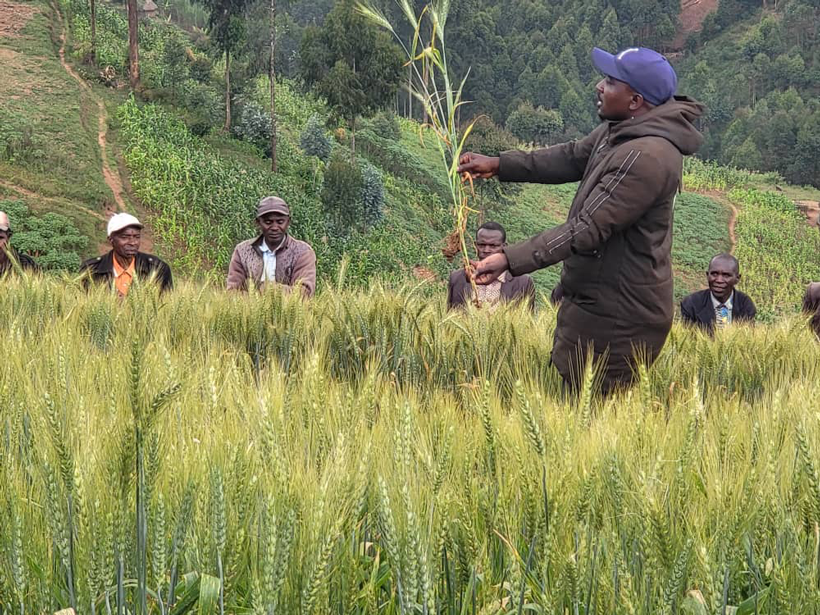
Additionally, Rachele Kavira, a farmer from Lubero, expressed her sincere gratitude to the IITA, AALI, and the Virunga Foundation Consortium for their training and technical support. “We were on the verge of abandoning agriculture, even though it is the main source of income for more than 90% of the population, because our yields kept declining season after season due to soil degradation. Thanks to their practical training and technical guidance, they revealed the key techniques that enabled us to increase yields, improve productivity, and sustainably boost the production of wheat and maize.”
The project’s farmer field days, held from 1 to 5 December 2025 across Lubero Center, Masereka, Magheria, Kyondo, and Kasongwere, played a central role in strengthening the adoption of the ISFM package. These events served as open-air classrooms where farmers observed the direct impact of improved technologies on crop performance. Under the guidance of IITA researchers and AALI, participants compared traditional farming approaches with ISFM-enhanced fields, gaining first-hand experience that reinforced what they had learned during training.
“Farmers trust what they see more than what they are told. These demonstration plots help them understand how improved seed and proper soil fertility management can easily double or even triple their yields,” noted Engineer Moustapha Kigangu from IITA.
By December 2025, the project had facilitated the establishment of 52.5 hectares of improved production fields, including 30 hectares of wheat and 22.5 hectares of maize. Expected yields from these fields are 60 tons of wheat and 67.5 tons of maize, corresponding to average yields of 2 tons per hectare and 3 tons per hectare, respectively. These gains translate into potentially significant income: an estimated USD 36,000 from wheat and USD 33,750 from maize. Beyond these numbers, the project has given farmers renewed confidence in their ability to increase their productivity using simple, proven practices that restore soil fertility and protect the environment.
Contributed by Moustapha Kigangu and Bumwe Ritha
