
IITA and Tanzania Ministry of Agriculture collaborate to boost cassava commercialization
12 September 2025

Cassava is the second crop in production volume with an average production of 6.3 million metric tons, and the third most important staple food crop after maize and rice in Tanzania. About 1.9 million stakeholders are involved in business throughout the cassava value chain. The crop’s position signifies the need for strengthening the opportunities for its commercialization for increased government revenue, in line with addressing key constraints such as the use of poor quality seed of low-yielding varieties and agronomic practices, less use of improved technologies along the value chain; low levels of investment in cassava sub-sector; inadequate and volatile price for the cassava produces, limited and fragmented market information amongst the stakeholders.
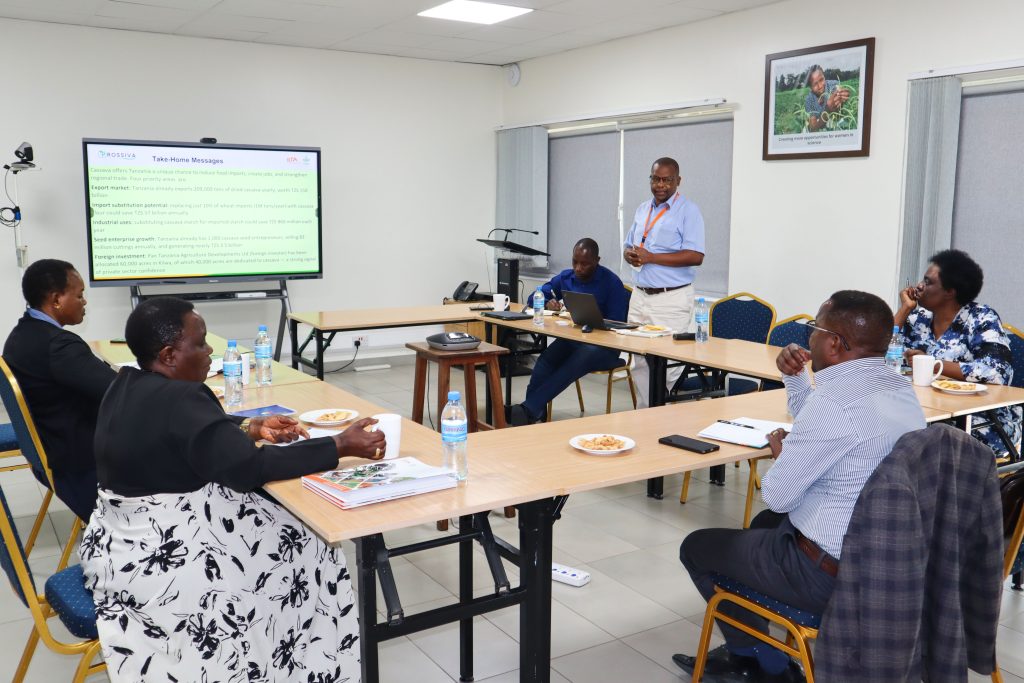 In response to streamlining cassava commercialization, IITA–CGIAR, in collaboration with the Ministry of Agriculture, led by Dr Stephen Nindi, the Deputy Permanent Secretary, convened on 18 August to discuss strategic plans for cassava commercialization in Tanzania.
Pathways to commercialization
During the meeting, Lembris Laizer, the Project Coordinator, presented pathways for unlocking cassava commercialization in the country, focusing on four priority areas: strengthening the regional market, import substitution potential, industrial uses, and seed enterprise growth.
Laizer requested government support to strengthen regional trade in dried cassava. Currently, Tanzania exports 209,000 tons of dried cassava annually, worth approximately TZS 150 billion (approx. US$60 million) to Burundi, DR Congo, Rwanda, South Sudan, and Uganda. “Yet cost-effective improvements through establishing simple and effective drying facilities and aggregation infrastructures in strategic districts like Kakonko District could contribute approximately a 24% increase in trade volumes with a worth of US$4.8 million as an additional revenue annually,” he explained.
According to government official data, Tanzania’s heavy dependence on wheat imports remains a burden. In 2020, the country imported one million tons of wheat valued at US$231 million and 7,297 tons of starch worth US$3.3 million. Laizer emphasized that replacing just 10% of these wheat imports with cassava flour could save TZS 57 billion (US$22.8 million) annually. He further pointed to opportunities for engaging breweries, as practiced in Mozambique, and promoting cassava flour in pastries and related products.
On the other hand, Dr Juma Yabeja, a Senior Research Associate working on seed systems, explained that this is the right time for cassava commercialization in Tanzania due to the establishment of a cassava seed system for farmers to access certified cassava seed from the network of more than 1,000 cassava seed entrepreneurs (CSEs) countrywide.
“Certified cassava seeds by the Tanzania Official Seed Certification Institute (TOSCI) increase farmer productivity by over 80%, yielding an extra 7.5 tons per hectare compared to using their own saved seeds,” said Dr Yabeja.
Government commitment and collaborative efforts
According to Dr Nindi, in the 2025/26 budget, the Ministry has committed funds to support cassava commercialization, which aligns with the National Cassava Development Strategy (NCDS 2020–2030) ambitions. These commitments include supporting the Tanzania Agricultural Research Institute (TARI) in assessing industrial starch varieties and establishing cassava value addition centers in the Kigoma region. The initiatives directly advance the NCDS target of improving industrial processing capacity by 30% in major cassava production zones by 2030, while also transforming processor groups into Agricultural Marketing Cooperative Society (AMCOS) structures to strengthen farmer–market linkages.
“It is important to educate smallholder producers to adopt affordable, locally made technologies such as raised drying facilities to reduce post-harvest losses and contamination, major barriers that depress regional trade competitiveness.” Dr Nindi emphasized.
Dr Nindi urged IITA to work closely with the Government at both national and local levels to educate farmers on cost aggregation and financial management to rely less on subsidies. Farmers are urged to buy improved seeds to benefit economically through higher yields and stronger market opportunities.
Dr Frederick Baijukya, IITA Country Representative for Tanzania, suggested strengthening collaboration between actors. “We need to strengthen our collaboration in sharing findings,” he said. Stakeholders have the same vision on cassava but face a collaboration challenge.”
Dr Nindi further expressed his appreciation for IITA’s efforts in addressing key barriers to cassava commercialization and that such scientific and practical contributions are critical for ensuring Tanzania achieves its NCDS 2020–2030 ambitions and secures cassava’s place as both a food security and industrial crop.
IITA and the Ministry of Agriculture have committed to strengthening collaboration to ensure the successful commercialization of cassava, securing its role as a priority crop of Tanzania’s food and economic security.
Contributed by Gloriana Ndibalema
