IITA empowers smallholder farmers through farmer field school days in Cameroon
6 November 2025
Across Cameroon, agriculture remains the backbone of rural livelihoods. Yet, most smallholder farmers continue to rely on rudimentary farming tools and traditional methods, often using non-certified planting materials that limit yields and worsen challenges such as food insecurity and malnutrition.
Recognizing this gap, the IITA–CGIAR, in collaboration with the Ministry of Scientific Research and Innovation (MINRESI), has introduced Farmer Field Days — a hands-on learning platform designed to transform smallholder agriculture through knowledge sharing and innovation.
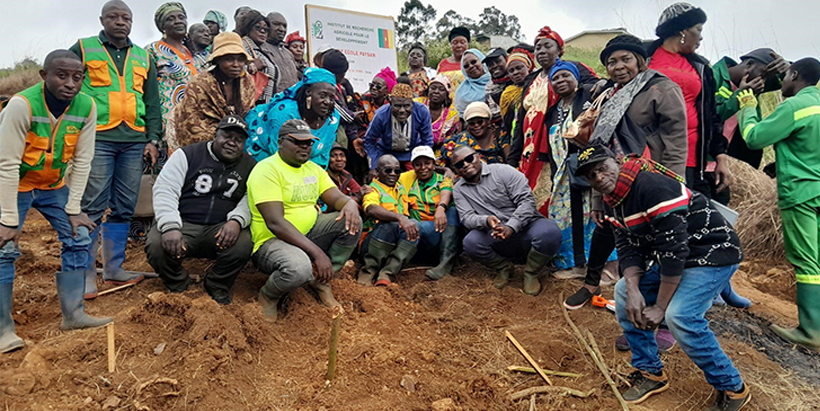
IITA organized a Farmer Field Day in Bandjoun, an event that brought together farmers, researchers, and policymakers to promote sustainable and productive farming techniques. Locally known as Journées Scientifiques and Champs-Écoles Paysans (CEP), the event took place at the Tchala and Touegoue sites, attracting over 10,000 farmers eager to learn about improved agricultural practices.
A multidisciplinary team of experts from IITA, the Institute of Agricultural Research for Development (IRAD), and the International Potato Center (CIP) facilitated interactive, field-based sessions focusing on key crops including plantain, maize, and beans. Farmers had the opportunity to gain practical knowledge on soil preparation, pest management, and crop husbandry techniques that could directly enhance their productivity and income.
The field demonstrations extended to cassava and potato cultivation, where farmers learned how to prepare sites and plant improved varieties such as cassava TME419 and TME693, and potato DOSA. These participatory sessions enable farmers to observe and practice new methods, thereby reinforcing their confidence in adopting improved technologies on their own farms.
“The idea behind these farmer field school days is to bridge the gap between scientific research and local farming practices,” explained Dr Nanga Samuel, a researcher from IITA. “We want farmers to see, touch, and test improved technologies in real field conditions because when they learn by doing, adoption becomes faster and more sustainable.”
Importantly, the initiative also emphasized inclusivity, empowering women farmers and ensuring they play an active role in decision-making and agricultural innovation. The hands-on learning approach not only strengthened technical capacity but also fostered collaboration among farmers, researchers, and local authorities.
“I used to plant my cassava without proper spacing or improved stems,” said Tchoumba, a farmer from Bandjoun. “During the field day, I learned how to prepare the soil and use certified varieties like TME419. I plan to apply these methods on my own farm next season to increase my yield and income.”
“This experience opened my eyes,” shared Nguene, a female farmer from Touegoue. “Before, I didn’t know how to control pests effectively or use organic compost. Now I feel confident to teach other women in my group how to do it. We’ll start by improving our maize plots together.”
The Minister of Scientific Research and Innovation, Dr Madeleine Tchuente, attended the event and praised IITA’s contributions to seed production and agricultural development in Cameroon. Her presence underscored the government’s recognition of IITA’s pivotal role in advancing the country’s agricultural transformation agenda.
Dr Madeleine Tchuente, Minister of Scientific Research and Innovation, said: “IITA’s work is helping transform our agriculture from subsistence to innovation-driven productivity. These field days demonstrate how science can truly serve our farmers and strengthen Cameroon’s food security.”
IITA’s ongoing initiatives in Cameroon reflect a strong commitment to building resilient and productive agri-food systems through research, technology, and innovation. By engaging farmers directly in learning and experimentation, and by fostering partnerships with institutions like MINRESI, IRAD, and CIP, IITA continues to drive real change on the ground.
As these collaborative efforts expand, the future of agriculture in Cameroon looks increasingly promising, with farmers being better equipped, communities becoming more food-secure, and the nation’s agricultural landscape defined by innovation and opportunity.
Contributed by Ritha Bumwe
