IITA enhances the capacities of Central Africa Republic researchers on SAH technology
7 October 2025

The Central African Republic has been facing challenges related to the shortage of clean seeds for food security crops, mainly cassava, yams, and maize. This shortage leads to farmers planting diseased seeds, resulting in insufficient productivity that exacerbates food security issues among smallholder farmers and negatively affects their livelihoods.
To address this challenge, the Government of the Central African Republic (CAR) aims to invest in establishing Semi-Autotrophic Hydroponics (SAH) technology to produce healthy, high-yield cassava and yam cuttings, as well as disseminating technologies and innovations to improve productivity in the cassava value chain.
The Government of the Central African Republic and IITA–CGIAR, through the Agricultural Value Chain Development Project in the Savannahs (PADECAS), are currently introducing SAH facilities in the CAR. IITA-CGIAR provides technical support through capacity building for local scientists, enabling them to establish the foundation for SAH technology in the country and accelerate breeding work for pre-basic seeds of food security crops, primarily cassava, yams, and maize.
In early August 2025, six researchers from the Institute of Agronomic Research of Central Africa (ICRA), the implementing entity of the PADECAS project, and the PADECAS project coordinator participated in a two-week intensive training program at the IITA headquarters in Ibadan, Nigeria. During this training, they were guided through a stepwise introduction to SAH technology and learned how it can be implemented in Central Africa to accelerate seed multiplication, thereby increasing the availability of clean seeds in CAR farming systems.
The Deputy Director General for Partnership for Delivery, Dr Abdoulaye Tahirou, welcoming the team on behalf of the IITA Director General, expressed satisfaction with the partnership between IITA-CGIAR and the Central African Republic under the PADECAS project. He encouraged the team to collaborate further in developing opportunities for technology delivery to farmers through the development of a Memorandum of Understanding (MoU).
“This collaboration with ICRA under the PADECAS project is a testament to IITA-CGIAR’s commitment to strengthening national agricultural systems through partnership. By building capacity in innovative technologies such as Semi-Autotrophic Hydroponics, we are not only advancing cassava and yam research but also contributing to food security and resilience in the Central African Republic. We look forward to deepening this collaboration and co-developing solutions that directly benefit farmers and communities,” urged Dr Abdoulaye Tahirou, the IITA Deputy Director General, Partnership for Delivery.
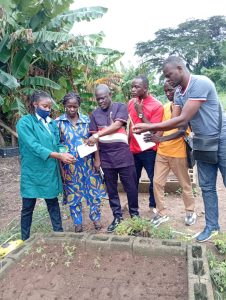
The training focused on Semi-Autotrophic Hydroponics (SAH), a cutting-edge plant propagation method designed to improve the multiplication of clean planting materials for cassava, yam, and maize. The scientists participated in hands-on sessions in the Cassava and Yam SAH units, where they gained valuable experience in setting up and managing the system. They also received training on cassava breeding strategies, visited seed multiplication trials, and explored yam breeding fields.
Beyond SAH, the delegation was exposed to IITA-CGIAR’s Bioscience and Genebank facilities, cassava processing units, and the Aflasafe production plant, demonstrating the Institute’s broad scope of research and innovation.
The ICRA Director General, Steive Mbenda, expressed his appreciation for the opportunity to strengthen the team’s technical skills and emphasized how the knowledge gained would be directly applied in CAR’s strategy to enhance the clean seed system.
Speaking on behalf of the Central African Republic scientists’ delegation, he stated: “On behalf of the Central African Republic team, I would like to express our gratitude for the welcome we received. We had a pleasant stay, during which we learned about SAH cassava and yam technology, visited the Genebank and Bioscience laboratory, and our entire program went smoothly. Our objective was achieved, and we leave with a feeling of satisfaction. May God bless IITA and all its staff. The success of the IITA-PADECAS partnership will be demonstrated through the deployment of such technology in our country. We will report to the Minister of Agriculture what we have seen and learned.”
This initiative enhanced the participants’ technical expertise in SAH technology and reinforced institutional collaboration between IITA and ICRA. A follow-up training will be organized in Bangui in October 2025, reflecting IITA’s continued dedication to building research capacity, transferring technology, and fostering partnerships that support food security and agricultural transformation across Africa.
Within the framework of PADECAS, the researchers will use their acquired expertise to establish and scale up SAH units for cassava and yam multiplication, improve the supply of clean planting materials, and strengthen local seed systems. This is expected to enhance productivity, ensure the availability of disease-free planting materials, and contribute to food security and income generation for farmers in CAR.
Contributed by Apollin Fotso Kuate & Bumwe Ritha
