
Nigeria’s Minister of State for Agriculture visits IITA to reinforce deeper collaboration
9 May 2025
In a significant step to reinforce national agricultural institutions through deeper collaboration with IITA–CGIAR, the Honourable Minister of State for Agriculture, Federal Ministry of Agriculture and Food Safety (FMAFS), His Excellency Dr Aliyu Abdullahi, paid a working visit to IITA’s headquarters in Ibadan on 30 April.
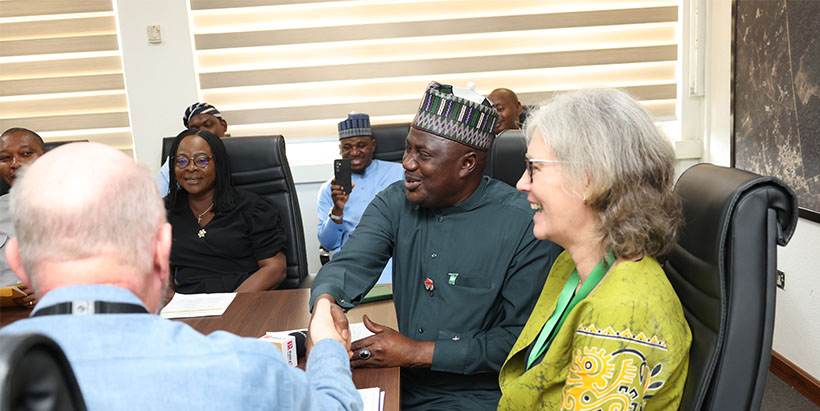
The IITA Director for West Africa Hub and Head of Genetic Resources Centre (GRC), Michael Abberton, outlined the institute’s contributions toward building a sustainable food system. He highlighted IITA’s integrated research efforts in breeding, agronomy, socio-economics, nutrition, and health. He also emphasized the importance of scaling innovations through robust partnerships with national institutions.
The IITA Program Lead for Food Security, Nutrition, and Health, Mercy Lung’aho, commended FMASF for its collaboration on the National Food Consumption and Micronutrient Survey (NFCMS) and reaffirmed IITA’s continued support for nutrition-sensitive agriculture through strategic partnerships with FMASF.
In his address, Dr Abdullahi expressed deep appreciation for IITA’s research-for-development initiatives and their positive impact across the continent. He stressed the urgent need to strengthen national agricultural research institutions and proposed the creation of a “mirror image” of IITA within these institutions. This initiative, he explained, would involve IITA “handholding” national institutions to build their capabilities, ultimately transforming Nigeria’s food system. “If we succeed in Nigeria, we will succeed in Africa,” the Minister stated.
Dr Abdullahi also spoke on the sustainability of agricultural development projects, underscoring the need for long-term impact and resilience within the agricultural sector.
Regarding youth engagement, Dr Abdullahi highlighted the need to expand IITA’s programs to underserved regions, particularly Borno and Yobe states, which have been affirmed to have considerable agricultural potential. He stressed the importance of selecting participants who are already involved in agriculture. This is to ensure the effectiveness of training and capacity-building initiatives. Responding to this, the IITA Agribusiness Hub Manager, Waheed Oni, noted that the institute is actively engaging with donors to develop proposals to extend program coverage to northern Nigeria.
The Regional Hub Director for Fertilizer and Soil Health in West Africa and the Sahel, Lionel Kadja, presented the Hub’s mission and initiatives during the visit. He underscored its vital role in coordinating technical support to countries across the region in fertilizer and soil health management. In line with this, Dr Abdullahi referenced the Nigerian Farmers Soil Health Scheme, commending IITA for hosting and managing the program’s research data. He emphasized the importance of this partnership and called for enhanced collaboration to ensure broader and more effective implementation.
Kadja reaffirmed the Hub’s commitment to advancing soil health initiatives and continuing collaboration with FMARD.
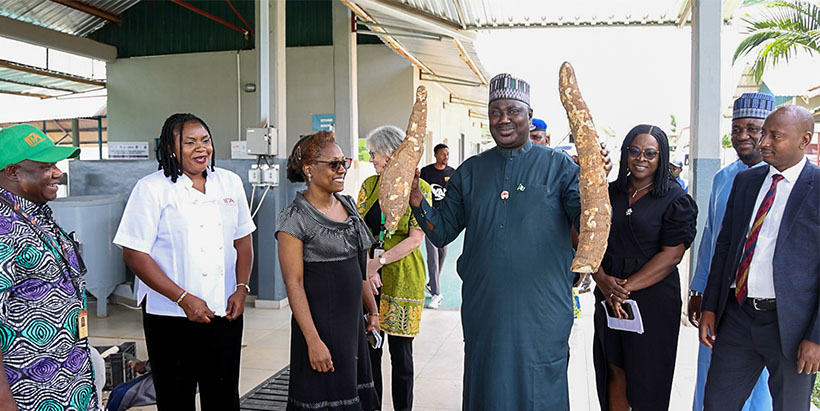
Dr Abdullahi also visited the IITA Cassava unit, where he expressed admiration for the improved cassava varieties and technologies on display. He stated, “I would develop a program around the ‘Renewed Hope,’ featuring the latest cassava variety, and aligning the program with the Nigerian President’s agricultural agenda. This initiative, he said, would be disseminated to smallholder farmers as part of a broader effort to transition Nigeria from conventional to modern agricultural practices.”
Contributed by Anita Akinyomade
