Soils4Liberia Project launch amidst partner engagements to empower Liberia’s agriculture
13 August 2024
IITA-CGIAR Soil Expert Samuel Mesele attended the EU Productivity to Product, Peers to Peers (P2P) coordination meeting held at the EU office in Monrovia from 23 to 27 July. The meeting was set to coordinate the P2P program, provide updates on the state of play, and discuss strategies to synergize the P2P projects—Seeds4Liberia, Soils4Liberia, and Food Safety. On day 2 of the event, the EU-sponsored Soils4Liberia project was officially approved and slated to begin on 1 August.
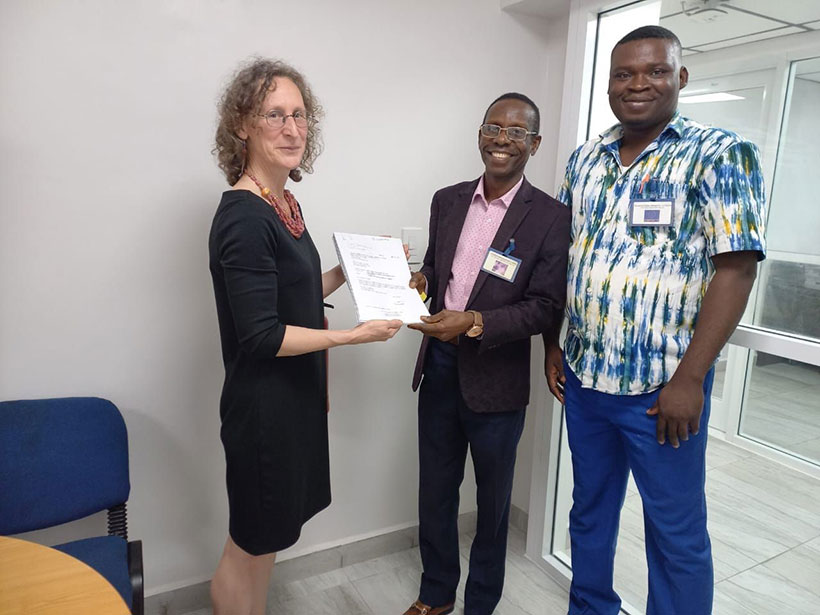
The Liberian Minister of Agriculture, Alexander Nuetah, was present at the event alongside other partners from AfricaRice, WorldFish, UNIDO, and CARI. The P2P programs are set to be guided by six principles: the demand-driven approach, the system approach to bring structural changes, the value-chain approach, public-private partnership, effective linkages with the National Agricultural Development Plan, and the strategic focus on nutrition, climate change, and gender approach.
The team had a productive meeting, discussing the three components of the Productivity to Product, Peers to Peers (P2P) program. This involves establishing a fully functional land and soil information system, raising stakeholders’ awareness and insight into the value of land and soil data, and establishing a functional center that generates and manages relevant and reliable information on Liberia’s soil and land resources.
Mesele highlighted the objectives of the Soils4Liberia project on behalf of IITA-CGIAR and emphasized its key contributions to the National Agricultural Development Plan (NADP). He said, “We are truly committed to Liberia’s agricultural transformation through improved access to and use of soil information in national development.” IITA leads the Soils4Liberia project alongside ISRIC, ICRAF, MATE, and the Regional Hub for Fertilizer and Soil Health in West Africa and the Sahel.
For decision support and applications, the team also considered various factors around sustainable food production, land degradation and restoration, and climate change adaptation and mitigation. The sustainable food production component of the project involves the evaluation of crop suitability, soil constraints, yield potential, yield gap, nutrient limitations, and land capabilities. The land degradation and restoration component covers soil erosion risks, vegetative cover-bare soil, soil conservation measures, landslides, vegetation growth, and biomass production. The climate change adaptation and mitigation will measure soil carbon stocks, carbon saturation index, and carbon deficiency.
The EU Team Leader for Green Economy, Montse Pantaleoni, raised the issue of sustainability and effective utilization of the Soils4Liberia project deliverables. Minister Nueteh assured them of a continued proactive engagement. Hence, the ministry secured approval to recruit 50 extension workers who will be trained in the field survey and sample collection. The Ministry of Agriculture agreed to organize the P2P meetings regularly.
Contributed by Samuel Ayodele Mesele and Folake Oduntan
Theme: Soil health, Partnerships
Related stories: https://www.iita.org/news-item/soils4africa-workshop-madagascar-youth-learn-soil-information-system-tools/
