Over 60 young people from South Kivu have been trained in agricultural and agribusiness entrepreneurship by IITACGIAR as part of the Projet d’Entrepreneuriat de Jeunes dans l’Agriculture et l’Agrobusiness (PEJAB) project.

The closing ceremony and the presentation of business plans were organized on 23 February during a business morning in Bukavu.
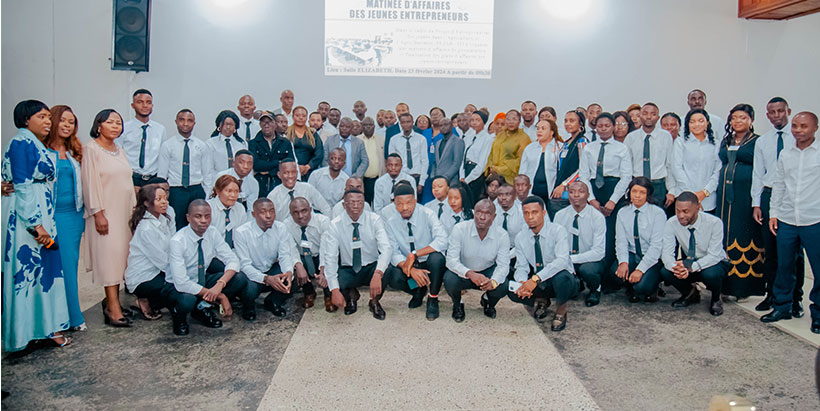
Beneficiaries of the training.

According to IITA-Kalambo Administrator Julie Lunzihirwa, these young people received technical and entrepreneurial training on several cross-cutting modules, mentoring and coaching, and visits to exchange experiences and learn from each other to promote the young graduates the spirit of creating profitable businesses, integrated into promising agropastoral sectors.

“At the request of the Government of the Democratic Republic of Congo, the International Institute of Tropical Agriculture (IITA) was asked to provide technical assistance to PEJAB. The AfDB was to finance the technical assistance to be rendered by IITA. This request was justified by IITA’s experience in implementing similar projects in Madagascar, Côte d’Ivoire, and Sudan, and the offer for technical assistance was prepared in this regard. Today, IITA presents over 60 young people who have been trained in collaboration with its partner, COSECOT, for six months, some of whom are going to present their bankable business plans, which we hope will attract your attention and receive financing from investors and certain financial institutions,” she declared.

For his part, the provincial minister in charge of agriculture, Jean Bosco Ruteye Kitambala, promises to support these young people and hopes they will flood the market to reduce unemployment and food insecurity.

“The efforts made by IITA to train young entrepreneurs in South Kivu with cross-cutting themes align with the provincial government’s aim to offer young people the space to develop their entrepreneurial skills in a healthy business climate. It is the duty of those in authority, who also serve as guardians, to accompany young people in their daily entrepreneurial activities to limit the rate of unemployment, banditry, and perdition for their better future and that of our beloved province. Our concern is to see these young people flood the city and regional markets with local production and no longer rely on imports, which do nothing to enhance our pride and joy,” he declared.

The trainees were satisfied with the knowledge they had acquired and hoped to find financial partners to turn their projects into reality.

PEJAB’s representative, Marie Caroline, was pleased to see that 68 companies, newly created by these young trainees, had legalized their documents at the end of the business morning.

This intense training program began on 26 October 2023 in Kalambo, South Kivu province, lasting over three months.

Contributed by Isabelle Buhoro
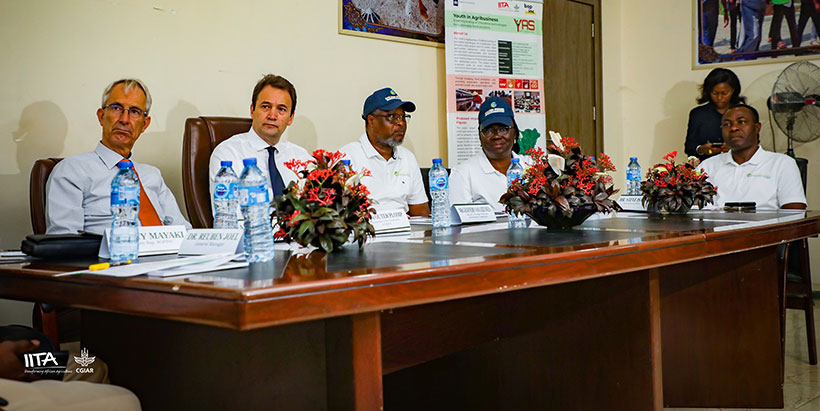
The Minister of Foreign Trade and Development Cooperation, Kingdom of the Netherlands, Geoffrey van Leeuwen, has applauded the Youth in Agribusiness, Enabling the Scaling of Innovative Technologies for Sustainable Food Solutions (YAS) project of IITACGIAR for exposing more youth to high-tech agriculture through training and other support initiatives.

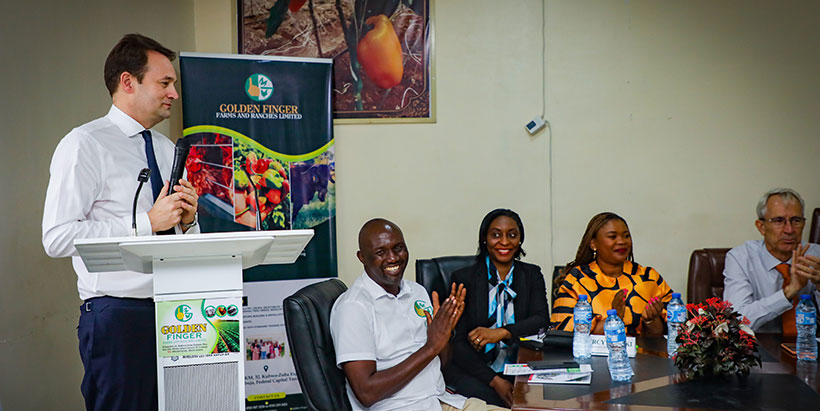
(L-R): The Netherlands Ambassador to Nigeria, Mr Wouter Plomp; Minister of Foreign Trade and Development Cooperation, Mr Geoffrey van Leeuwen; the Chairman, Golden Finger Farms and Ranches, Abuja, Major General Ezra Jakko (retd.); his wife and Vice/Chair, GFFR, Mrs Grace Jakko, and others at the event.

Speaking during his recent visit to the Golden Finger Farms and Ranches, the YAS Agrihub in Abuja, where selected young people were trained in the aquaculture value chain, the Minister said if the Netherlands could be the second largest exporter of agricultural products globally despite its 18 million population, Nigeria could harness its population, especially the youth demographic, to boost its agricultural productivity.

He added that YAS would help Nigeria attain food security and reduce youth unemployment, as he noted that the youth remained the future of Nigeria.

The Minister addressing participants at the event.

The Minister stated, “The youths are the future of Nigeria. The Netherlands’ driving force is not only agriculture but agriculture, technology, science, and business, and we combine these for our agricultural sector. It’s really wonderful for the Netherlands to participate in this project.”

He noted, “In the Netherlands, when you talk about farming, it’s not traditional farming. Rather, farming means business that includes the use of technology, exportation of goods, and making of money. We are not just reaching you (the trainees), but through you, we are reaching companies, which will also impact the economy.”

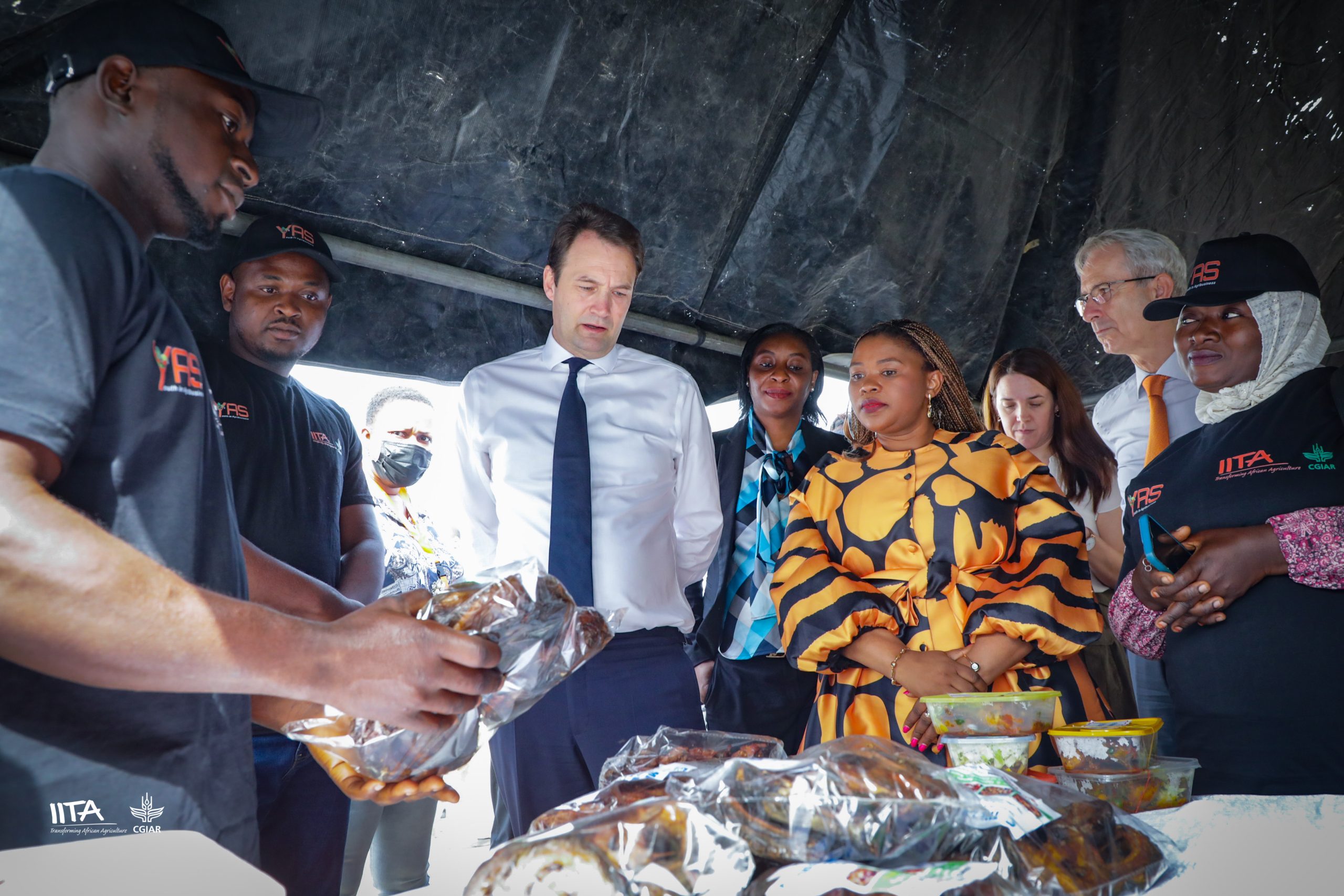
A 2023 beneficiary of YAS training exhibiting some of his products

He said the Netherlands was willing to share knowledge with Nigeria that could help develop its agricultural sector.

The GFFR Chairman, Major General Ezra Jakko (rtd), speaking on the collaboration with YAS, assured the trainees that GFFR was putting in place more facilities to broaden the commodities they would be exposed to. “So as to give them more opportunities to practice what they are learning and to expand their vision and dreams,” he said.

Similarly, YAS team lead Aline Mugisho applauded the partnership and support of the Netherlands government.

She added, “YAS is an important project to all of us. The CGIAR and IITA are long-term partners of the Netherlands Government, and we have built sustainable partnerships over the last 25 years in developing technologies and innovations.”

Contributed by Babatunde Ajaja

Steven Cole, a US Citizen, is the new Senior Scientist (Gender Specialist) for IITA, based in the Eastern Africa Hub in Dar es Salaam, Tanzania. He obtained his PhD in Biological Anthropology from the University of Arizona in 2012.  He also holds a MSc degree in Agricultural and Resource Economics and a BSc in Health and Nutrition.  Steven employs a mixed methodology in his research and strives to work collaboratively with biophysical scientists to ensure that agriculture research for development has greater impact. He led the social science research for WorldFish in Zambia over the past 6 years, integrating gender and other social science perspectives in aquaculture, small-scale fisheries, value chains and nutrition research.  He led a number of research projects more recently focused on piloting pro-poor, gender and youth-inclusive approaches in aquaculture value chains in Zambia, Sierra Leone, and together with IITA colleagues in DRC.

His email address is s.cole@cgiar.org and he looks forward to working with everyone at IITA and helping grow and strengthen the gender integrated and strategic research for development portfolio in the coming years.

Béla Teeken is an associate social and gender scientist at IITA and is based in Ibadan Nigeria. He is especially interested in how the biophysical environment, local institutions, and culture shape and determine local agricultural innovations and how such innovations and practices relate to those of formal scientific research.

He worked shortly on grassroots innovations at the NGO ‘Sristi’ in India, before pursuing his PhD research at Wageningen University. He has an interdisciplinary background with an MSc thesis in rural development sociology and another in agronomy/plant physiology from Wageningen University. His PhD research combined these disciplines and covered field research in the Togo Hills in Ghana and Togo to study the interaction between rice genotypes, ecological and sociocultural factors within farmer seed innovation, and selection pathways among different ethnic minorities. After his PhD research he worked at IITA as a post-doctoral fellow on interdisciplinary research including social segmentation and specifically gender, in relation to user-preferred cassava trait preferences.

Within the Nextgen Cassava and RTB foods and RTB CRP projects he is now working together with biophysical scientist to further study gender and other social dynamics in relation to crop production and processing to inform and reform CGIAR breeding programs to develop more accurate breeding programs.