
As part of its effort in extending agribusiness opportunities to more youth in Africa, ENABLE-TAAT, the youth enabler compact of the Technologies for African Agricultural Transformation (TAAT) in collaboration with the Togolese government, organized a 4-day comprehensive training for trainers at Centre Pilote des Techniques Agricoles du Togo (CPTA), in LomĂ©, Togo 11–14 June.

The training, which was a follow up on the sensitization and awareness creation carried out by ENABLE-TAAT at the National Farmers’ Forum organized by the Togolese government in April 2019, is the first step leading to the implementation of the TAAT youth program in Togo.
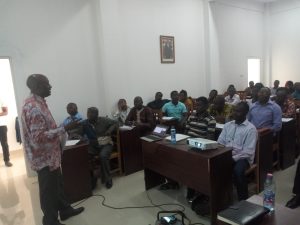
ENABLE TAAT Trainer-Valentina Ekun facilitating-one of the sessions

It was organized to ensure that trainers, who would be training youth during the ENABLE-TAAT pilot phase, are well-equipped with the skills to run an incubation program, and enlighten them on the technologies promoted by TAAT.

With this expansion, ENABLE-TAAT will develop agribusiness skills, change counterproductive mindsets, and provide economic opportunities to rural youth in agribusiness, including young women.

The compact will also work with other TAAT commodity value chains to establish a range of innovative, youth-led agricultural enterprises and consolidate the gains along value chains, including higher-value crop production, marketing, value addition, and a range of agricultural services.

In addition, it will support rural enterprise networks that provide youth-led initiatives with interactive agribusiness and financial information and raise the creditworthiness of aspiring youth going into agribusiness.

Addressing the participants at the training, the Head of TAAT Clearinghouse, Mpoko Bokanga, stated that the training marks the beginning of agricultural transformation in Togo.

“Africa has to feed itself. We cannot wait for other continents to feed us. We have the land mass, climate, and weather, but what is hindering us I believe is the technology. Hence, TAAT has come to introduce improved agricultural technologies so that there can be an agricultural transformation in Africa and in Togo especially,” he said.

The representative of the Minister of Agriculture in Togo, Mr Kpadenou Kodjoga, advised the trained youth to be dedicated and tap into the vast agricultural technologies being promoted by TAAT through the young people working under ENABLE-TAAT.

The training had about 54 participants who were trained on topics that included youth marginalization, its negative impact on the economy and ENABLE-TAAT as a solution, the Agripreneurs movement, youth incubation, and agribusiness rural enterprise which covers topics on Agribusiness and incubation, Value chains, Mentorship, Financial management, ICT in agribusiness, and Marketing.

One of the participants, Tsibi Blakeur, a trainer at Institut National de Formation Agricole (INFA) said the training had enlightened him about the available opportunities along the agricultural value chains focusing on improved technologies. He further said that he is ready to transfer the knowledge to other youth.
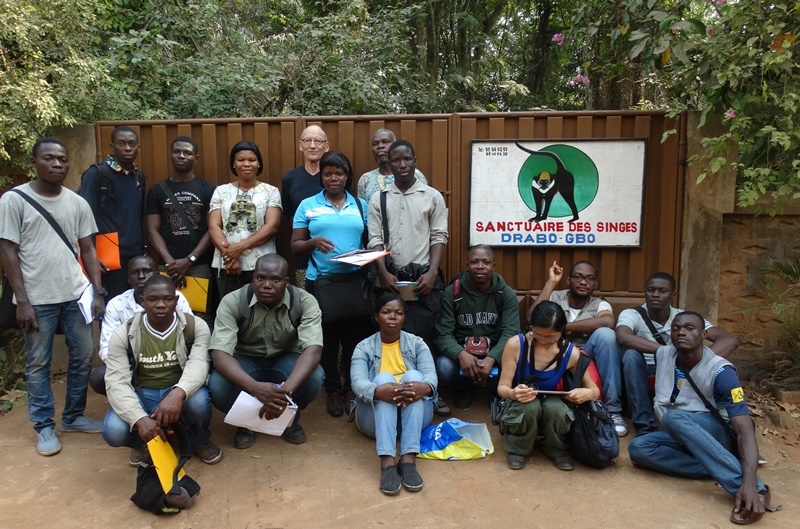
A workshop was organized at IITA-Benin on 7-14 January to strengthen the research capacities of 14 young researchers already active in nature conservation from universities and NGOs in Benin and Togo. The workshop also aimed to demonstrate the standardized procedures for observing monkeys and empower the participants to launch new projects in national and international cooperation.

Participants in front of the gate to the ‘Sanctuaire des singes de Drabo Gbo’.

Participants in front of the gate to the ‘Sanctuaire des singes de Drabo Gbo’.

Benin and Togo constitute the refuge for three threatened monkeys, namely the critically endangered red-bellied monkey (Cercopithecus erythrogaster erythrogaster), the vulnerable Geoffroy’s Black-and-white Colobus (Colobus vellerosus), and the olive colobus (Procolobus verus).

After two days of theoretical training at IITA-Benin, the participants spent a day at the “Sanctuaire des Singes de Drabo Gbo” in the IITA forests of Drabo. The trainers stressed that this was the only place in the world where red-bellied monkeys are used to people and can be observed at ease. In the other sites in Benin and along the border to Nigeria or Togo, where this monkey has been recorded, the animals are hunted and therefore extremely shy. This visit allowed the paticipants to observe this species close up and develop their skills in recording its behavior. The next day they departed for a prolonged visit to the Lama Forest, where they learned how to estimate monkey populations along fixed observation lines in the forest. The last day was spent again at IITA wrapping up the workshop findings.

The workshop was coordinated by the local NGO “Organisation pour le DĂ©veloppement Durable et la BiodiversitĂ©â€ (ODDB) with internationally recognized primatologists Reiko Goodwin (Fordham University, New York, USA) and CĂ©lestin Kouakou, Centre Suisse de Recherches Scientifiques en CĂŽte dÍvoire (CSRS). It was supported by scientists from the UniversitĂ© d’Abomey-Calavi, CENAGREF of the Benin Ministry of Environment, ODDB, and IITA.

The IITA forests of Drabo were officially handed over to IITA last year, and are managed by Peter Neuenschwander. The forests are reserved for research in nature conservation focusing on plant and insect biodiversity, but also involving all sorts of wildlife, including endangered monkeys. This is in view of the continuous effort by IITA and the IITA-Benin station in particular to study the links between biodiversity and sustainable agriculture. The full text of the workshop proceedings are available here.

The UN Food and Agriculture Organization (FAO) says crop losses in sub-Saharan Africa amount to $200 million a year. As a result scientists at the International Institute of Tropical Agriculture (IITA) are reminding farmers about how to improve soil and crop harvests, highlighting fertilization and crop rotation to increase the supply of nitrogen, potassium and phosphorus.

IITA scientists and their partners working in Nigeria, Benin and Togo are reinforcing those findings after completing a six-year project called “Balanced Nutrient Management Systems” in which they identified better crop varieties and validated crop-rotation techniques. They also devised soil fertility technology and set up cooperative approaches with national researchers and extension organizations.

Dr. Robert Abaidoo, soil microbiologist at IITA in Ibadan, Nigeria, says the long-term soil studies advanced their underst anding of how disadvantaged farmers in maize-producing regions can overcome declines in soil fertility and increase farm income.

More than 130 million farmers live in the moist savannah of coastal and central sub-Sahara Africa. Many record annual crop losses. Abaidoo says it’s these farmers who will benefit most from the improved techniques.

The research shows that the solution to higher maize yields lies in the proper mix of fertilizers and organic nutrients, manure made from plant and animal waste. It also proves there are many benefits from rotating maize with legumes crops like soybean and cowpea, which are rich in nitrogen and protein.

A former IITA project leader, Professor Dan Diels, says by working together the researchers were able to take practical problems into account and develop simple technologies that could be adopted by farmers.

Maize is an important food in Africa and the main ingredient in several well-known national dishes. Examples are tuwon masara and akamu in northern Nigeria, Koga in Cameroon, injera in Ethiopia and ugali in Kenya. It’s also used as animal feed and as raw material for brewing beer and for producing starch.

The FAO says over the decades, fertilizers and other inputs to enrich the soil have been used to help improve maize production in West and Central Africa. In response, maize yields there have increased from three million hectares 25 years ago to three times that amount today. However, as food production increased, so has the population, which put more pressure on food supply.