
Adopting new cassava genotypes in gari production
7 October 2022
Cassava, a perennial woody shrub with an edible root, is one of IITA–CGIAR’s mandate crops and a major staple crop in Africa. It is available in different varieties that possess characteristics suitable for numerous food preferences and delicacies.

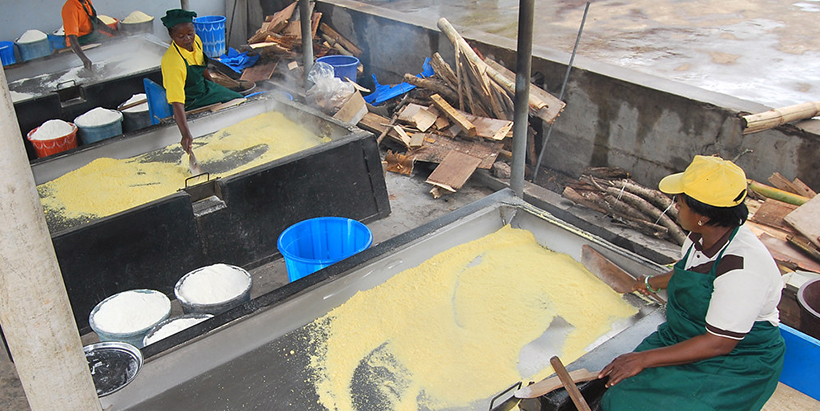
One of the widely consumed delicacies of cassava is gari or garri as it is known in several African countries. Gari is a roasted, fermented cassava grit, soaked in cold water, or prepared with hot water as eba—a food for millions of people in developing countries.
With IITA-CGIAR breeders researching new varieties to address food security, climate change issues, consumer preference, and nutrition security, researchers carried out a study to evaluate the use of the biophysical attributes of gari and the textural characteristics of eba to determine the possible substitution of an adopted cassava variety (TMBE419), with the improved genotypes from the Institute’s breeding program. According to the study, thirty improved varieties, including TMEB419, were harvested from the Ikenne demonstration site in Ikenne, Ogun State in Nigeria, and processed to gari and eba for evaluation. TMBE419, an outstanding variety widely used in gari production due to high product yield and good biophysical attributes, served as a check in the study.
IITA-CGIAR researchers in Ibadan observed the biophysical attributes of gari, looking at swelling power (SWP), dispersibility, water absorption capacity (WAC), peak, breakdown, and final viscosity, peak time, and pasting temperature. The moisture, ash, starch, amylose, and cyanogenic potential (CNP) content were also evaluated.
Although the cohesiveness, moldability, stretchability, and softness of eba are essential and desired by consumers at various levels depending on the region, culture, and personal preferences; the breeding program at IITA-CGIAR is working with partners across Africa to develop varieties that are disease- and pest-resistant, low in the potential to generate cyanide, drought-resistant, early maturing, and high yielding.
The results of the study show that there were significant differences in all the biophysical attributes of the gari samples as well as the textual attributes of the eba. The sensory texture attributes depict that all the eba was moderately soft, sticky, and moldable. Following principal component analysis during the study, gari made from TMS14F1285P0006 and TMS13F1053P0010 genotypes may have similar dispersibility, swelling power, and peak and breakdown viscosities as the TMBE419 variety. The stickiness of the eba prepared from these genotypes may also be like that of the TMBE419 variety. Therefore, TMS14F1285P0006 and TMS13F1053P0010 genotypes may be suitable substitutes for producing gari like the TMBE419 variety.
The results from the study will help to increase food production and improve the livelihoods of farmers. Smallholder farmers can grow suitable cassava substitutes for producing gari/eba.
Contributed by Timilehin Osunde and Tolulope Akinola
