
NEWS

ATA-DRC registers quick wins in three months of start-up
July 30, 2022

After only three months of implementing the Agenda for the Transformation of Agriculture in the Democratic Republic of Congo (ATA-DRC), the program has registered multiple successes, giving the government and people of the country much to celebrate. IITA Director General, Dr Nteranya Sanginga, highlighted these wins during his recent visit to multiple program sites in DRC.

One of the triumphs recorded was in the seed sector with the rapid multiplication of healthy cassava seedlings using Semi Autotrophic Hydroponics (SAH) technology.
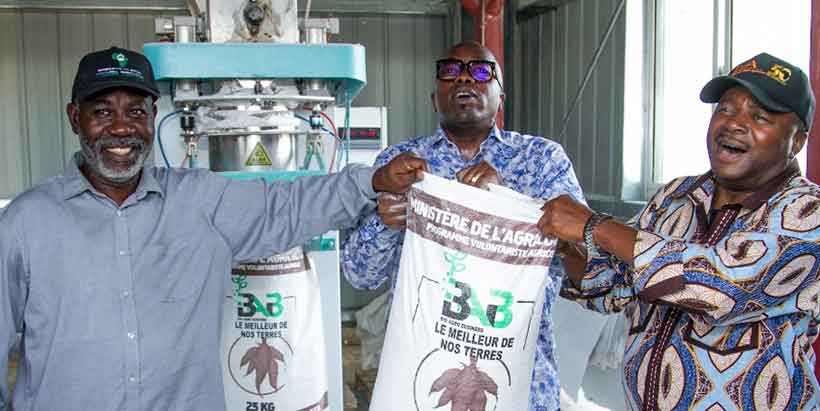
Dr Abbas Adebayo ( IITA), M. Pacifique Kahasha, DRC President Representative, Dr SANGINGA ( DG IITA).

Five healthy, high-yielding varieties are now available from ATA-DRC’s rapid multiplication partner in Kinshasa, Centre de Recherche en Agrumiculture (CERAGRU). They have produced 600,000 cassava seedlings from 30 ha for transfer at the end of June to the Mongata agricultural base for transplanting to produce cuttings.

ATA-DRC  has also registered success in maize seed supply, with IITA purchasing 60 tons of maize seed for the agricultural bases of Mongata and Nkuadi. IITA sourced these on behalf of the ATA-DRC program from SAGRICIM, a Congolese seed company located in Lubudi in Haut Katanga.

IITA signed an MoU with Les Plantations et Huileries du Congo (PHC) for intensive rice, maize, cassava, and soybean seed production. Private sector participation is critical to the successful implementation of ATA-DRC, particularly the scaling of agricultural technologies. Though specialized in oil palm exploitation, PHC has extensive expertise in managing large-scale agro-production activities with qualified technical staff to produce quality seed. As a result, IITA has chosen to access its seed-production proficiency to meet the needs of rural communities in areas of intervention.
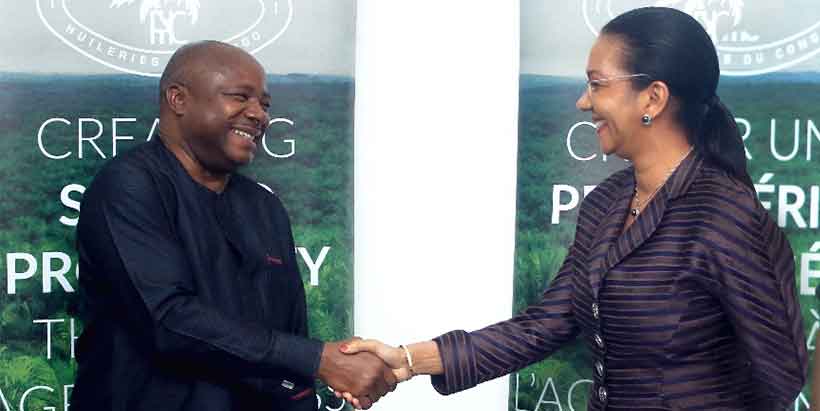
DG SANGINGA, M. Kahasha, DRC president representative, M. Mbilo, IITA Partner (SAH).

The program activities in the Mongata site in Kinshasa have also progressed considerably, with 200 ha of cassava already cultivated. The harvested cassava is being processed at the factory. The Nkuadi site in Kasai-oriental will sow at least 50 ha of land for seed multiplication during the first phase of implementation 2022‒2023 (which starts in September 2022).

Preparations for the next growing season are underway. Consequently, various stakeholders met to finalize the subcontracting aspect. Postharvest activities primarily focus on the continued construction of the cassava processing plant and the manual processing of maize into flour. Also, IITA has identified ten young people involved in agricultural production in Nkuadi.

IITA experts carried out a mission in the Tshopo and Haut-Uélé sites to assess potential seed production sites and discuss with potential national and private partners. Plantain is the main crop for the Tshopo agricultural site, and cassava for Haut-Uélé.

The South Kivu Ruzizi site has cultivated 120 hectares of cassava, and construction continues on the cassava and maize factories, offices, stores, canteen, and rooms for staff.

IITA has also finalized an exploratory study in aquaculture and identified active aquaculturists, including young people.
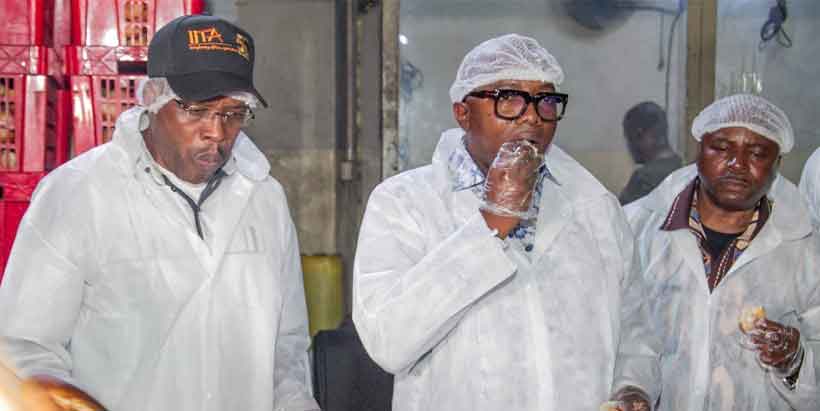
DG SANGINGA and Mrs Monique Gieskes, DG PHCProgress in value addition has seen 20 large bakeries and three individual donut makers in Kinshasa already incorporating—on an experimental basis—high-quality cassava flour (HQCF) into bread-making and manufacturing their other products. To improve agribusiness development in the region, IITA contacted the University of Kinshasa (UNIKIN) to develop a market study on cassava flour and derivative products.

The ATA-DRC implementation has also been a vehicle for advocacy, leading to engagement with the Congolese government, through the ministries of Agriculture and Finance, to explore the ratification of programs funded by the World Bank, African Development Bank (AfDB), and other financial development partners. Additional advocacy with the Industry Promotion Fund (FPI) led to the construction of the road leading to the Mongata agricultural base, and the Governor of the Province of Kasaï-Oriental in favor of the agricultural base of Nkuadi.

Contributed by Michèle Kimpwene and Uzoma Agha


Contributed by

Recent stories

No items found

Leave a Reply

Your email address will not be published. Required fields are marked *

Scroll to Top
Olaosebikan, Olamide

Olamide Deborah Nwanze is a Senior Research Associate specializing in gender mainstreaming research to inform participatory and inclusive breeding, variety development, and seed systems policies regarding root, tuber, and banana (RTB) crops in the International Institute of Tropical Agriculture Headquarters, Ibadan, Nigeria. She is a PhD candidate at the University of Ibadan and holds an MSc and B. Agric in Agricultural Extension and Rural Development. Olamide is a fellow of the African Women in Agricultural Research and Development – Gender Responsive Agricultural Systems Policy (AWARD-GRASP) and the Gender Responsive Researchers Equipped for Agricultural Transformation (GREAT). She seeks to apply her gender-mainstreaming learnings, gender-responsive research, and policy development, and review expertise to facilitate women, youth, children, and vulnerable social group’s access to and adoption of agricultural Innovations that guarantee food, nutrition, income, and livelihood security in Africa. Her current roles include mentoring research fellows, development of guides and training manuals, implementation and adaptation of gender frameworks and tools, value chain actors’ engagement as citizen science partners, policy review and redesign, data management, and analysis. Her current research explores mixed methods and participatory and interdisciplinary approaches to capture and highlight gender dynamics, needs, preferences, and challenges stakeholders face within the agricultural livelihood value chain to prioritize gender-inclusive strategies in breeding programs, policy design, and implementation.

At IITA, she contributes to the implementation of the CGIAR Accelerated Breeding Initiative and Genetic Innovation Programs; participatory and gender research within the NextGen CassavaHarvestPlusRTBFoods, and Tricot-ClimMob 1000Farms Projects; and gender knowledge communication via the G-LENS webinar series, video documentary, policy briefspublications, and blogs.


Recent publications

de Sousa, K., van Etten, J., Manners, R. Bello, A., Teeken, B., Olaosebikan, O., et al. 2024. The tricot approach: an agile framework for decentralized on-farm testing supported by citizen science. A retrospective. Agron. Sustain. Dev. 44, 8. https://doi.org/10.1007/s13593-023-00937-1

Madu, T., Onwuka, S., Nwafor, S., Onyemauwa, N., Ejechi, M., Ofoeze, M., Ukeje, B., Eluagu, C., Olaosebikan, O., Okoye, B., 2024. Gender-Inclusive Consumer Studies Improve Cassava Breeding in Nigeria in: Frontiers in Sociology, volume 9, number: 1224504, doi: 10.3389/fsoc.2024.1224504

Olaosebikan, O.; Bello, A.; Utoblo, O.; Okoye, B.; Olutegbe, N.; Garner, E.; Teeken, B.; Bryan, E.; Forsythe, L.; Cole, S.; Madu, T. 2023.  Stressors and Resilience within the Cassava Value Chain in Nigeria: Preferred Cassava Variety Traits and Response Strategies of Men and Women to Inform Breeding. Sustainability 15, 7837. https://doi.org/10.3390/su15107837

Okoye, B., Ofoeze, M., Ejechi, M., Onwuka, S., Nwafor, S., Onyemauwa, N., Ukeje, B., Eluagu, C., Obidiegwu, J.*, Olaosebikan, O., Madu, T.* 2023. Prioritizing preferred traits in the yam value chain in Nigeria: a gender situation analysis in: Frontiers in Sociology, volume 8, number: 1232626, pages 1 – 9, ISSN 2297-7775, 2023. https://www.frontiersin.org/articles/10.3389/fsoc.2023.1232626/full

Olaosebikan, O., Bello, A. A., de Sousa, K., Ndjouenkeu, R., Adesokan, M., Alamu, E. O., Agbona, A., van Etten, J., Kegah, F. N.*, Dufour, D., Bouniol, A., Teeken, B. 2023. Consumer acceptability of cassava gari-eba food products across cultural and environmental settings using the triadic comparison of technologies approach (tricot) in: Journal of the Science of Food and Agriculture,

Teeken, B., Olaosebikan, O., Bello, A. A., Madu, T.*, Cole, S. M. 2023. Qualitative assessment on the positionality and preferences of dyads in relation to cassava-related activities: working with tricot trial citizen scientists https://hdl.handle.net/10568/138326 Type: Manual

Bouniol, A., Ceballos, H., Bello, A. A., Teeken, B., Olaosebikan, O., Owoade, D., Agbona, A., Fotso Kuate, A., Madu, T.*, Okoye, B.*, Ofoeze, M.*, Nwafor, S.*, Onyemauwa, N.*, Adinsi, L.*, Forsythe, L., Dufour, D. 2023. Varietal impact on women’s labour, workload and related drudgery in processing root, tuber and banana crops: focus on cassava in sub-Saharan Africa in: Journal of the Science of Food and Agriculture, pages 1 – 25, ISSN 0022-5142,

Bello, A. A., Agbona, A., Olaosebikan, O., Edughaen, G., Dufour, D., Bouniol, A., Iluebbey, P., Ndjouenkeu, R.*, Rabbi, I. Y., Teeken, B. 2023. Genetic and environmental effects on processing productivity and food product yield: drudgery of women’s work in: Journal of the Science of Food and Agriculture, pages 1 – 32, ISSN 0022-5142, 5

Cavicchioli, M., Zimbiti, T., Teeken, B., Nwanze, D.O., Liani, M., Parkes, E. & Bello, A. 2023. IITA-Gender Responsive Breeding Training Report. Genetic Resources Center, IITA-HQ, Ibadan, 21-23 September, 2022. Ibadan, Nigeria: IITA, (34 p.).https://hdl.handle.net/10568/131368

Agbona, A. Peteti P., Teeken B., Olaosebikan O. Bello, A. A., Parkes, E., Rabbi, I. Y., Mueller, L., Egesi, C., Kulakow, P. 2022. Data Management in Multi-disciplinary African RTB Crop Breeding Programs. In: Williamson, H.F., Leonelli, S. (eds) Towards Responsible Plant Data Linkage: Data Challenges for Agricultural Research and Development. Springer, Cham. https://doi.org/10.1007/978-3-031-13276-6_5

Lora Forsythe, Pricilla Marimo, Sarah Mayanja, Olamide D. Olaosebikan, Esme Stuart, Bela Teeken, Benjamin Okoye, Tessy Madu, (2021). Cross-product Gender Analysis of RTBfoods Step 2 Gendered Food Mapping on RTB Products. Understanding the Drivers of Trait Preferences and the Development of Multi-user RTB Product Profiles, WP1. London, UK: RTBfoods Field Scientific Report, 30 p.

Teeken, B., Garner, E., Agbona, A., Balogun, I., Olaosebikan, O., Bello, A., Madu, T., Okoye, B., Egesi, C., Kulakow, P. and Tufan, H.A. 2021. Beyond “Women’s Traits”: Exploring How Gender, Social Difference, and Household Characteristics Influence Trait Preferences. Frontiers Sustainable Food Systems 5:740926. https://doi.org/10.3389/fsufs.2021.740926

Teeken, B., Agbona, A., Bello, A., Olaosebikan, O., Alamu, E., Adesokan, M., Awoyale, W., Madu, T., Okoye, B., Chijioke, U., Owoade, D., Okoro, M., Bouniol, A., Dufour, D., Hershey, C., Rabbi, I., Maziya‐Dixon, B., Egesi, C., Tufan, H. and Kulakow, P. (020. Understanding cassava varietal preferences through pairwise ranking of gari‐eba and fufu prepared by local farmer–processors. Int J Food Sci Technol. https://doi.org/10.1111/ijfs.14862

Bela Teeken, Olamide Olaosebikan, Ireti Balogun, Benjamin Okoye, Tessy Madu, Steven Cole, Abolore Bello, Elizabeth Parkes. (2020). Piloting the G+ customer and product profile tools for gender-responsive cassava breeding in Nigeria. Nigeria: International Institute of Tropical Agriculture (IITA). https://hdl.handle.net/20.500.11766/13000