
Plantain is one of the most important food crops, contributing 16% of farmers’ incomes and 4.5% to agricultural GDP in Cameroon. It is one of the priority crops included in Cameroon’s development strategy (SND30) for increasing production and reducing importation. However, plantain cultivation faces banana bunchy top disease (BBTD) caused by the banana bunchy top virus (BBTV), which is spread by the banana aphid and infected planting material.
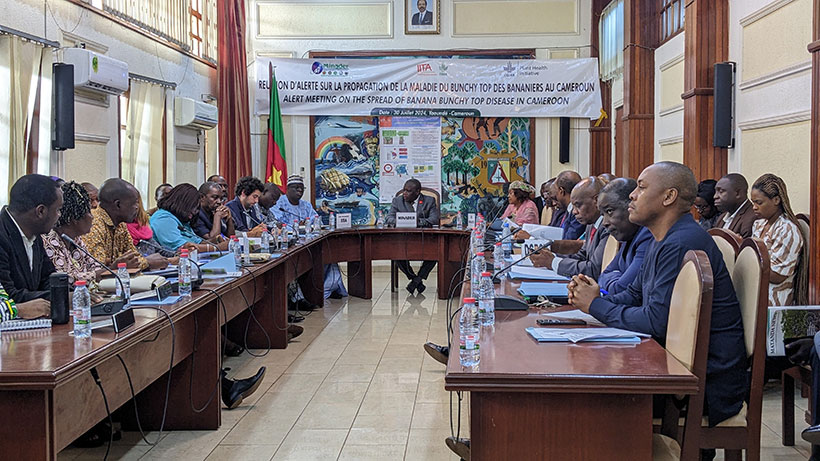
In Cameroon, BBTD was reported in 2008 and confined to a single district at the border with Gabon. Although the infection was limited to this district from 2008 to 2022, BBTD is insidiously spreading to the north of the country, and this spread is usually through infected plant materials by human movement, constituting a significant threat to the development of the plantain sector. IITA-CGIAR Virologist and member of the ALLIANCE against BBTV initiative, Lava Kumar, acknowledged funding from CGIAR for combating BBTV in Africa from 2012 to 2021 through the CRP-RTB Program and from 2022 onwards through the CGIAR Plant Health Initiative. He said the CGIAR Trust Fund donor’s support enabled emergency response actions, development, and transfer of innovations to partners.
The BBTD awareness creation meeting funded by the CGIAR Plant Health Initiative aimed to inform high decision levels of the Ministry of Agriculture and Rural Development, political decision-makers, and stakeholders in the plantain value chain about the status of BBTV spread and control methods to halt the contagion, and discuss a response plan to be implemented for BBTD control in Cameroon. The meeting was held on 30 July at the Ministry of Agriculture and Rural Development (MINADER) and organized by IITA Cameroon in collaboration with the National Fruits Crops Development Project (PNDCF), a specialized program of MINADER.
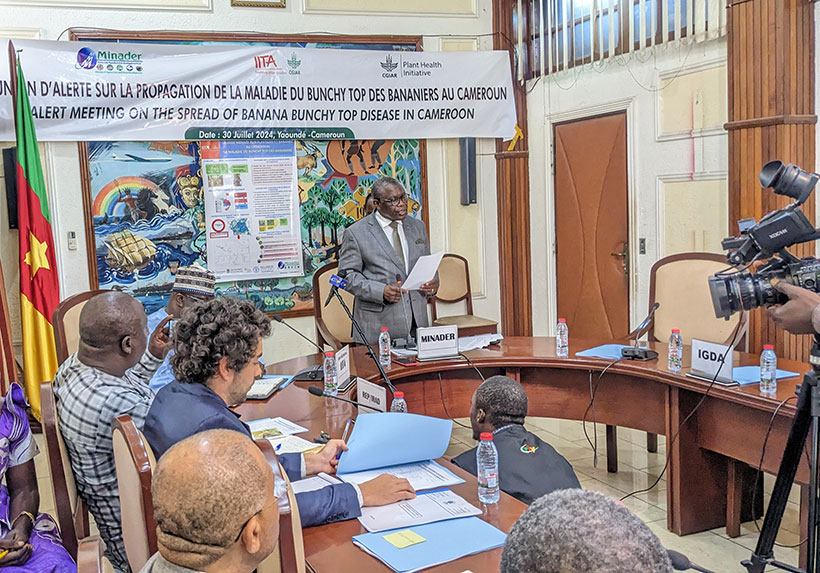
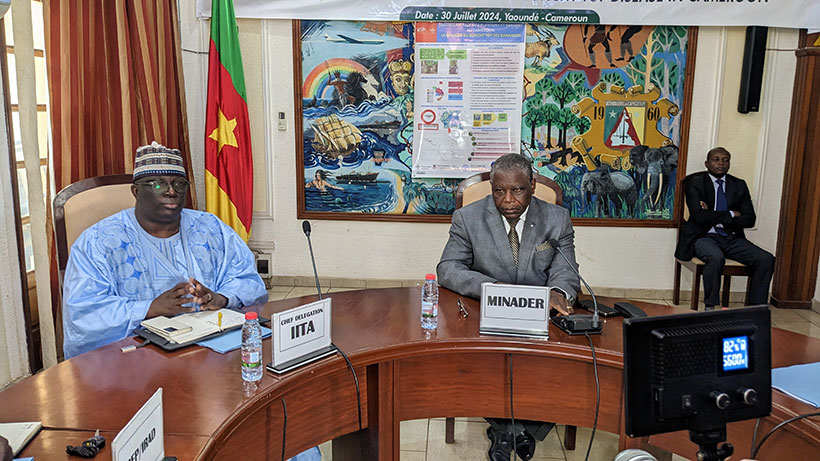
His Excellency Gabriel Mbairobe, the Minister of Agriculture and Rural Development, presided over the meeting, assisted by the General Secretary of MINADER. In his speech, the Minister recalled the value of plantain in Cameroon for livelihood and income, warning the participants about the necessity of taking action to tackle this disease and even eradicate it from Cameroon. He then acknowledged IITA for its strong involvement in BBTD research and for sounding the alarm that led to this meeting.
During the meeting, Sergine Ngatat, a Plant Pathologist at IITA Cameroon, presented on BBTD symptoms and damage, the extent of BBTD spread in Cameroon, which is so far confined within the Ambam district /Ntem Valley Division in the South Region at the border area with Gabon and Equatorial Guinea, and some actions undertaken towards BBTD control in the country’s endemic area.
Eric Avom, the National Coordinator of the National Fruits Crops Development Project (PNDCF), presented a response plan against BBTD in Cameroon for 2025 to 2027, including phytosanitation of infected materials and replacement with clean planting materials, surveillance, quarantine regulation of seed movement, and awareness-raising campaigns.
IITA Deputy Director for Central Africa Hub and IITA Country Representative in Cameroon, Komi Fiaboe, emphasized the necessity of controlling the movement of plantain seeds, given that for Cameroon, the seed is a contributor at 95% for BBTV spread and highly recommended the use of vitroplants as clean planting materials in the endemic area while recalling the importance of training the farmers on BBTD symptom recognition.
A plenary session was conducted, with discussions and recommendations to complement the response plan against BBTD in Cameroon.
In the end, the Minister of Agriculture pleaded with IITA to search for alternative safe herbicides and biopesticides for phytosanitation of BBTV-infected materials in the endemic area, urged Quarantine Authority to take the necessary actions for implementation of the by-law on plantain seed movement from the endemic area, and requested the implementation of a response plan that will not only limit its spread to inside of the country but will definitively eradicate this dangerous plantain disease from the country.
The meeting enlightened participants on BBTD and ended with validating the response plan against BBTD in Cameroon.
Contributed by Sergine Ngatat
Contributed by
Recent stories