
Bridging the gender gap in research across Africa
May 27, 2022
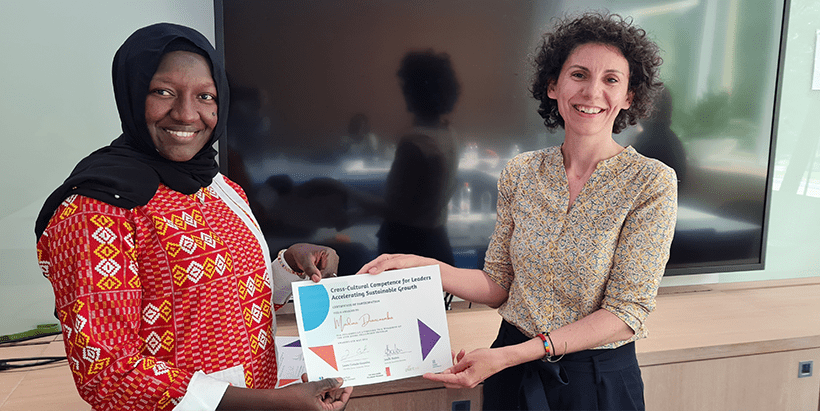 The Open Doors Fellowship Program for women researchers in Africa is an all-inclusive program that targets women researchers in Africa to help them acquire the necessary hard and soft skills to strengthen their placements, while creating an awareness culture about recruiting women within their hosting institutions and, ultimately, avoid the dropout before their consolidation stage. The program also supports these women along their tenure track, thereby creating a next generation of mentors and role models for the younger generation of scientists. LAURA CORTADA, a Senior Scientific Officer at VIB-IPBO and a Visiting Professor at Ghent University talks about what VIB-IPBO is doing through the Open Doors Fellowship in Africa.
Please tell us more about IPBO’s plan to work in Africa through the Open Doors Fellowship Program
The mandate of VIB-IPBO is to build bridges between Belgian and African Research and High Education Institutions (HEI) to promote a fruitful scientific collaboration that advances sustainable agriculture across the continent while enhancing the capacity of Belgian and African scholars. To this extent, the Open Doors Fellowship Program (ODFP or Open Doors) aims to support women in African research (inter)national centers and HEI to access state-of-the-art facilities and technical resources in Belgium that may be missing in their countries to advance their scientific careers. Furthermore, ODFP intends to equip postdoctoral fellows with a range of personalized soft and hard skills they need to expand their research areas and navigate their careers with more confidence. In addition, ODFP actively works on expanding the network of our fellows in Belgium to build up future intercontinental research projects. Last but not least, Open Doors also intends to bring Belgian scientists closer to the actual research and institutions working in Africa to learn and identify how their ongoing research in the EU can apply to sustainable agriculture and climate change challenges.
Does IPBO have plans to expand the project through partnerships with other institutions in other countries outside of Africa?
Yes. The Open Doors Fellowship Program has been conceived, developed, and implemented by VIB-IPBO but we have been collaborating with different organizations who have been instrumental in supporting the kickstart of our programs. In Belgium, we have received the support of several UGent professors and researchers at the Flanders Research Institute for Agriculture, Fisheries and Food (ILVO in its Flemish acronym) to open their labs to our ODFP fellows, and we are currently looking at institutionalizing such collaboration. Another non-African institution we are in contact with is the Belgian Women in Science (BeWise). We are currently exploring a collaboration of the Open Doors Fellowship Program with the BeWise ‘Mentor-Mentee’ program and the participation in the BeWise e-learning activities, seminars and workshops.
While the fellowship will be creating future opportunities to strengthen collaboration between Belgium and Africa, what are the long-term goals for the fellowship and the fellows?
According to researchers, the global retention rates in academia for women are 20% lower than for men[1]. This phenomenon is known as the leaking pipeline of science[2], with dropouts affecting the entire scientific career path, suggesting that solutions focusing only on early-career scientists may not revert the gender imbalance in the longer term. ODFP for women researchers in Africa is a holistic program that targets women researching in Africa to help them acquire the necessary hard and soft skills to strengthen their placements within their hosting institutions and, ultimately, avoid dropout before their consolidation stage.
The long-term goal for our fellows is to prevent women from dropping their scientific careers and ‘leaking’ from the scientific pipeline. Ultimately, the Open Doors Fellows of today will be the role models and mentors of young researchers in the near future. We hope they shall play a role in supporting the advancement of research in Africa.
As a program, our goal is to sustain and expand this program within the VIB-IPBO portfolio with additional external funding support. Currently, this program is mostly funded by internal IPBO seed funds to prove the impact of the concept and also via the Plant Biotechnology and Breeding International Thematic Network funded by UGent. In the short to medium term, we intend to financially support this project through competitive project proposals and with philanthropic donations to the Marc and Nora Van Montagu Fund.
What opportunities are available for the selected fellows during the fellowship period?
The Open Doors Fellowship Program is a unique two-year training and mentoring program that offers personalized learning content to our fellows. The program is divided into two phases. Phase 1 is a short research stage (from 8 to a maximum of 12 weeks) in a research or academic institution in Belgium. During this period, the Open Doors Fellows will be trained in hard skills at the hosting laboratories but they shall also take part in several soft skills courses (e.g., negotiation skills, cross-cultural communication, oral presentation or how to submit competitive proposals as partners under an EU-Africa call). The fellows also take part in seminars and events at their hosting institutions and connect with local scientists during their stage in Belgium.
Further to this, the Open Doors Fellows enter into Phase 2 of the program once they’ve returned to their duty stations in Africa. During this period, the fellows will be able to access online courses for soft and hard skills from the VIB training portfolio; they also participate in our online course ‘Speaking Science’ with the Alliance for Science. In addition to this, we shall organize monthly online meetings and special events to discuss relevant topics for our fellows, give visibility to their research and generate awareness about the importance of promoting gender-inclusive policies in their institutions. During Phase 2, our Open Doors Fellows will be supported with a bursary to travel to an international congress, they shall receive financial support to cover the open access fees of a publication, and the program will cover their tuition fees for an AWARD leadership course.
Finally, we also hope that the Open Doors Program can serve as a platform for them to discuss, share and create visibility about their own research, but also on other topics that they consider important for their personal and professional development.
What are the deliverables expected from the fellows in the course of the fellowship?
We expect proactive participation of the Open Door Fellows in all the activities planned for them. To successfully complete their training program, our fellows will have to take 3 soft and 3 hard skill courses available on the VIB training portfolio during Phase 2 of their fellowship. In addition, the program expects them to be able to publish one research paper in peer-reviewed journals as the first or corresponding author, attend at least one international conference where they will deliver an oral presentation; and successfully complete an AWARD Leadership Series course. Upon successful completion of all these outputs, our fellows will receive a start-up grant for equipment worth 2,000 euros to facilitate research in their duty stations.
What are the future plans for the Open Doors Fellowship Program?
Our main objective in the short term is to consolidate partnerships and collaboration and secure financial support to run the program by 2025. In the mid-term, we shall look into expanding our training portfolio and online activities and creating a robust network of Open Door alumni who will become Ambassadors of our program in their home countries. We shall also support our fellows to promote MSc and PhD students’ exchange with Belgian labs and support the development of joint research projects with Belgian scientists.
Laura’s bio:
Laura Cortada holds a BSc in Biology (Autonomous University of Barcelona-UAB), a BSc in Agronomy in Crop and Livestock Management (Technical University of Catalonia – UPC), and an MSc in Biotechnology and Sustainability (UPC). In 2010 she obtained her PhD studies at the Plant Pathology Department of the Institute for Research and Technology, Food and Agriculture (IRTA) (Spain). She also obtained a specialization in International Agri-Food Policy (Dept. Food Systems, Culture and Society) from the Open University of Catalonia (UOC) in 2011.
Laura has extensive experience working in East Africa, where she worked with Koppert Biological Systems Ltd (2011-2012), the Food and Agriculture Organization of the UN in the Somalia Program (2012-2016) and the International Institute of Tropical Agriculture (2016-2020). Since March 2020 she has been a Senior Scientific Officer at VIB-IPBO and holds a position as a visiting professor at Ghent University for the International MSc in Nematology since September 2019.
Her current work involves conceptualizing, developing, and implementing R4D activities, and building effective partnerships and global networks to advance science and education in Africa and elsewhere. She is passionate about active learning and teamwork. As a woman researcher and professor, she is committed to building more gender-inclusive and diverse research and academic institutions for all of us now and for future generations.
The Open Doors Fellowship Program for women researchers in Africa is an all-inclusive program that targets women researchers in Africa to help them acquire the necessary hard and soft skills to strengthen their placements, while creating an awareness culture about recruiting women within their hosting institutions and, ultimately, avoid the dropout before their consolidation stage. The program also supports these women along their tenure track, thereby creating a next generation of mentors and role models for the younger generation of scientists. LAURA CORTADA, a Senior Scientific Officer at VIB-IPBO and a Visiting Professor at Ghent University talks about what VIB-IPBO is doing through the Open Doors Fellowship in Africa.
Please tell us more about IPBO’s plan to work in Africa through the Open Doors Fellowship Program
The mandate of VIB-IPBO is to build bridges between Belgian and African Research and High Education Institutions (HEI) to promote a fruitful scientific collaboration that advances sustainable agriculture across the continent while enhancing the capacity of Belgian and African scholars. To this extent, the Open Doors Fellowship Program (ODFP or Open Doors) aims to support women in African research (inter)national centers and HEI to access state-of-the-art facilities and technical resources in Belgium that may be missing in their countries to advance their scientific careers. Furthermore, ODFP intends to equip postdoctoral fellows with a range of personalized soft and hard skills they need to expand their research areas and navigate their careers with more confidence. In addition, ODFP actively works on expanding the network of our fellows in Belgium to build up future intercontinental research projects. Last but not least, Open Doors also intends to bring Belgian scientists closer to the actual research and institutions working in Africa to learn and identify how their ongoing research in the EU can apply to sustainable agriculture and climate change challenges.
Does IPBO have plans to expand the project through partnerships with other institutions in other countries outside of Africa?
Yes. The Open Doors Fellowship Program has been conceived, developed, and implemented by VIB-IPBO but we have been collaborating with different organizations who have been instrumental in supporting the kickstart of our programs. In Belgium, we have received the support of several UGent professors and researchers at the Flanders Research Institute for Agriculture, Fisheries and Food (ILVO in its Flemish acronym) to open their labs to our ODFP fellows, and we are currently looking at institutionalizing such collaboration. Another non-African institution we are in contact with is the Belgian Women in Science (BeWise). We are currently exploring a collaboration of the Open Doors Fellowship Program with the BeWise ‘Mentor-Mentee’ program and the participation in the BeWise e-learning activities, seminars and workshops.
While the fellowship will be creating future opportunities to strengthen collaboration between Belgium and Africa, what are the long-term goals for the fellowship and the fellows?
According to researchers, the global retention rates in academia for women are 20% lower than for men[1]. This phenomenon is known as the leaking pipeline of science[2], with dropouts affecting the entire scientific career path, suggesting that solutions focusing only on early-career scientists may not revert the gender imbalance in the longer term. ODFP for women researchers in Africa is a holistic program that targets women researching in Africa to help them acquire the necessary hard and soft skills to strengthen their placements within their hosting institutions and, ultimately, avoid dropout before their consolidation stage.
The long-term goal for our fellows is to prevent women from dropping their scientific careers and ‘leaking’ from the scientific pipeline. Ultimately, the Open Doors Fellows of today will be the role models and mentors of young researchers in the near future. We hope they shall play a role in supporting the advancement of research in Africa.
As a program, our goal is to sustain and expand this program within the VIB-IPBO portfolio with additional external funding support. Currently, this program is mostly funded by internal IPBO seed funds to prove the impact of the concept and also via the Plant Biotechnology and Breeding International Thematic Network funded by UGent. In the short to medium term, we intend to financially support this project through competitive project proposals and with philanthropic donations to the Marc and Nora Van Montagu Fund.
What opportunities are available for the selected fellows during the fellowship period?
The Open Doors Fellowship Program is a unique two-year training and mentoring program that offers personalized learning content to our fellows. The program is divided into two phases. Phase 1 is a short research stage (from 8 to a maximum of 12 weeks) in a research or academic institution in Belgium. During this period, the Open Doors Fellows will be trained in hard skills at the hosting laboratories but they shall also take part in several soft skills courses (e.g., negotiation skills, cross-cultural communication, oral presentation or how to submit competitive proposals as partners under an EU-Africa call). The fellows also take part in seminars and events at their hosting institutions and connect with local scientists during their stage in Belgium.
Further to this, the Open Doors Fellows enter into Phase 2 of the program once they’ve returned to their duty stations in Africa. During this period, the fellows will be able to access online courses for soft and hard skills from the VIB training portfolio; they also participate in our online course ‘Speaking Science’ with the Alliance for Science. In addition to this, we shall organize monthly online meetings and special events to discuss relevant topics for our fellows, give visibility to their research and generate awareness about the importance of promoting gender-inclusive policies in their institutions. During Phase 2, our Open Doors Fellows will be supported with a bursary to travel to an international congress, they shall receive financial support to cover the open access fees of a publication, and the program will cover their tuition fees for an AWARD leadership course.
Finally, we also hope that the Open Doors Program can serve as a platform for them to discuss, share and create visibility about their own research, but also on other topics that they consider important for their personal and professional development.
What are the deliverables expected from the fellows in the course of the fellowship?
We expect proactive participation of the Open Door Fellows in all the activities planned for them. To successfully complete their training program, our fellows will have to take 3 soft and 3 hard skill courses available on the VIB training portfolio during Phase 2 of their fellowship. In addition, the program expects them to be able to publish one research paper in peer-reviewed journals as the first or corresponding author, attend at least one international conference where they will deliver an oral presentation; and successfully complete an AWARD Leadership Series course. Upon successful completion of all these outputs, our fellows will receive a start-up grant for equipment worth 2,000 euros to facilitate research in their duty stations.
What are the future plans for the Open Doors Fellowship Program?
Our main objective in the short term is to consolidate partnerships and collaboration and secure financial support to run the program by 2025. In the mid-term, we shall look into expanding our training portfolio and online activities and creating a robust network of Open Door alumni who will become Ambassadors of our program in their home countries. We shall also support our fellows to promote MSc and PhD students’ exchange with Belgian labs and support the development of joint research projects with Belgian scientists.
Laura’s bio:
Laura Cortada holds a BSc in Biology (Autonomous University of Barcelona-UAB), a BSc in Agronomy in Crop and Livestock Management (Technical University of Catalonia – UPC), and an MSc in Biotechnology and Sustainability (UPC). In 2010 she obtained her PhD studies at the Plant Pathology Department of the Institute for Research and Technology, Food and Agriculture (IRTA) (Spain). She also obtained a specialization in International Agri-Food Policy (Dept. Food Systems, Culture and Society) from the Open University of Catalonia (UOC) in 2011.
Laura has extensive experience working in East Africa, where she worked with Koppert Biological Systems Ltd (2011-2012), the Food and Agriculture Organization of the UN in the Somalia Program (2012-2016) and the International Institute of Tropical Agriculture (2016-2020). Since March 2020 she has been a Senior Scientific Officer at VIB-IPBO and holds a position as a visiting professor at Ghent University for the International MSc in Nematology since September 2019.
Her current work involves conceptualizing, developing, and implementing R4D activities, and building effective partnerships and global networks to advance science and education in Africa and elsewhere. She is passionate about active learning and teamwork. As a woman researcher and professor, she is committed to building more gender-inclusive and diverse research and academic institutions for all of us now and for future generations.
VIB-IPBO For more information, visit the website: https://ipbo.vib-ugent.be/en/open-doors-fellowship-program; Contact email: ipbo@vib-ugent.be UGent- VIB International Plant Biotechnology Outreach (VIB-IPBO) The UGent-VIB International Plant Biotechnology Outreach (VIB-IPBO) is an outreach division of the Vlaams Instituut voor Biotechnologie (VIB), a world-leading life sciences research institute based in Flanders (Belgium), and Ghent University (UGent). Over the last twenty years, the VIB-IPBO’s vision is to ‘contribute to the participatory engagement of agricultural communities and local actors in Least Development Economies to new sustainable agricultural systems, to enable a healthy planet with a sound social, cultural, economic and environmental development. Contributed by Timilehin Osunde
Contributed by
Recent stories
No items found