
Bunchy top disease emerges as new threat to East African bananas
21 September 2022
Africa’s leading banana production region is threatened by the invasive spread of the banana bunchy top virus (BBTV). The virus occurrence in East African countries was recorded in 2021, and the virus spread is unabated in the region. Urgent regional action is required to halt the expansion of the most lethal banana virus spread to safeguard banana production and banana biodiversity.
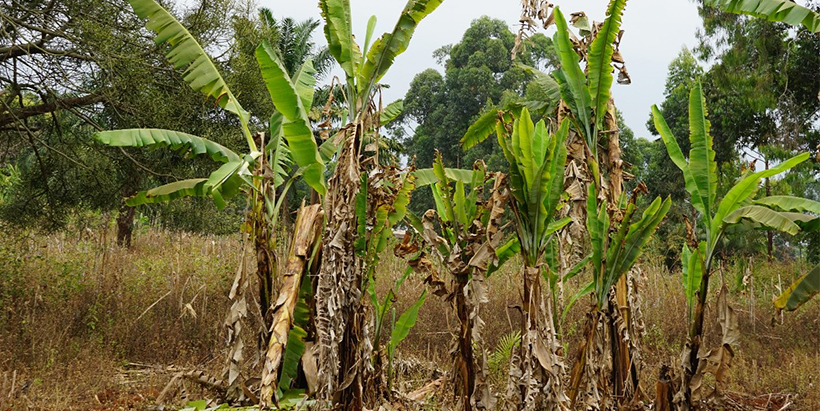
The emergence of the banana bunchy top virus (BBTV), responsible for the bunchy top disease, is causing havoc in the Kigoma region of Tanzania. The virus infection results in severe stunting and complete loss of fruit production. The infected plants degenerate in the field and eventually die due to extreme stress. BBTV spread through vegetative propagation of banana as well as by the aphid, Pentalonia nigronervosa, which is known to occur in all banana production regions.
In August, a team of scientists from IITA–CGIAR, Tanzania Plant Health and Pesticide Authority (TPHPA), and Tanzania Agricultural Research Institute (TARI) conducted a delimiting survey to assess the extent of BBTV spread in Kigoma and its impact on banana production. The ground situation suggests the unabated spread of the virus as farmers and local officials lack any knowledge about the new virus.
“Farmers used to harvest 40 to 80 bunches per month from their 2.5-acre farm, worth 400,000 to 800,000 Tsh at an average cost of 10,000 to 20,000 Tsh per bunch, depending on the size. Since the BBTD outbreak about two years ago, bananas have become scarce, and the selling price of bananas has doubled, becoming unaffordable to most families in the district,” said Mpoki Shimwela, a scientist from TARI.
Moreover, unaffected plants in the field are succumbing to another destructive disease, Banana Xanthomonas wilt (BXW), caused by the bacterium Xanthomonas vasicola pv. musacearum, which is endemic in the region and causing huge losses. This double challenge worries farmers as their banana plantations disappear and threaten their food and income security.
“Before the disease came, I used to harvest 60 ̶80 banana bunches per month from my 2.5-acre land. I had enough money to pay for my son’s education and employ people to work on my farm. Now, I must look for work to get money to buy bananas for my family,” commented Alex Baletse. He has lost most of his banana crop to BBTD and BXW.
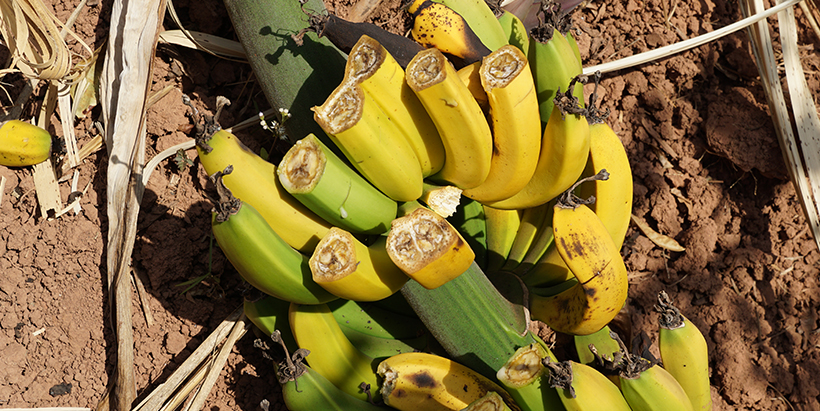
“From the interactions with farmers and extension officers, it is apparent there is a lack of awareness about the new virus, including symptoms, diagnosis, and control methods. We need to intensify efforts to disseminate information about disease symptoms and actions to prevent virus spread,” commented George Mahuku, IITA Plant Pathologist and the survey team lead.
The disease is spreading over long distances through infected planting materials. Farmers source the planting material from their neighbors or their own farm. “Seemingly healthy plants might be infected, as it takes time for disease symptoms to manifest,” said Lava Kumar, IITA Virologist who has been leading the BBTV ALLIANCE to contain the spread of the virus in sub-Saharan Africa. “This is why it is very important to test planting materials while multiplying to ensure that farmers are accessing only clean planting material,” he added.
As part of the CGIAR Plant Health Initiative, the IITA team is working with national partners to contain the spread of BBTV and recover banana production.
Contributed by George Mahuku and Lava Kumar
