
IITA NEWS

Catalyzing change through youth capacity building to unlock Africa’s soybean potential
January 12, 2026

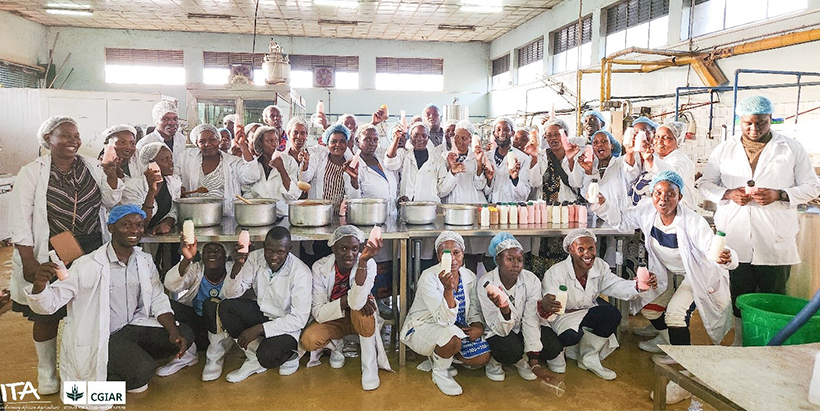
Participants pose for a group photo at the Makerere Food Technology and Business Incubation Centre (FTBIC) pilot plant.

In Uganda, value addition and product development are crucial for enhancing agribusiness competitiveness and sustainability. However, many youths and women in agri-food enterprises face challenges in processing, product formulation, and quality assurance, limiting their ability to meet market standards and scale their businesses. To address this, IITACGIAR, through the Technologies for African Agricultural Transformation (TAAT) Soybean Compact and ENABLE TAAT Youth Compact, in collaboration with Makerere University and Smart Foods Uganda Limited, organized a 5-day Training-of-Trainers (ToT) workshop on Food Processing and Value Addition under the TAAT Soybean project. This training hosted by Makerere University’s Department of Food Technology and Nutrition in Kampala, Uganda brought together 60 youths, women and men. The training objectives were multifaceted, focusing on strengthening technical skills in formulating diverse soy-based products, building knowledge and competencies in Good Hygiene and Manufacturing Practices (GHP/GMP), and equipping trainees with practical experience in the manufacturing of soy-based products.
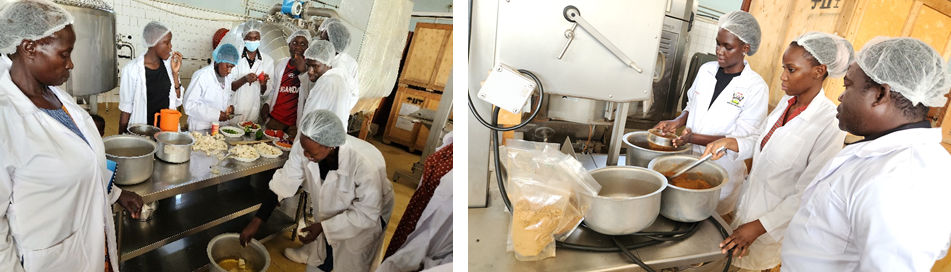
Participants learning how to prepare soy fortified "Daddies".
Participants learning how to prepare soy fortified “Daddies”.

Africa strategy (2016-2025) aims to boost agricultural productivity across Africa by rapidly delivering proven technologies to millions of farmers. TAAT also seeks to generate an additional 120 million metric tons (MT) of agricultural produce and improve the livelihoods of over 40 million smallholder farmers across Africa by 2025. Specifically, the TAAT Soybean Compact focuses on building capacity and providing technical assistance to National Agricultural Research and Extension Services (NARES) and the private sector, enhancing soybean production and productivity for improved nutrition and income.
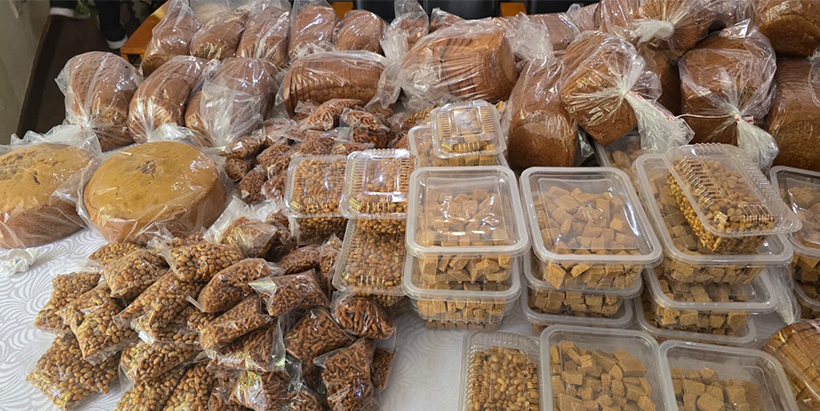
Soy fortified products made by the trainees.

The training utilized a mix of theoretical instruction and rigorous hands-on practical sessions in the Makerere Food Technology and Business Incubation Centre (FTBIC) pilot plants, covering various aspects of soy-based product manufacturing. Experts emphasized the delicate balance of temperature and ratios required for dairy alternatives, protein concentration and coagulation techniques, and fortifying common snacks with soy flour to increase nutritional value. Participants learned about soy milk and yoghurt processing, using a ratio of 1 cup of soybean to 6 cups of water, and pasteurizing the milk at 90°C to 100°C to inactivate trypsin inhibitors and destroy harmful microorganisms. They also learned about tofu production, focusing on protein concentration and coagulation techniques, including the use of Magnesium Chloride as a coagulant. Additionally, participants learned about soy-enriched baking, experimenting with substitution levels of soy flour in bread and snacks, and dry processing of soy flour and coffee, involving roasting, grinding, and hygienic packaging.
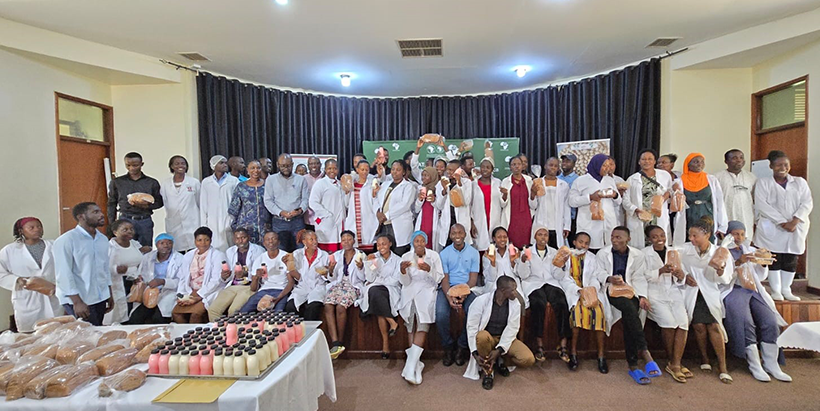
Trainees graduate and pose to showcase the soy-based products they made.

Facilitators emphasized the importance of collaboration, innovation, and food safety, setting the stage for a new wave of agripreneurs to make their mark. Martin Ssali, Director of Smart Foods Ltd, encouraged young minds to adopt a mindset of abundance, reminding them that “there is enough space for everyone to fly,” and urging them to collaborate rather than compete. Prof. Ivan Mukiisa Muzira, Head of the Department of Food Technology and Nutrition at Makerere University, drove home the crucial point that food safety is the cornerstone of the food business, extending an open invitation to participants to utilize the university’s facilities, saying, “This equipment belongs to you… Don’t let that knowledge stay in those books.”
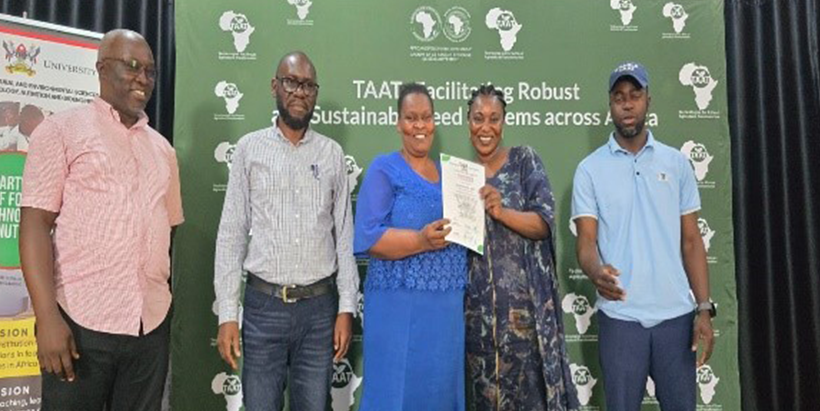
Certificates being awarded to trainees.

Emphasizing the power of partnerships, John Obaniyi of IITA-ENABLE TAAT Youth Compact challenged participants to innovate and compete with established brands, noting, “Starting alone might be challenging.’ ‘What happens when you have a partner? You can share the burden.”

The way forward involves the youth translating the skills and knowledge gained from the training program into viable agribusiness ventures. Participants are expected to start small-scale production using the formulations developed, leveraging access to FTBIC equipment for initial production runs. Strategic partnerships with Makerere University and Smart Foods Ltd will provide market connections and opportunities for growth. A monitoring and learning framework will track performance, technology adoption, and enterprise growth, guiding future interventions and scaling strategies. With this support, the 60 certified trainers are poised to make a significant impact on their communities, contributing to the growth of the soybean value chain and improving nutrition and income levels.

Contributed by Moureen Awori (IITA-Uganda), Welissa Mulei (IITA-Kenya/TAAT), Beckie Nakabugo (IITA-Uganda/TAAT), Oluwaseun Omikunle (IITA-Nigeria/TAAT), John Obaniyi (IITA-Nigeria/TAAT), Ivan Mukiisa Muzira (Makerere University) and Martin Ssali (Smart Foods Ltd).


Contributed by

Related news

No items found

Leave a Reply

Your email address will not be published. Required fields are marked *

Scroll to Top
Olaosebikan, Olamide

Olamide Deborah Nwanze is a Senior Research Associate specializing in gender mainstreaming research to inform participatory and inclusive breeding, variety development, and seed systems policies regarding root, tuber, and banana (RTB) crops in the International Institute of Tropical Agriculture Headquarters, Ibadan, Nigeria. She is a PhD candidate at the University of Ibadan and holds an MSc and B. Agric in Agricultural Extension and Rural Development. Olamide is a fellow of the African Women in Agricultural Research and Development – Gender Responsive Agricultural Systems Policy (AWARD-GRASP) and the Gender Responsive Researchers Equipped for Agricultural Transformation (GREAT). She seeks to apply her gender-mainstreaming learnings, gender-responsive research, and policy development, and review expertise to facilitate women, youth, children, and vulnerable social group’s access to and adoption of agricultural Innovations that guarantee food, nutrition, income, and livelihood security in Africa. Her current roles include mentoring research fellows, development of guides and training manuals, implementation and adaptation of gender frameworks and tools, value chain actors’ engagement as citizen science partners, policy review and redesign, data management, and analysis. Her current research explores mixed methods and participatory and interdisciplinary approaches to capture and highlight gender dynamics, needs, preferences, and challenges stakeholders face within the agricultural livelihood value chain to prioritize gender-inclusive strategies in breeding programs, policy design, and implementation.

At IITA, she contributes to the implementation of the CGIAR Accelerated Breeding Initiative and Genetic Innovation Programs; participatory and gender research within the NextGen CassavaHarvestPlusRTBFoods, and Tricot-ClimMob 1000Farms Projects; and gender knowledge communication via the G-LENS webinar series, video documentary, policy briefspublications, and blogs.


Recent publications

de Sousa, K., van Etten, J., Manners, R. Bello, A., Teeken, B., Olaosebikan, O., et al. 2024. The tricot approach: an agile framework for decentralized on-farm testing supported by citizen science. A retrospective. Agron. Sustain. Dev. 44, 8. https://doi.org/10.1007/s13593-023-00937-1

Madu, T., Onwuka, S., Nwafor, S., Onyemauwa, N., Ejechi, M., Ofoeze, M., Ukeje, B., Eluagu, C., Olaosebikan, O., Okoye, B., 2024. Gender-Inclusive Consumer Studies Improve Cassava Breeding in Nigeria in: Frontiers in Sociology, volume 9, number: 1224504, doi: 10.3389/fsoc.2024.1224504

Olaosebikan, O.; Bello, A.; Utoblo, O.; Okoye, B.; Olutegbe, N.; Garner, E.; Teeken, B.; Bryan, E.; Forsythe, L.; Cole, S.; Madu, T. 2023.  Stressors and Resilience within the Cassava Value Chain in Nigeria: Preferred Cassava Variety Traits and Response Strategies of Men and Women to Inform Breeding. Sustainability 15, 7837. https://doi.org/10.3390/su15107837

Okoye, B., Ofoeze, M., Ejechi, M., Onwuka, S., Nwafor, S., Onyemauwa, N., Ukeje, B., Eluagu, C., Obidiegwu, J.*, Olaosebikan, O., Madu, T.* 2023. Prioritizing preferred traits in the yam value chain in Nigeria: a gender situation analysis in: Frontiers in Sociology, volume 8, number: 1232626, pages 1 – 9, ISSN 2297-7775, 2023. https://www.frontiersin.org/articles/10.3389/fsoc.2023.1232626/full

Olaosebikan, O., Bello, A. A., de Sousa, K., Ndjouenkeu, R., Adesokan, M., Alamu, E. O., Agbona, A., van Etten, J., Kegah, F. N.*, Dufour, D., Bouniol, A., Teeken, B. 2023. Consumer acceptability of cassava gari-eba food products across cultural and environmental settings using the triadic comparison of technologies approach (tricot) in: Journal of the Science of Food and Agriculture,

Teeken, B., Olaosebikan, O., Bello, A. A., Madu, T.*, Cole, S. M. 2023. Qualitative assessment on the positionality and preferences of dyads in relation to cassava-related activities: working with tricot trial citizen scientists https://hdl.handle.net/10568/138326 Type: Manual

Bouniol, A., Ceballos, H., Bello, A. A., Teeken, B., Olaosebikan, O., Owoade, D., Agbona, A., Fotso Kuate, A., Madu, T.*, Okoye, B.*, Ofoeze, M.*, Nwafor, S.*, Onyemauwa, N.*, Adinsi, L.*, Forsythe, L., Dufour, D. 2023. Varietal impact on women’s labour, workload and related drudgery in processing root, tuber and banana crops: focus on cassava in sub-Saharan Africa in: Journal of the Science of Food and Agriculture, pages 1 – 25, ISSN 0022-5142,

Bello, A. A., Agbona, A., Olaosebikan, O., Edughaen, G., Dufour, D., Bouniol, A., Iluebbey, P., Ndjouenkeu, R.*, Rabbi, I. Y., Teeken, B. 2023. Genetic and environmental effects on processing productivity and food product yield: drudgery of women’s work in: Journal of the Science of Food and Agriculture, pages 1 – 32, ISSN 0022-5142, 5

Cavicchioli, M., Zimbiti, T., Teeken, B., Nwanze, D.O., Liani, M., Parkes, E. & Bello, A. 2023. IITA-Gender Responsive Breeding Training Report. Genetic Resources Center, IITA-HQ, Ibadan, 21-23 September, 2022. Ibadan, Nigeria: IITA, (34 p.).https://hdl.handle.net/10568/131368

Agbona, A. Peteti P., Teeken B., Olaosebikan O. Bello, A. A., Parkes, E., Rabbi, I. Y., Mueller, L., Egesi, C., Kulakow, P. 2022. Data Management in Multi-disciplinary African RTB Crop Breeding Programs. In: Williamson, H.F., Leonelli, S. (eds) Towards Responsible Plant Data Linkage: Data Challenges for Agricultural Research and Development. Springer, Cham. https://doi.org/10.1007/978-3-031-13276-6_5

Lora Forsythe, Pricilla Marimo, Sarah Mayanja, Olamide D. Olaosebikan, Esme Stuart, Bela Teeken, Benjamin Okoye, Tessy Madu, (2021). Cross-product Gender Analysis of RTBfoods Step 2 Gendered Food Mapping on RTB Products. Understanding the Drivers of Trait Preferences and the Development of Multi-user RTB Product Profiles, WP1. London, UK: RTBfoods Field Scientific Report, 30 p.

Teeken, B., Garner, E., Agbona, A., Balogun, I., Olaosebikan, O., Bello, A., Madu, T., Okoye, B., Egesi, C., Kulakow, P. and Tufan, H.A. 2021. Beyond “Women’s Traits”: Exploring How Gender, Social Difference, and Household Characteristics Influence Trait Preferences. Frontiers Sustainable Food Systems 5:740926. https://doi.org/10.3389/fsufs.2021.740926

Teeken, B., Agbona, A., Bello, A., Olaosebikan, O., Alamu, E., Adesokan, M., Awoyale, W., Madu, T., Okoye, B., Chijioke, U., Owoade, D., Okoro, M., Bouniol, A., Dufour, D., Hershey, C., Rabbi, I., Maziya‐Dixon, B., Egesi, C., Tufan, H. and Kulakow, P. (020. Understanding cassava varietal preferences through pairwise ranking of gari‐eba and fufu prepared by local farmer–processors. Int J Food Sci Technol. https://doi.org/10.1111/ijfs.14862

Bela Teeken, Olamide Olaosebikan, Ireti Balogun, Benjamin Okoye, Tessy Madu, Steven Cole, Abolore Bello, Elizabeth Parkes. (2020). Piloting the G+ customer and product profile tools for gender-responsive cassava breeding in Nigeria. Nigeria: International Institute of Tropical Agriculture (IITA). https://hdl.handle.net/20.500.11766/13000