
During the International Rice Festival held in Can Tho, Vietnam, in December 2023, the MARD recognized CGIAR, the International Rice Research Institute (IRRI), and the CGIAR Excellence in Agronomy (EiA) Initiative for their outstanding contributions to the sustainable development of Vietnam’s agriculture and rural development sector. The award was handed over at the Strategic Cultivation Management for Climate Change Adaptation and Mitigation in Vietnam on 14 December, in Can Tho City, at the workshop held to share experiences on the innovations and excellence in agronomy for adaptation to climate change and reduction of greenhouse gas emissions in rice industry of Viet Nam. The workshop attendees deliberated on sustainable advancements in rice production and innovative agronomy practices within the Mekong Delta.
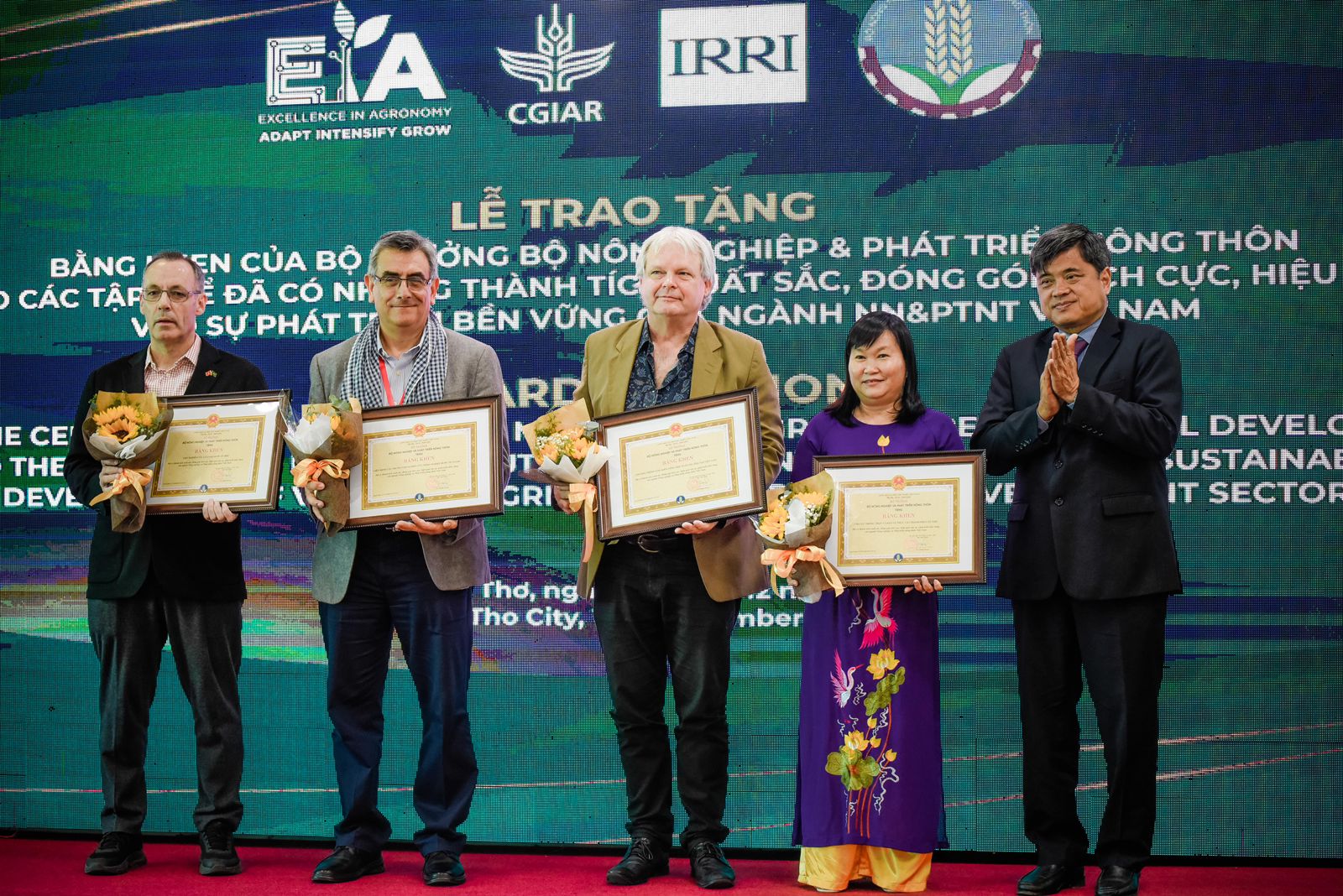
The recognition of EiA, IRRI, and CGIAR was an acknowledgment of the initiative’s integral role in Vietnam’s rice production and a testament to the transformative power of collaboration and innovation in reshaping the global food system and the profound commitment shown by the Vietnamese government towards responsible and sustainable agriculture, mainly through rice production.
Vice Minister of Vietnam Ministry of Agriculture and Rural Development (MARD), Tran Thanh Nam, presented the award to IRRI, CGIAR EiA, and Can Tho’s sub-department of Crop Production and Plant Protection for their outstanding achievements and contribution to the sustainable development of Vietnam’s agriculture and rural development sector.
The participants included Vietnam’s scientists, policymakers, relevant stakeholders, nearly 100 scientists, and global EiA partners. Notably, the delegation from the Agriculture Department of the Republic of the Philippines was headed by the Undersecretary for Rice Industry Development of the Agriculture Department.
This event allowed scientists, policymakers, and relevant stakeholders to exchange information and experience in management strategies, solution development, and duplication for adaptive agriculture in Vietnam. The presentation and open dialogue with the participation of national and international scientists, managers, and private sector representatives was followed by a launching ceremony of MARD’s Decision on promulgation of the Technical Protocol and Manual on Mechanized Direct Seeding for Increased Productivity and Reduced GHG emission in Rice Production in the Mekong River Delta as supported by IRRI and the hand-over of the Manual to provincial Department of Agriculture and Rural Development, relevant research institutes, universities and related counterparts. This event stood as a testament to the effective scaling of EiA, showcasing the launch of the MDS handbook. This handbook, resulting from collaborative endeavors with the government, has been seamlessly integrated into policies and embraced for official governmental use.
Since 2021, IRRI has facilitated the Excellence in Agronomy Initiative in Vietnam to alleviate hunger and poverty, ensure food security, close the gender equality gap, conserve biodiversity, mitigate the effects of climate change, and contribute to “South-South” cooperation in agricultural science and technology development.
IRRI has been working with the Crop Production Department – Ministry of Agriculture and Rural Development to deploy technical packages based on mechanized direct seeding rice (mDSR) that help contribute to the target of Mekong River Delta’s “1 Must, 5 Reductions” practice, increasing efficiency and reducing greenhouse gas (GHG) emissions in rice production. Some notable activities include (i) developing technologies and verifying practical benefits from mDSR and (ii) building capacity and promoting mechanized direct seeding for improved productivity and reduced emissions in rice production in the Mekong River Delta.
Through this activity, IRRI has supported the Crop Production Department in developing Protocols on Mechanized Direct Seeding for Increased Effectiveness and Reduced GHG emissions in rice production in the Mekong River Delta and supported the demonstration of mDSR for more than 4,000 farmers in the Mekong River Delta.
Excellence in Agronomy has gained many outstanding achievements after three years of deployment in Vietnam that positively influence the development and promotion of mechanization in adaptive rice production. These innovative technologies are essential foundations for sustainable rice production and contribute to implementing the Project on sustainable development of high quality, low emission rice production associated with green growth in the Mekong River Delta by 2030 as hosted by the Ministry of Agriculture and Rural Development.
Aligned with the Vietnam-Africa Policy Dialogue’s principles, the Excellence in Agronomy Initiative aims to transform farming by enhancing productivity and profitability by 2030, nurturing soil health, and assisting smallholder farmers with agronomic gain, resource management, and climate-smart farming.
The EiA initiative is being implemented and scaled up by ten CGIAR centers in numerous regions in the world, aiming to support and replicate agronomy solutions for adaptation to climate change reduction in the affected countries. The CGIAR centers supporting the EiA represent a global force for agricultural transformation and include AfricaRice, Alliance of Bioversity and the International Center for Tropical Agriculture (CIAT), the International Maize and Wheat Improvement Center (CIMMYT), the International Potato Center (CIP), the International Center for Agricultural Research in the Dry Areas (ICARDA), the International Crops Research Institute for the Semi-Arid Tropics (ICRISAT), the International Rice Research Institute (IRRI), International Food Policy Research Institute (IFPRI), International Water Management Institute (IWMI) and International Institute of Tropical Agriculture (IITA). Their collective expertise and unwavering commitment are driving positive change, not just in Vietnam but across the globe.
Contributed by Barbra Sehlule Muzata
Contributed by
Recent stories