
Consumer demand emerging as catalyst for cassava breeding innovation
21 November 2025
(Source: Enoch et al., 2020)
In the world of crop improvement, consumer preferences are more than just opinions; they are powerful drivers of breeding innovation. For instance, cassava (Manihot esculenta) is a significant staple food across Africa. Beyond its role as a primary source of calories, cassava’s value addition processes help extend its shelf life, countering the rapid deterioration caused by its naturally high moisture content.
For breeders, understanding what consumers want is essential. In food products, consumer preference is measured by the level of acceptability, with specific quality traits determining whether a product will be embraced or rejected. In cassava, one culinary trait stands out above all others: Cassava Root Mealiness (CRM), the ability of boiled cassava roots to soften quickly, be easily chewed, and dissolve effortlessly upon biting. For many consumers, mealiness is the single most important attribute of boiled cassava.
Recognizing this, scientists have worked to enhance the culinary qualities of cassava varieties, encouraging their adoption by both farmers and consumers. In 2025, a study (Consumer Perception and Sensory Profiling of Cassava Mealiness Attributes using Hedonic, Just About Right (JAR), and Check-All-That-Apply (CATA) methods) evaluated four cassava varieties: danwarri, suppi, akpu, and dangbo.
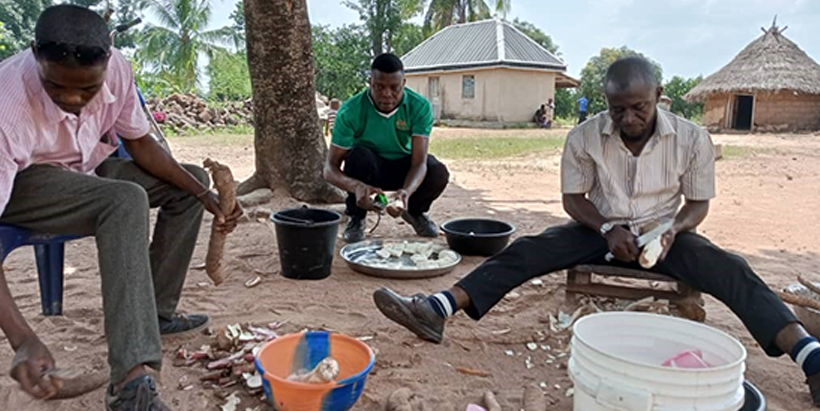
The study funded by the Gates Foundation and conducted by scientists from IITA-CGIAR in collaboration with Ladoke Akintola University of Technology (LAUTECH), Nigeria, worked to identify the specific mealiness attributes preferred by consumers and to evaluate the acceptability of various boiled cassava varieties.
The findings included:
- Hedonic and CATA results highlighted three key mealiness traits: dissolving easily, being easy to chew, and moderate softness, which were deemed the most important to consumers.
- JAR results showed that the softness and chewiness of certain varieties scored above 50%, indicating they were “just about right” for most respondents.
Among the varieties tested, danwarri and suppi emerged as the most preferred for boiling, meeting consumer expectations for mealiness and overall eating quality.

Ultimately, this research holds significant implications for cassava breeding programs. By aligning breeding objectives with consumer-driven traits, scientists can develop improved varieties that are not only high-yielding and resilient but also meet the sensory expectations of the people who eat them.
The study concludes with a recommendation that while danwarri and suppi are currently the best mealy cassava varieties for boiling, other varieties cultivated in South-West and South–South Nigeria, such as okoiyawo, odongbo, molekaga, and banada, should also be evaluated for their mealiness attributes to expand consumer preferences, market potential, and achieve food security.
Contributed by Anita Akinyomade
