
Danish embassy explores collaboration with IITA in Ghana
9 December 2025
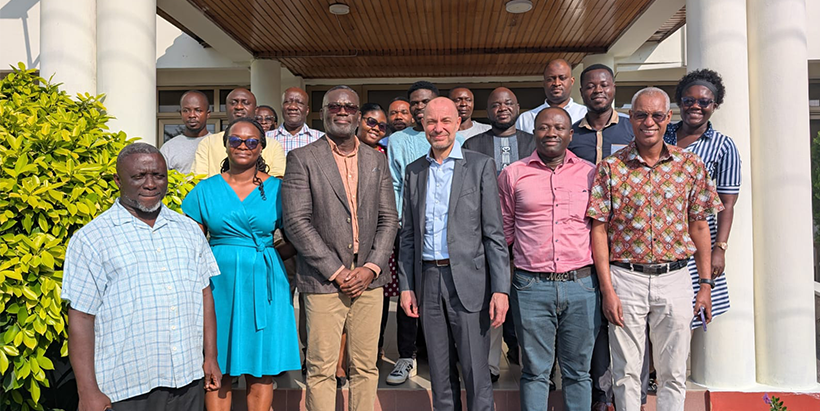
In a move to establish a strategic working relationship with the IITA–CGIAR, H. E. Jakob Linulf, the Danish Ambassador to Ghana, paid an official visit to the institute’s office in Accra, Ghana, on 1 December.
Linulf was welcomed by Dr Richard Asare, the IITA Country Representative for Ghana, Prof. Samuel Agyei-Nsiah, Dr Bekele Kotu, Dr Djana Mignouna, Dr Faustina Obeng-Adomaa, and the staff at the IITA Accra office.
In his welcome address, Dr Asare introduced IITA-CGIAR, highlighting its activities in the sub-Saharan regions of Africa. He indicated the importance of IITA’s collaborative work with the government of Ghana, the private sector, CSOs, and NGOs. He further highlighted the strategic work being conducted under various projects in Ghana. He identified the institute’s key areas, aligned with the CGIAR’s impact areas, namely Climate adaptation and mitigation, health and nutrition, system transformation, gender equality, youth, and social inclusion.
Following his address, he gave an update on the ongoing projects implemented by IITA in Ghana. The Sustainable Soybean Production in Northern Ghana (SSPiNG) project, implemented in 15 districts in Northern Ghana, and the BBEST project, which utilizes the BSF technology to provide new agricultural solutions to smallholder livestock and vegetable farmers, are both Norad-funded projects.
In addition to these, the AICCRA project funded by the World Bank works in collaboration with national and regional partners to transform climate services and to scale climate-smart agriculture, PROSSIVA works to enhance the efficiency and productivity of seeds system for vegetatively propagated crops, AKILIMO works to provide agronomic support to smallholder farmers and the Strengthening Rural Livelihoods, Resilience to Climate Change in Africa: Innovative Agroforestry Integrating People, Trees, Crops and Livestock (GALILEO) and the EU Food Security project, which is a response to food security in the Northern part of Ghana;
He also mentioned the importance of the Wassa Amenfi Cocoa Landscape Initiative and the Cocoa Agroforestry Systems for Resilient Smallholder Livelihoods in Ghana (CASILIENT), both of which are projects funded by the Danida Green Business Partnerships (DGBP).
Linulf provided an overview of the embassy’s portfolio in Ghana. He said, “The embassy focuses on the following areas: health, meteorological services, and water”. He added that the embassy works collaboratively with the government of Ghana.
One key highlight of this strategic meeting was discussing collaboration and cooperation between the institute and Danish Universities and companies.
Dr Asare highlighted a few challenges, including climatic conditions in northern Ghana, illegal mining, and rising cases of water pollution, as well as competition for land resulting from illegal mining, especially in cocoa-growing areas. He reaffirmed IITA’s commitment to collaborate with the Embassy of Denmark in Ghana.
Contributed by Francisca Ocloo
