
With recent outbreaks in Tanzania and Uganda, banana bunchy top disease (BBTD) emerged as a significant threat to banana crops in East Africa. The disease, caused by the banana bunchy top virus (BBTV), can lead to yield losses of 70 to 90% in the first season, with subsequent seasons seeing no bananas produced. Recent surveys have revealed the devastating consequences of BBTV’s spread and the threat of its rapid spread to previously unaffected areas in East Africa.
Growers and other stakeholders are unfamiliar with the symptoms of this new disease in the region, hindering early recognition. Furthermore, the dwarf and stumpy shoots of the virus-infected plants are often mistaken for young suckers, leading to further delays in identifying the disease and, worse, further spread when such shoots are harvested for replanting in new regions.
To address this challenge, IITA conducted a training workshop on “Diagnosis and detection of BBTV infection in banana” and “SOS for root, tuber and banana (RTB) crops in Africa: A regional surveillance and emergency response action to contain the banana bunchy top disease outbreak in East Africa” as part of the project. This project is funded by the USAID Innovation Lab for Current and Emerging Threats to Crops (CETC IL) led by Pennsylvania State University, USA, and the CGIAR Plant Health Initiative.
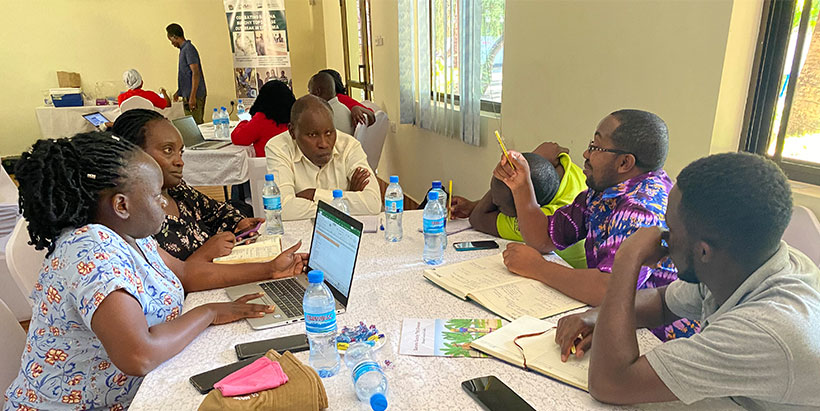
The workshop, held from 25 to 28 March at IITA’s East Africa hub offices in Dar es Salaam, Tanzania, aimed to equip participants with the necessary skills to diagnose BBTD-affected plants based on symptoms and using rapid, point-of-use diagnostic assays such as Recombinase Polymerase Amplification (RPA) and Loop-mediated Isothermal Amplification (LAMP), developed at IITA as part of the BBTV Alliance project.
The 21 trainees who attended the workshop were from Tanzania (TPHPA, TARI, and TAHA), Uganda (MAAIF and NARO), Kenya (KEPHIS), and private sector organizations such as PlantVillage, Crop Bioscience, and Maua Mzuri. The workshop aimed to strengthen diagnostic capabilities to support BBTV surveillance and banana seed health testing.
IITA Pathologist and Project Lead George Mahuku emphasized the importance of understanding and identifying the problem to manage it effectively. He said, “You cannot manage what you don’t know. Therefore, it is imperative to know where your enemy is located so that appropriate measures can be taken to manage the problem.”
The BBTV Alliance Lead and IITA Virologist, Lava Kumar, one of the key resource persons, urged the participants to use the acquired skills and knowledge to train others in their organizations and create a formidable disease diagnostic team in respective countries for early diagnosis and effective disease control.
The participants found the hands-on training on LAMP and RPA beneficial. They gained a deep understanding of various aspects of BBTV, including its biology, epidemiology, and methods for diagnosis and control. Participants were pleased with the training methods, particularly the group challenges, which created an excellent environment for learning through games.
This training is a critical input to the BBTV containment initiatives to safeguard banana-based value chains and food systems, preserve banana biodiversity, and protect livelihoods in the region.
Contributed by Gloriana Ndibalema
Contributed by
Recent stories