
IITA–CGIAR has partnered with the Ministry of Agriculture and Rural Development (MINADER) and the Food and Agricultural Organization (FAO) to release the Fall armyworm (FAW) egg parasitoid Telenomus remus in West Cameroon. The collaborators have been developing innovations to manage FAW in Cameroon.
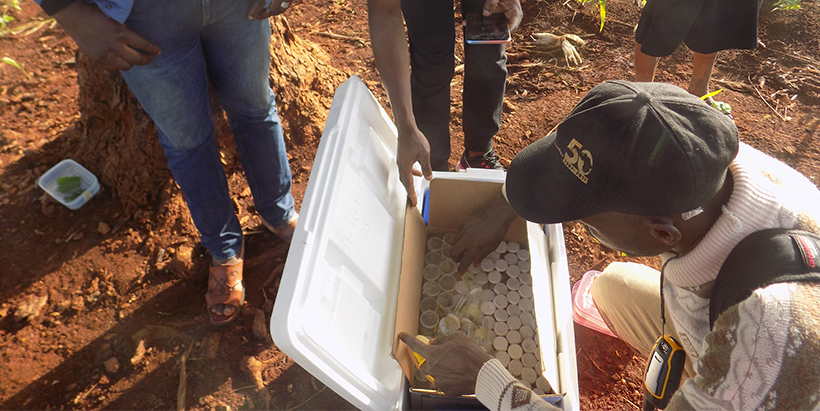
Through the One CGIAR’s Plant Health Initiative (PHI), the IITA-Cameroon IPM team, led by Komi Fiaboe, has identified several FAW natural enemies under the humid tropical forest and Sudano-Sahelian agroecologies of Cameroon. They established that the egg parasitoid Telonomus remus was the most aggressive, frequent, and widely distributed in farmer fields. Through joint funding of PHI and the FAO-funded Integrated Management Strategy for the Fall armyworm in Central Africa project, the parasitoid was collected from fields and mass-produced in the IITA Cameroon Entomology Laboratory under the leadership of IITA researcher Samuel Nanga Nanga.
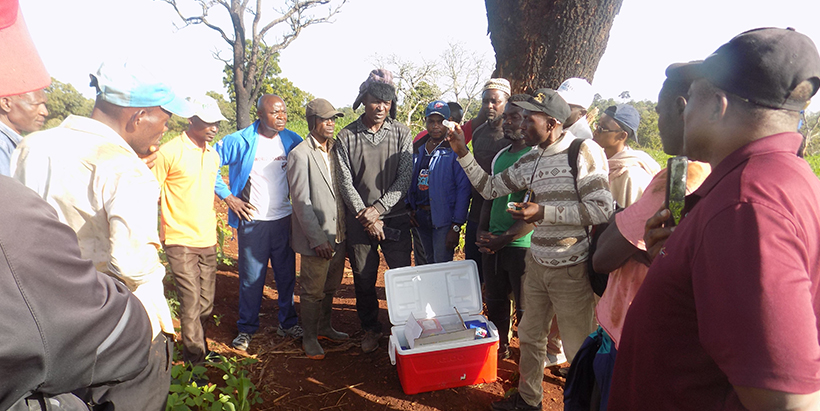
The current release aims to promote conservative and augmentative biological control in a small-scale maize production system. The first batch of 45,000 T. remus individuals was released from 3 to 5 October in Bangangte, Dschang, and Foumbot in the West Region of Cameroon by IITA researcher Albert Abang, in collaboration with Nguelo Collins from MINADER and Jeannette Florence Magni from FAO.
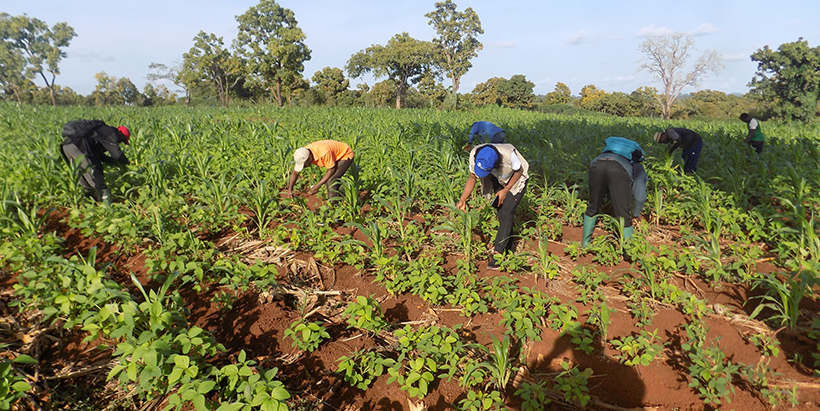
The release was witnessed by nine FAO and MINADER field trainers (seven men and two women) and 42 farmers (12 women). Forty-two farmers (30 men and 12 women) were trained on conserving natural enemies in the maize production system and on the ecosystem services rendered by those invisible friends. Specifically, farmers learned to identify FAW egg batches, differentiate the characteristics of parasitized eggs from non-parasitized ones, and recognize the
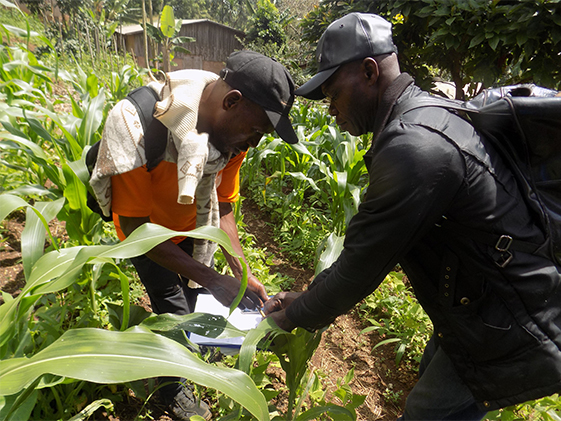
presence of natural enemies and the detrimental effect of broad-spectrum
pesticides on natural enemies.
The second release round will be conducted in the cropping season, and a similar release exercise is planned for the Centre Region of Cameroon. Post-release surveys will also be carried out to assess the improvement of egg parasitism rates. According to Abang, this release, the first of its kind in the Central Africa region, is expected to create awareness of conservative biological control of major pests in the maize production systems among farmers and extension officers.
Contributed by Dr Komi Fiaboe
Contributed by
Recent stories