
One of the vast benefits of the IITA forest reserve is the diversity of creatures the forest supports and protects from poaching and extinction. The IITA Forest Center carries out biodiversity monitoring, tree propagation, and other environmental protection activities. The Forest Center staff observe and record plant phenology and animals during occasional walks and regular scientific data collection.
During one of the recent biodiversity conservation walks, Field Supervisor Ademola Ajayi spotted an African House Snake (Boaedon fuliginosus). This snake is non-venomous and harmless to humans. It has aglyphus teeth—simple round, uniform teeth that are solid and have no grooves or specialized venom-injecting fangs.
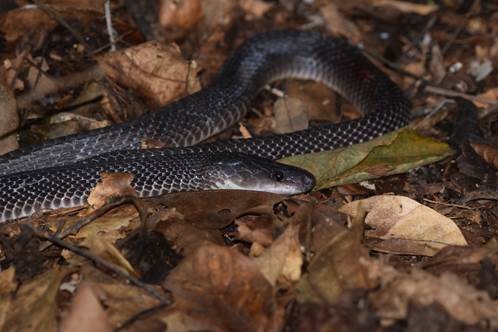
The African House Snake is widely distributed across sub-Saharan Africa, exploiting different habitats, including gardens, forests, scrubland, woodland, savanna, and montane regions. The snake is widely kept and bred as a pet by reptile and amphibian lovers because of its small size, placid demeanor, and preference for rodents, small lizards, and birds. The African House Snake is sexually dimorphic, meaning males and females can be distinctly differentiated.
Snake bites are well-known occupational hazards among farmers, field workers, and home gardeners. While there are about 3,000 snake species worldwide, only 15% are considered dangerous to humans. Most snakes only try to bite when they are cornered or frightened. They are generally more scared of humans than humans are of them.
While the African House Snake is harmless, Ajayi promotes general safety guidelines to protect oneself from snake bites. He says, “When walking along bush paths, tap ahead with a walking stick to scare them off. And wear long trousers and boots.”
In the event of unforeseen snake bites, he urges, “Do not cut the bitten area or try to suck the venom out of the wound.” He advises against using a tourniquet or trying to catch the snake. “Calm the patient down and ask them not to move. Then use a pressure bandage or cloth to apply pressure without stopping the blood supply to the limb,” he continues.
“Call for an ambulance, record the time of the bite and when the bandage was applied. Stay with the victim to ensure blood keeps circulating in the victim until the ambulance arrives,” he concludes.
Contributed by
Recent stories