
NEWS

IITA joins with Tanzania’s Ministry of Agriculture to organize starch stakeholders’ meeting to expand cassava commercialization
January 14, 2022

As part of efforts to realize the national cassava commercialization strategy, IITA, through the BEST Cassava project, co-organized a starch meeting with the Ministry of Agriculture under the Honorable Minister, Professor Adolf Mkenda. The meeting brought together cassava producers, starch processors, importers, and various institutions in trade and regulatory bodies.
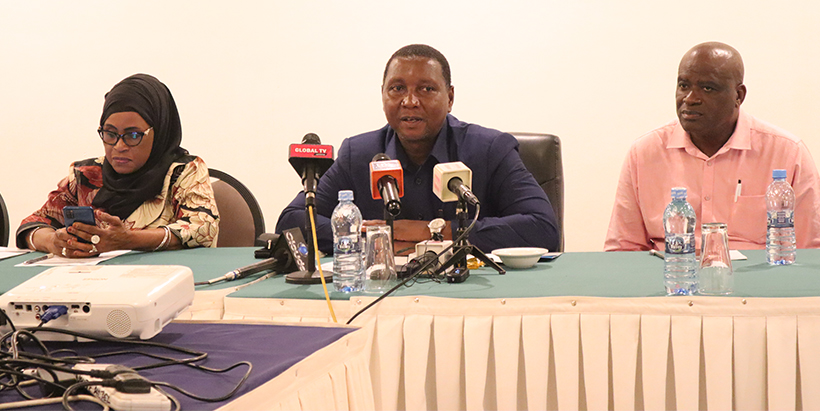
Minister of Agriculture, Hon prof Adolf Mkendi (centre), addressing the meeting participants. He is flanked by the Chairperson of Tanzania Cassava Producers and Processors Association (TACAPPA) Ms Mwantumu Mahiza (right) and MP, Handeni Rural, Hon. John Michael Sallu (left).

The objective of the meeting was to facilitate discussion to understand the starch needs of importers and identify market opportunities available for cassava producers, creating demand for commercialized, high-quality planting material of superior cassava varieties. The event took place on 30 November in Dar es Salaam and was graced by the Hon Minister.

The Minister said he had convened the meeting to learn from the starch importers their needs in terms of quality and quantity. This information will help the cassava producers to meet the market demands and reduce importation.
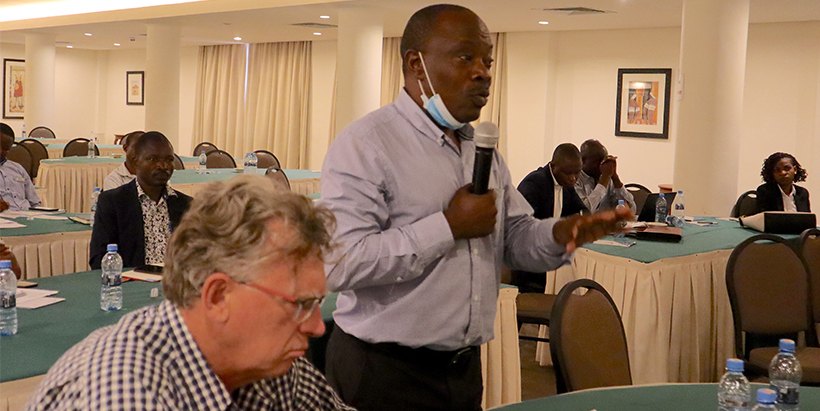
Freddy Baijukya, IITA’s coordinator for ACAI project making a contribution during the event.

Upendo Mndeme, the Ministry’s cassava desk officer, indicated that the event is part of efforts to commercialize cassava in the country, as spelled out in the recently launched National Cassava Development Strategy. IITA, through her BEST Cassava project, played a key role in its development, publication, and launching.

“Currently, most cassava grown in Tanzania is for home consumption, yet it has great potential as a cash crop and can improve lives of rural communities,’’ said Regina Kapinga, BEST Cassava Project Leader and Head of Advocacy and Resource Mobilization Unit. Furthermore, she said researchers had developed high-yielding improved varieties with moderate to high-starch content.

“The presentation made jointly by IITA and the Tanzania Agricultural Research Institute (TARI) showed clearly that many released cassava varieties have high dry matter content and so can be a good source of starch. And if we are searching for cassava market, then the first place is the domestic market, and one such product is cassava starch,” said the Minister.

Dr Esther Masumba, a cassava breeder and national root/tuber crops coordinator from TARI, indicated that the new varieties could be processed into quality starch used for food, textile, and pharmaceutical purposes due to low amylose content.

Victor Kabegu, a youth businessman and Chief Executive Officer of JV Biotech, a starch processing factory, said the three criteria for starch importers were the consistency of supply, quality, and the types of starch.

Victor noted that most starch processors produce native starch instead of modified starch primarily used in industries. He suggested that the producers invest more in modified starch.

“The starch importers need to tell us the quality they need so that we can improve starch production. IITA and TARI have done a good job of training and supporting us on good agronomic practices of cassava production, and I am sure they will not abandon us now. We are ready to learn and invest just as we were taught on cassava production,” said Sharifa Abebe, a cassava producer, and processor from Handeni District.

During the meeting, stakeholders suggested that cassava farmers be equipped with an agripreneur mindset and support with mechanization. “We need mechanization and processing of cassava to reduce food loss on the farm. Also, invest in cassava warehouse just like those we have for other crops,” recommended Frederick Baijukya, Agronomy scientist at IITA.

The stakeholders appreciated the opportunity to brainstorm with the government on challenges currently facing cassava farmers and starch importers. “This meeting was useful because it gave us the chance to brainstorm with policymakers on how cassava can reduce starch importation costs. Therefore, I call upon the youth to grab the opportunity in cassava production,” explained Victor Kabegu.

The BEST Cassava project seeks to develop Tanzania’s commercial cassava seed system. Through the commercial seed system, farmers will have timely access to quality-declared, disease-resistant, and disease-tolerant varieties in the right quantities and at a price they can afford. The adoption of these superior varieties will support farmers in producing high-yielding cassava in the face of increasing disease pressure.


Contributed by

Recent stories

No items found

Leave a Reply

Your email address will not be published. Required fields are marked *

Scroll to Top
Olaosebikan, Olamide

Olamide Deborah Nwanze is a Senior Research Associate specializing in gender mainstreaming research to inform participatory and inclusive breeding, variety development, and seed systems policies regarding root, tuber, and banana (RTB) crops in the International Institute of Tropical Agriculture Headquarters, Ibadan, Nigeria. She is a PhD candidate at the University of Ibadan and holds an MSc and B. Agric in Agricultural Extension and Rural Development. Olamide is a fellow of the African Women in Agricultural Research and Development – Gender Responsive Agricultural Systems Policy (AWARD-GRASP) and the Gender Responsive Researchers Equipped for Agricultural Transformation (GREAT). She seeks to apply her gender-mainstreaming learnings, gender-responsive research, and policy development, and review expertise to facilitate women, youth, children, and vulnerable social group’s access to and adoption of agricultural Innovations that guarantee food, nutrition, income, and livelihood security in Africa. Her current roles include mentoring research fellows, development of guides and training manuals, implementation and adaptation of gender frameworks and tools, value chain actors’ engagement as citizen science partners, policy review and redesign, data management, and analysis. Her current research explores mixed methods and participatory and interdisciplinary approaches to capture and highlight gender dynamics, needs, preferences, and challenges stakeholders face within the agricultural livelihood value chain to prioritize gender-inclusive strategies in breeding programs, policy design, and implementation.

At IITA, she contributes to the implementation of the CGIAR Accelerated Breeding Initiative and Genetic Innovation Programs; participatory and gender research within the NextGen CassavaHarvestPlusRTBFoods, and Tricot-ClimMob 1000Farms Projects; and gender knowledge communication via the G-LENS webinar series, video documentary, policy briefspublications, and blogs.


Recent publications

de Sousa, K., van Etten, J., Manners, R. Bello, A., Teeken, B., Olaosebikan, O., et al. 2024. The tricot approach: an agile framework for decentralized on-farm testing supported by citizen science. A retrospective. Agron. Sustain. Dev. 44, 8. https://doi.org/10.1007/s13593-023-00937-1

Madu, T., Onwuka, S., Nwafor, S., Onyemauwa, N., Ejechi, M., Ofoeze, M., Ukeje, B., Eluagu, C., Olaosebikan, O., Okoye, B., 2024. Gender-Inclusive Consumer Studies Improve Cassava Breeding in Nigeria in: Frontiers in Sociology, volume 9, number: 1224504, doi: 10.3389/fsoc.2024.1224504

Olaosebikan, O.; Bello, A.; Utoblo, O.; Okoye, B.; Olutegbe, N.; Garner, E.; Teeken, B.; Bryan, E.; Forsythe, L.; Cole, S.; Madu, T. 2023.  Stressors and Resilience within the Cassava Value Chain in Nigeria: Preferred Cassava Variety Traits and Response Strategies of Men and Women to Inform Breeding. Sustainability 15, 7837. https://doi.org/10.3390/su15107837

Okoye, B., Ofoeze, M., Ejechi, M., Onwuka, S., Nwafor, S., Onyemauwa, N., Ukeje, B., Eluagu, C., Obidiegwu, J.*, Olaosebikan, O., Madu, T.* 2023. Prioritizing preferred traits in the yam value chain in Nigeria: a gender situation analysis in: Frontiers in Sociology, volume 8, number: 1232626, pages 1 – 9, ISSN 2297-7775, 2023. https://www.frontiersin.org/articles/10.3389/fsoc.2023.1232626/full

Olaosebikan, O., Bello, A. A., de Sousa, K., Ndjouenkeu, R., Adesokan, M., Alamu, E. O., Agbona, A., van Etten, J., Kegah, F. N.*, Dufour, D., Bouniol, A., Teeken, B. 2023. Consumer acceptability of cassava gari-eba food products across cultural and environmental settings using the triadic comparison of technologies approach (tricot) in: Journal of the Science of Food and Agriculture,

Teeken, B., Olaosebikan, O., Bello, A. A., Madu, T.*, Cole, S. M. 2023. Qualitative assessment on the positionality and preferences of dyads in relation to cassava-related activities: working with tricot trial citizen scientists https://hdl.handle.net/10568/138326 Type: Manual

Bouniol, A., Ceballos, H., Bello, A. A., Teeken, B., Olaosebikan, O., Owoade, D., Agbona, A., Fotso Kuate, A., Madu, T.*, Okoye, B.*, Ofoeze, M.*, Nwafor, S.*, Onyemauwa, N.*, Adinsi, L.*, Forsythe, L., Dufour, D. 2023. Varietal impact on women’s labour, workload and related drudgery in processing root, tuber and banana crops: focus on cassava in sub-Saharan Africa in: Journal of the Science of Food and Agriculture, pages 1 – 25, ISSN 0022-5142,

Bello, A. A., Agbona, A., Olaosebikan, O., Edughaen, G., Dufour, D., Bouniol, A., Iluebbey, P., Ndjouenkeu, R.*, Rabbi, I. Y., Teeken, B. 2023. Genetic and environmental effects on processing productivity and food product yield: drudgery of women’s work in: Journal of the Science of Food and Agriculture, pages 1 – 32, ISSN 0022-5142, 5

Cavicchioli, M., Zimbiti, T., Teeken, B., Nwanze, D.O., Liani, M., Parkes, E. & Bello, A. 2023. IITA-Gender Responsive Breeding Training Report. Genetic Resources Center, IITA-HQ, Ibadan, 21-23 September, 2022. Ibadan, Nigeria: IITA, (34 p.).https://hdl.handle.net/10568/131368

Agbona, A. Peteti P., Teeken B., Olaosebikan O. Bello, A. A., Parkes, E., Rabbi, I. Y., Mueller, L., Egesi, C., Kulakow, P. 2022. Data Management in Multi-disciplinary African RTB Crop Breeding Programs. In: Williamson, H.F., Leonelli, S. (eds) Towards Responsible Plant Data Linkage: Data Challenges for Agricultural Research and Development. Springer, Cham. https://doi.org/10.1007/978-3-031-13276-6_5

Lora Forsythe, Pricilla Marimo, Sarah Mayanja, Olamide D. Olaosebikan, Esme Stuart, Bela Teeken, Benjamin Okoye, Tessy Madu, (2021). Cross-product Gender Analysis of RTBfoods Step 2 Gendered Food Mapping on RTB Products. Understanding the Drivers of Trait Preferences and the Development of Multi-user RTB Product Profiles, WP1. London, UK: RTBfoods Field Scientific Report, 30 p.

Teeken, B., Garner, E., Agbona, A., Balogun, I., Olaosebikan, O., Bello, A., Madu, T., Okoye, B., Egesi, C., Kulakow, P. and Tufan, H.A. 2021. Beyond “Women’s Traits”: Exploring How Gender, Social Difference, and Household Characteristics Influence Trait Preferences. Frontiers Sustainable Food Systems 5:740926. https://doi.org/10.3389/fsufs.2021.740926

Teeken, B., Agbona, A., Bello, A., Olaosebikan, O., Alamu, E., Adesokan, M., Awoyale, W., Madu, T., Okoye, B., Chijioke, U., Owoade, D., Okoro, M., Bouniol, A., Dufour, D., Hershey, C., Rabbi, I., Maziya‐Dixon, B., Egesi, C., Tufan, H. and Kulakow, P. (020. Understanding cassava varietal preferences through pairwise ranking of gari‐eba and fufu prepared by local farmer–processors. Int J Food Sci Technol. https://doi.org/10.1111/ijfs.14862

Bela Teeken, Olamide Olaosebikan, Ireti Balogun, Benjamin Okoye, Tessy Madu, Steven Cole, Abolore Bello, Elizabeth Parkes. (2020). Piloting the G+ customer and product profile tools for gender-responsive cassava breeding in Nigeria. Nigeria: International Institute of Tropical Agriculture (IITA). https://hdl.handle.net/20.500.11766/13000