
IITA partners with Malawi government and key stakeholders to strengthen food security
17 November 2025
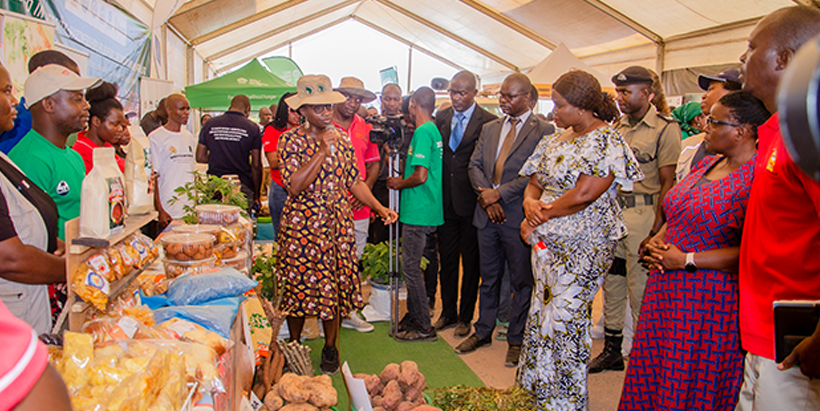
As part of efforts to reinforce partnership and policy engagement, IITA–CGIAR joined the government and partners in Malawi to commemorate the joint African Day for Food and Nutrition Security and World Food Day. Exhibitions and presentations by IITA-CGIAR were tailored to promote Aflasafe to control aflatoxins – food safety and nutrition), and the consumption of alternative underutilized crops of cassava, soybean, and cowpea, to help transform lives.
Briefing the Minister of Agriculture, Irrigation, and Water Development, Hon. Rosa Fatch Mbilizi and partners at the event, IITA Country Representative, Dr Sika Gbegbelegbe, highlighted various research interventions and how IITA-CGIAR has, over the years, been a source of cross-cutting agricultural innovations and technologies, helping farmers in Malawi to overcome poverty and achieve food security.
In Malawi, IITA-CGIAR has a proven track record of research targeting crops such as cassava, soybeans, cowpeas, and bananas.
At the commemoration, IITA-CGIAR displayed cassava roots alongside various mouth-watering cassava-based snacks, including cassava zigege, donuts made with 80 percent high-quality cassava flour, chin-chin, and other snacks. The snacks were provided by Ellen’s Kitchen, a small-medium enterprise currently operating in Lilongwe.
IITA and its partners are promoting cassava as a crop and diet diversification in Malawi with support from the Embassy of Ireland under the Roots and Tuber Crops (RTC)-MARKETS project.
Soybean breeding conducted by IITA and its partners has led to the recent release of high-yielding and resilient Soybean varieties: Chitedze 4, a rust-resistant variety with a yield potential of 4,000 kg/ha; and Chitedze 6, a rust-tolerant variety with a potential yield of 3,000 kg/ha. IITA’s soybean breeding program promotes improved and adapted technologies for smallholder farmers in sub-Saharan Africa.
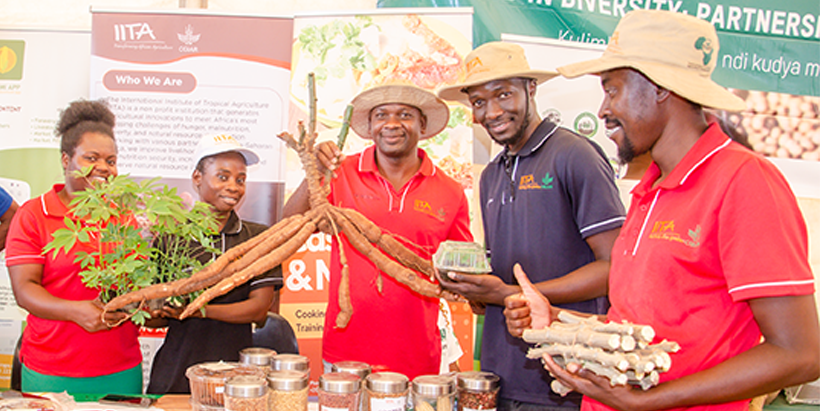
Through the Roots and Tuber Crops-Markets project, IITA is collaborating with the International Potato Center to improve the market-led development of roots and tuber crops, including cassava, sweet potato, and potato.
At the commemoration of World Food Day and African Day for Food and Nutrition Security, IITA and CIP – both CGIAR centers, mounted a united stand to showcase food products and improved varieties of cassava, potatoes, sweet potatoes, soybeans, and cowpeas. IITA showcased the newly released line of Chinangwa 3, which is high-yielding and disease-tolerant. With climate change posing an existential threat to human well-being, it has become a prerequisite for farmers to adapt and adopt proven, climate-smart practices.
At IITA’s exhibition stand, products made from cassava, soybean, and cowpea were on display to show value addition efforts. Visiting the IITA stand, the Minister of Agriculture, Irrigation, and Water Development, flanked by government officials and partners that included the World Food Programme (WFP), Food and Agriculture Organization (FAO) and International Fund for Agricultural Development (IFAD), expressed happiness to see how IITA is working with farmers and small and medium enterprises in translating research to tangible development.
“With the prevailing economic situation, we are working hand in hand with partners to promote the consumption of alternative underutilized crops of Soybean, Cassava, and cowpea. This is why we are also a leading research institute under the CGIAR in developing and promoting new technologies that are climate change adaptive and beneficial to our farmers,” said Dr Gbegbelegbe.
Dr Gbegbelegbe further emphasized the importance of collaboration with partners in genetic innovation and the development of resilient agrifood systems, which has driven the release and promotion of improved innovations, including Aflasafe. She acknowledged that legumes alone cannot achieve nutritional security, which makes it essential for IITA-CGIAR to collaborate with other stakeholders in a coordinated effort.
The commemoration was held at a remote site in Dedza, 100 kilometers from the capital city of Lilongwe, offering an opportunity for agricultural players to interact with rural farmers and showcase various technologies aimed at achieving food and nutrition security.
With the Integrated Food Security Phase Classification (IPC) estimating that approximately 4 million people in Malawi are likely to experience high levels of acute food insecurity between October 2025 and March 2026, driven by high food prices, economic decline, and below-average agricultural production.
Hon. Mbilizi, assured the participants at the event of the Ministry’s plans to strengthen food systems in the country, “No one is going to die of hunger,” she said.
Hon. Mbilizi encouraged everyone to promote sustainable and resilient programs such as climate-smart agriculture, irrigation, and conservation agriculture.
Contributed by Emmanuel Mwale
