Liberia’s Ministry of Agriculture proposes partnership with IITA to address its agricultural agenda
8 July 2024
In a country with a population of over 5 million, agriculture serves as the primary source of livelihood for more than 60 percent of Liberia’s population, with crops like cassava, maize, and rice. While the country has abundant arable land, according to the Africa Union Liberia Country Food and Agriculture Delivery Compact, around 15 percent of the population is food insecure as production is at subsistence level.

With the agenda to address the challenges inherent in the Liberian food systems and agriculture sector, Liberia’s Minister of Agriculture, Alexander J. Nuetah, paid an exploratory visit to IITA, where he learned about the existing technologies transforming agriculture across Africa.
Meeting with IITA Director General and CGIAR Regional Director for Continental Africa, Dr Simeon Ehui, to discuss ways to leverage IITA’s research for Liberia’s food security, Minister Nuetah called for strategic collaborative efforts that will ensure IITA’s research provides technical backstopping for Liberia’s national research systems.
Welcoming the Liberian Minister of Agriculture and his team to IITA, DG Ehui said some of the existing challenges in agriculture and farming systems on the continent can be adequately addressed with research scaling. He added that IITA’s research aims to drive agricultural transformation in Africa.
Highlighting proposed areas of collaboration, Minister Nuetah said the Liberian government is ready to partner with IITA to implement President Joseph Boakai’s agricultural agenda.
“We want to substantially reduce our dependence on external supplies for food and agriculture. We also want to scale up cassava production in the country, looking at 20,000 hectares over five years. We are trying to see how we can establish mechanization centers across agroecological zones, thereby reducing food insecurity. We are looking at the entire value chain targeting rice, cassava, and maize,” Minister Nuetah said.

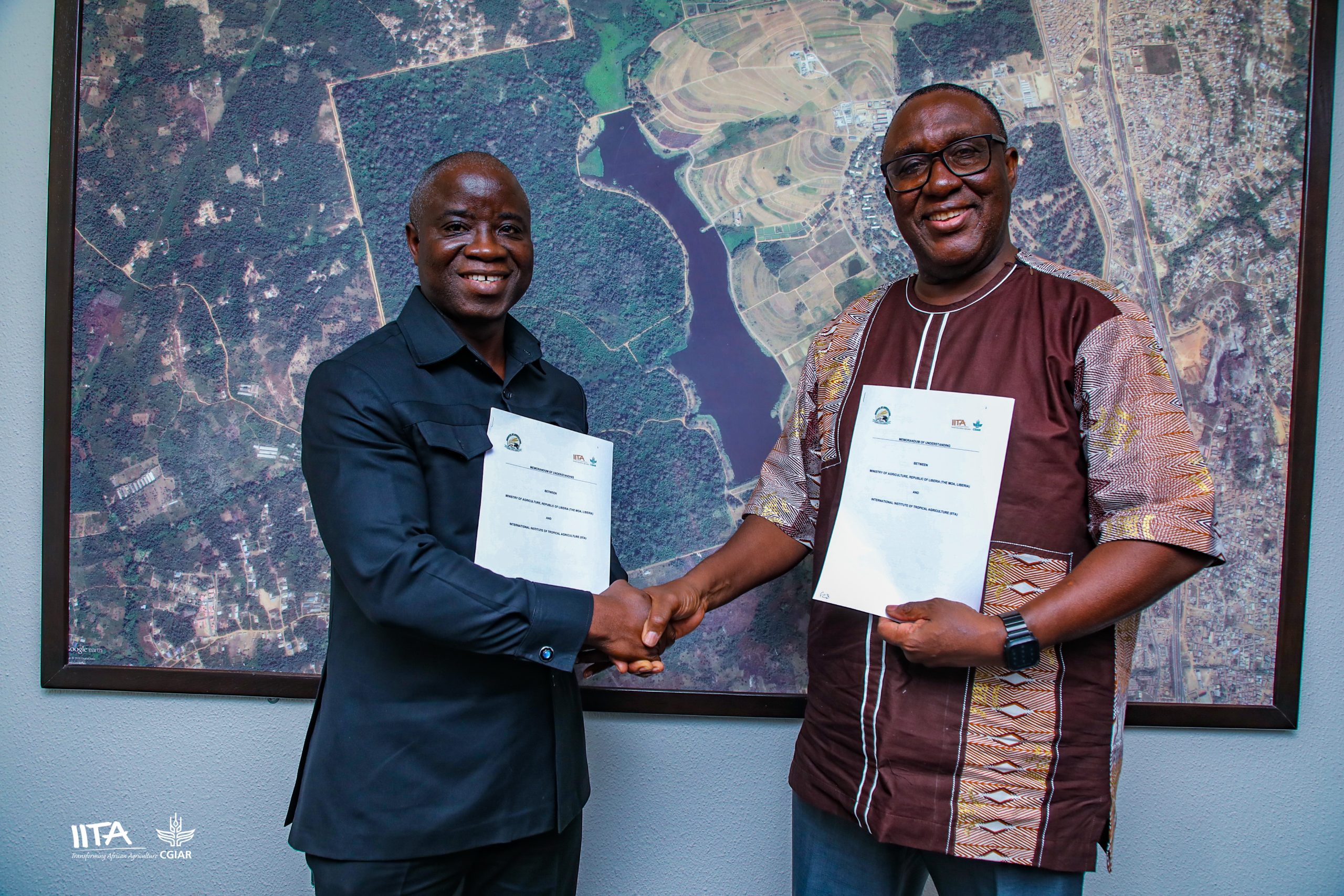
Presentations from IITA scientists covered various research areas, including post-harvest loss reduction, Semi-Autotrophic Hydroponics (SAH), Aflasafe mitigation, and mechanization. Both parties agreed to formalize partnership terms by signing a Memorandum of Understanding (MoU).
“With Liberia’s clear vision of the agricultural agenda, IITA already has the work lined up, and we are ready to work with the government of Liberia,” said IITA Deputy Director General, Partnerships for Delivery (DDG-P4D), Kenton Dashiell. Additionally, IITA will work with the government to identify thematic areas to address.
While IITA has been working in Liberia in silos for over a decade, the MoU will provide support in building research capacity and technology transfer, especially in seed systems and post-harvest loss reduction for cassava and maize.
After the signing, Minister Nuetah said the government will establish a technical team to ensure the implementation of the agreed terms in the MoU.
“We look forward to a sustainable and enduring collaboration that will help bridge the gaps in our agrifood systems while both parties benefit from working together. We need clearly defined roles, which we have identified in the MoU,” he said.
“With programs like the Technologies for African Agricultural Transformation (TAAT) and the scaling of technologies like Aflasafe, we intend to create pathways for strengthening existing ties and the capacity of the research systems in Liberia,” DG Ehui said.
IITA-CGIAR is committed to providing support and technical backstopping for the government of Liberia to actualize its agricultural transformation agenda. “IITA and our partners like the World Bank will explore specific areas of intervention and ways to strengthen the National Agricultural Research Systems (NARS) and the extension system in Liberia, ensuring the ease of technology transfer,” he added.
Contributed by Timilehin Osunde
