
One CGIAR West and Central Africa, in collaboration with the West and Central African Council for Agricultural Research and Development (CORAF), held an Update and Consultative Workshop from 13 to 14 December in Accra, Ghana. Another subregional organization in the WCA region, the Association for Strengthening Agricultural Research for Eastern and Central Africa (ASARECA), also attended the hybrid event. Seventy-three stakeholders—48 in-person and 25 virtual attendees—engaged in the two-day workshop, including participants from NARES, regional organizations, development partners, and government officials from Ghana—the Ministry of Food and Agriculture (MoFA) and Ministry of Environment, Science, Technology, and Innovation (MESTI).
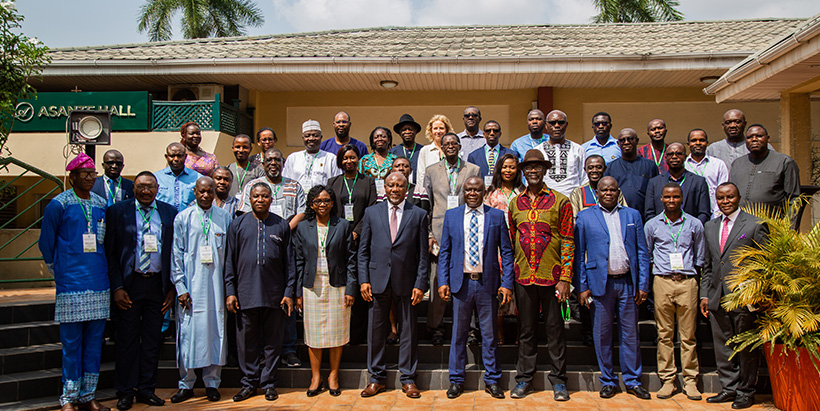
The workshop aimed to create awareness amongst partners and stakeholders in the WCA Region about One CGIAR’s overall research agenda in the region. It was also a forum to receive perspectives and insights from participants and share experiences and insights relating to partnerships and engagement through One CGIAR toward regional and country-level impacts.
In his opening remarks Hon. Yaw Frimpong Addo, representing the Hon Minister of Food and Agriculture, expressed his satisfaction with the One CGIAR goal of ensuring stronger partnerships with the national agricultural systems in a way that ensures a coordinated solution to the lingering food crisis. He added that through the work of the One CGIAR, the countries in WCA would access proven technologies and human capacity development.
CGIAR Managing Director, Regions and Partnership Division, Harold Roy-Macauley, and the One CGIAR – WCA Advisor on Country and Regional Engagement, Kwesi Atta-Krah, introduced a big-picture view of One CGIAR in WCA. CORAF Director of Research, Emmanuel Njukwe, described CORAF’s research and operational framework, highlighting some regional dimension engagements, including partnerships with One CGIAR. Prof Paul Bosu, Director General, Council for Scientific and Industrial Research (CSIR), Ghana, highlighted the country dimension and framework of research operation in Ghana and how the One CGIAR could engage within it.
The workshop also introduced the research and delivery operations of the One CGIAR, emphasizing the importance of existing bilateral and multilateral projects. The 19 CGIAR initiatives with operations in the region were highlighted.
The final segment presented country convenorship operations, addressing engagement issues in both internal and external dimensions and showing familiarity and alignment with countries’ strategic goals and priorities. Country Conveners profiled operations in seven countries—Benin, Burundi, Cameroon, DR Congo, Mali, Rwanda, and Senegal.
Participants lauded the One CGIAR reform, its partnership with NARS, and the strong alignment of the initiatives to national policies, strategic agendas, and the SDGs. Some attendees declared that the workshop had engendered a clearer understanding of the One CGIAR reformulation. They noted that CORAF’s and ASARECA’s position could serve as the gateway for partnership with NARS in various countries, which will remove the fragmentation in partnerships and make integration at the highest level possible.
They urged One CGIAR to consider joint project conceptualization and development with associated resource mobilization. IITA-DRC was cited as a good case study of a situation where the country’s government engaged with a technical partner (IITA) to develop a program, which was then implemented with country resources, including a government loan from a development bank. The TAAT program currently champions this engagement model.
The workshop was an excellent opportunity to profile the overall One CGIAR functioning and plans for the West and Central Africa Region and identify partner and stakeholder perspectives and opportunities for strengthening engagement and collaboration with critical organizations at both country and region levels.
Contributed by Oyewale Abioye
Contributed by
Recent stories