Regional Hub for Fertilizer and Soil Health contribute towards Nigeria’s soil future
November 21, 2025
IITA–CGIAR, through the Regional Hub for Fertilizer and Soil Health for West Africa and the Sahel (Regional Hub), has reaffirmed that accurate, accessible soil data is the foundation of higher yields and truly sustainable agriculture across Nigeria.
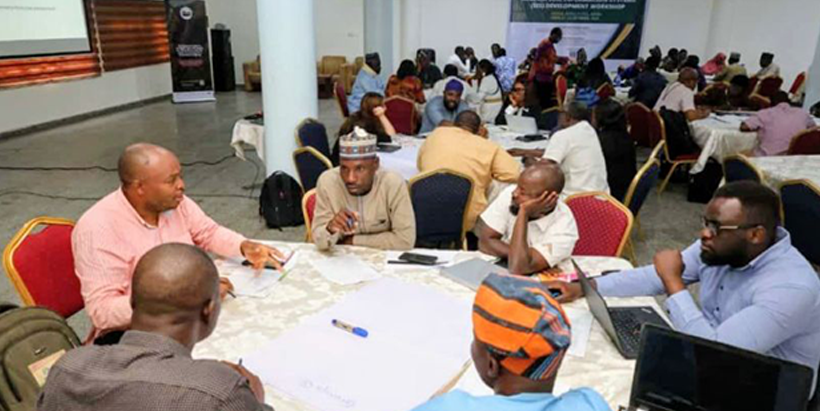
Some of the participants during the workshop
At a recent 3-day workshop held at Abuja, the Regional Hub, in partnership with the Centre for Agriculture and Bioscience International (CABI) and International Soil Reference and Information Centre (ISRIC) brought together a broad spectrum of stakeholders—from government agencies to research institutes, private sector players, and soil science experts with a shared goal of developing an actionable roadmap for strengthening soil information management and soil health across the country.
Speaking at the Nigeria Soil Information Systems (SIS) Development Workshop, IITA Deputy Director General for Research for Development, Dr Bernard Vanlauwe, emphasized that reliable soil data are crucial to achieving food security and supporting millions of farmers nationwide.
His remarks captured the workshop’s central objective, which aimed to build a functional national soil information system capable of delivering real-time, actionable guidance to farmers, extension agents, and decision-makers.
An improved Soil Information System will ensure that farmers and advisors can access reliable, location-specific soil data, helping them choose the right fertilizer type and rate, manage soil health effectively, and boost yields sustainably.
A system designed to reach millions of farmers
Dr Vanlauwe emphasized that the SIS initiative is not simply a technical exercise but a direct investment in Nigeria’s food future.
“What we are doing here is setting up a soil information system that must be linked to millions of farmers via advisory services and digital applications,” he said.
He explained that the system will integrate technical frameworks, databases, and analytics to support soil-specific recommendations on fertilizer use, soil management, and sustainable practices. For this to work, extension services must be equipped to interpret the data and translate it into practical guidance for farmers nationwide.
The SIS initiative aligns with the Federal Ministry of Agriculture and Food Security’s Nigerian Farmers’ Soil Health Initiative, which aims to improve soil health at scale across the country.
A turning point for soil data in Nigeria
Professor Jibrin M. Jibrin, President of the Soil Science Society of Nigeria and a visiting scientist to the Regional Hub, emphasized the importance of reliable data for agricultural planning.
“Before you can plan, you must have adequate and reliable information. If your recommendations are based on wrong data, the results will be wrong,” he said.
He added that a roadmap for implementing the comprehensive Soil Information System will soon be ready and urged the Federal Government to adopt and execute it promptly.
Representing the Federal Ministry of Agriculture and Food Security, Olanipekun Oshadiya, Head of Agricultural Land Management Services, reminded participants of the broader ecological perspective.
According to him, we must regard soil as a living thing. Maintaining healthy practices ensures sustainable agriculture and prevents nutrient depletion.
He emphasized that responsible fertilizer use and sound soil fertility management practices remain essential to protecting Nigeria’s soils.
A collaborative path forward
Throughout the workshop, speakers emphasized the importance of strong collaboration among the private sector, especially fertilizer and seed companies, government agencies, and research institutions. Dr Vanlauwe noted that agricultural sustainability ultimately depends on the economics of production.
“Success or failure depends on the economics of production. Soil information helps ensure production remains profitable while maintaining sustainability.”
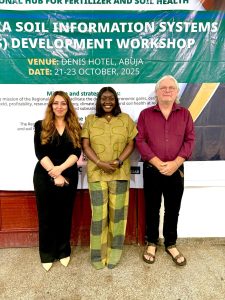
(L-R) Chrow Khushid, ISRIC representative, Sarah Sallau, IITA, and Dr Bernard Vanlauwe, IITA Deputy Director General Research for Development
The Nigeria SIS Development Workshop marks another milestone towards evidence-based agricultural planning in Nigeria. By prioritizing accurate soil information and building the systems to deliver it, Nigeria is positioning itself for a more productive, resilient, and sustainable agricultural future.
About the Regional Hub
The Regional Hub for Fertilizer and Soil Health for West Africa and the Sahel is a collaborative initiative promoting soil health and sustainable fertilizer use across the region. Launched in 2024 as a sub-program of the Economic Community of West African States (ECOWAS), the Hub brings together diverse stakeholders, including the International Institute of Tropical Agriculture (IITA), International Fertilizer Development Center (IFDC), OCP Africa, African Plant Nutrition Institute (APNI), University Mohammed VI Polytechnic (UM6P), and the World Bank through the Accelerating Impacts of CGIAR Climate Research for Africa (AICCRA) project under CGIAR.
Contributed by Ilerioluwa Oladipupo
Olamide Deborah Nwanze is a Senior Research Associate specializing in gender mainstreaming research to inform participatory and inclusive breeding, variety development, and seed systems policies regarding root, tuber, and banana (RTB) crops in the International Institute of Tropical Agriculture Headquarters, Ibadan, Nigeria. She is a PhD candidate at the University of Ibadan and holds an MSc and B. Agric in Agricultural Extension and Rural Development. Olamide is a fellow of the African Women in Agricultural Research and Development – Gender Responsive Agricultural Systems Policy (AWARD-GRASP) and the Gender Responsive Researchers Equipped for Agricultural Transformation (GREAT). She seeks to apply her gender-mainstreaming learnings, gender-responsive research, and policy development, and review expertise to facilitate women, youth, children, and vulnerable social group’s access to and adoption of agricultural Innovations that guarantee food, nutrition, income, and livelihood security in Africa. Her current roles include mentoring research fellows, development of guides and training manuals, implementation and adaptation of gender frameworks and tools, value chain actors’ engagement as citizen science partners, policy review and redesign, data management, and analysis. Her current research explores mixed methods and participatory and interdisciplinary approaches to capture and highlight gender dynamics, needs, preferences, and challenges stakeholders face within the agricultural livelihood value chain to prioritize gender-inclusive strategies in breeding programs, policy design, and implementation.
de Sousa, K., van Etten, J., Manners, R. Bello, A., Teeken, B., Olaosebikan, O., et al. 2024. The tricot approach: an agile framework for decentralized on-farm testing supported by citizen science. A retrospective. Agron. Sustain. Dev. 44, 8. https://doi.org/10.1007/s13593-023-00937-1
Madu, T., Onwuka, S., Nwafor, S., Onyemauwa, N., Ejechi, M., Ofoeze, M., Ukeje, B., Eluagu, C., Olaosebikan, O., Okoye, B., 2024. Gender-Inclusive Consumer Studies Improve Cassava Breeding in Nigeria in: Frontiers in Sociology, volume 9, number: 1224504, doi: 10.3389/fsoc.2024.1224504
Olaosebikan, O.; Bello, A.; Utoblo, O.; Okoye, B.; Olutegbe, N.; Garner, E.; Teeken, B.; Bryan, E.; Forsythe, L.; Cole, S.; Madu, T. 2023. Stressors and Resilience within the Cassava Value Chain in Nigeria: Preferred Cassava Variety Traits and Response Strategies of Men and Women to Inform Breeding. Sustainability 15, 7837. https://doi.org/10.3390/su15107837
Okoye, B., Ofoeze, M., Ejechi, M., Onwuka, S., Nwafor, S., Onyemauwa, N., Ukeje, B., Eluagu, C., Obidiegwu, J.*, Olaosebikan, O., Madu, T.* 2023. Prioritizing preferred traits in the yam value chain in Nigeria: a gender situation analysis in: Frontiers in Sociology, volume 8, number: 1232626, pages 1 – 9, ISSN 2297-7775, 2023. https://www.frontiersin.org/articles/10.3389/fsoc.2023.1232626/full
Olaosebikan, O., Bello, A. A., de Sousa, K., Ndjouenkeu, R., Adesokan, M., Alamu, E. O., Agbona, A., van Etten, J., Kegah, F. N.*, Dufour, D., Bouniol, A., Teeken, B. 2023. Consumer acceptability of cassava gari-eba food products across cultural and environmental settings using the triadic comparison of technologies approach (tricot) in: Journal of the Science of Food and Agriculture,
Teeken, B., Olaosebikan, O., Bello, A. A., Madu, T.*, Cole, S. M. 2023. Qualitative assessment on the positionality and preferences of dyads in relation to cassava-related activities: working with tricot trial citizen scientists https://hdl.handle.net/10568/138326 Type: Manual
Bouniol, A., Ceballos, H., Bello, A. A., Teeken, B., Olaosebikan, O., Owoade, D., Agbona, A., Fotso Kuate, A., Madu, T.*, Okoye, B.*, Ofoeze, M.*, Nwafor, S.*, Onyemauwa, N.*, Adinsi, L.*, Forsythe, L., Dufour, D. 2023. Varietal impact on women’s labour, workload and related drudgery in processing root, tuber and banana crops: focus on cassava in sub-Saharan Africa in: Journal of the Science of Food and Agriculture, pages 1 – 25, ISSN 0022-5142,
Bello, A. A., Agbona, A., Olaosebikan, O., Edughaen, G., Dufour, D., Bouniol, A., Iluebbey, P., Ndjouenkeu, R.*, Rabbi, I. Y., Teeken, B. 2023. Genetic and environmental effects on processing productivity and food product yield: drudgery of women’s work in: Journal of the Science of Food and Agriculture, pages 1 – 32, ISSN 0022-5142, 5
Cavicchioli, M., Zimbiti, T., Teeken, B., Nwanze, D.O., Liani, M., Parkes, E. & Bello, A. 2023. IITA-Gender Responsive Breeding Training Report. Genetic Resources Center, IITA-HQ, Ibadan, 21-23 September, 2022. Ibadan, Nigeria: IITA, (34 p.).https://hdl.handle.net/10568/131368
Agbona, A. Peteti P., Teeken B., Olaosebikan O. Bello, A. A., Parkes, E., Rabbi, I. Y., Mueller, L., Egesi, C., Kulakow, P. 2022. Data Management in Multi-disciplinary African RTB Crop Breeding Programs. In: Williamson, H.F., Leonelli, S. (eds) Towards Responsible Plant Data Linkage: Data Challenges for Agricultural Research and Development. Springer, Cham. https://doi.org/10.1007/978-3-031-13276-6_5
Lora Forsythe, Pricilla Marimo, Sarah Mayanja, Olamide D. Olaosebikan, Esme Stuart, Bela Teeken, Benjamin Okoye, Tessy Madu, (2021). Cross-product Gender Analysis of RTBfoods Step 2 Gendered Food Mapping on RTB Products. Understanding the Drivers of Trait Preferences and the Development of Multi-user RTB Product Profiles, WP1. London, UK: RTBfoods Field Scientific Report, 30 p.
Teeken, B., Garner, E., Agbona, A., Balogun, I., Olaosebikan, O., Bello, A., Madu, T., Okoye, B., Egesi, C., Kulakow, P. and Tufan, H.A. 2021. Beyond “Women’s Traits”: Exploring How Gender, Social Difference, and Household Characteristics Influence Trait Preferences. Frontiers Sustainable Food Systems 5:740926. https://doi.org/10.3389/fsufs.2021.740926
Teeken, B., Agbona, A., Bello, A., Olaosebikan, O., Alamu, E., Adesokan, M., Awoyale, W., Madu, T., Okoye, B., Chijioke, U., Owoade, D., Okoro, M., Bouniol, A., Dufour, D., Hershey, C., Rabbi, I., Maziya‐Dixon, B., Egesi, C., Tufan, H. and Kulakow, P. (020. Understanding cassava varietal preferences through pairwise ranking of gari‐eba and fufu prepared by local farmer–processors. Int J Food Sci Technol.https://doi.org/10.1111/ijfs.14862
Bela Teeken, Olamide Olaosebikan, Ireti Balogun, Benjamin Okoye, Tessy Madu, Steven Cole, Abolore Bello, Elizabeth Parkes. (2020). Piloting the G+ customer and product profile tools for gender-responsive cassava breeding in Nigeria. Nigeria: International Institute of Tropical Agriculture (IITA). https://hdl.handle.net/20.500.11766/13000