
RUNRES supports circular economy entrepreneur turning cassava waste into livestock feed
13 July 2022
Cassava, a major staple crop in Rwanda, is an essential source of calories and income for rural households. Besides household consumption, industrial production and processing have led to an environmental nightmare because of the volume of waste generated, particularly cassava peels. This represents a significant loss, with the cassava peels making up about 20% of tubers.

A small cassava processing firm in the Kamonyi District of Rwanda’s Southern Province, Akanoze Nyamiyaga Ltd, is changing the narrative about cassava waste by turning it into revenue. Founded by Alice Nyirasagamba in 2018, the business processes cassava into flour for cooking and baking.
Following exposure to the High-Quality Cassava Peels (HQCP) technology developed by IITA and partners, the business added a processing unit to its existing operations to produce and sell HQCP mash to poultry farmers. The HQCP mash is a perfect animal feed ingredient, which can be fed to livestock without further processing or mixed with other animal feeds to feed animals.
“We use between 12 and 15 tonnes of fresh cassava daily in the first processing unit, and waste generated is processed into animal feed ingredients in the newly constructed unit,” Nyirasagamba said.
As the demand for the HQCP mash increases, the business faces significant challenges affecting its production capacity. The firm is securing its raw materials through supply deals with cassava farmers and cooperatives.
“We started buying 500 kilograms of peels from farmers daily, but today we are buying about four tonnes of them per day. We have a machine that turns the peels into livestock feed livestock species, namely poultry, cows, pigs, goats, and others,” she continued.
“Our activities help protect the environment as these peels were scattered on the ground and would cause environmental degradation because some farmers used to burn them, and its smoke harms the environment and human health,” she added. Besides the environmental advantages, this circular economy enterprise has already employed eight casual staff (five men and three women) and generated about Rwf25 million (US$25,000).
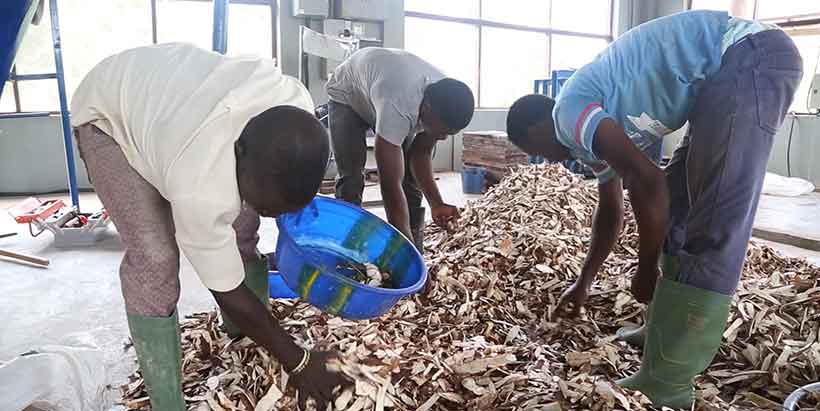
Nyirasagamba said she received technical and financial support from the Rural-Urban Nexus (RUNRES) project funded by the Swiss Agency for Development and Cooperation and implemented by the Swiss Federal Institute of Technology in Zürich (ETH Zurich) and IITA.
IITA Technical and Partnerships Officer Speciose Kantengwa said that the RUNRES initiative to turn agricultural waste into valuable products operates in four countries—DRC, Ethiopia, Rwanda, and South Africa. “Cassava peels are a threat to the environment in rural and urban areas, and the project seeks to address such waste accumulation by turning it into livestock feed. There is a need for such factories in every district to turn cassava waste into livestock feed. Entrepreneurs should tap into this opportunity,” Kantengwa said.
