
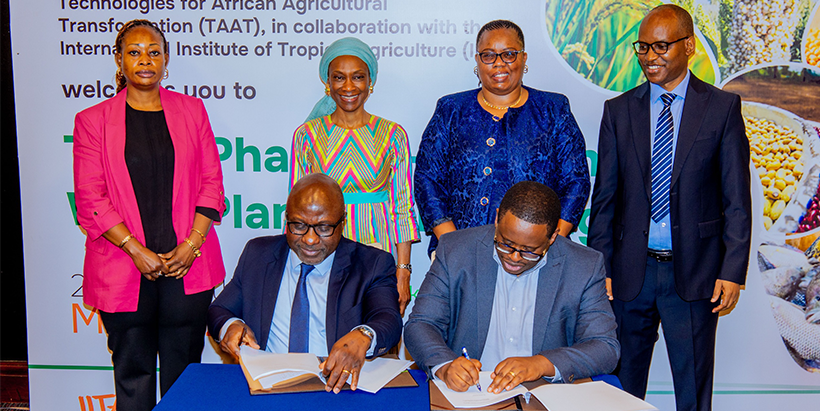
IITA-CGIAR has reinforced its leadership in Africa’s agricultural transformation with the signing of a Memorandum of Understanding (MoU) under the Technologies for African Agricultural Transformation (TAAT) Phase II Addendum. The MoU, signed in Kigali during a high-level Work Planning Meeting held from 23–24 March 2026, marks a significant step toward accelerating the delivery of climate-smart agricultural technologies across six African countries.
Convened with support from the African Development Bank (AfDB), the meeting brought together CGIAR Centers, Advanced Agricultural Research Institutes (AARIs), National Agricultural Research and Extension Systems (NARES), private-sector actors, and government representatives. Central to the discussions was the operationalization of a EUR 5 million grant from Germany, administered through the AfDB’s Transition Support Facility (TSF Pillar IV), to support implementation in Rwanda, Uganda, Tanzania, Mozambique, Malawi, and Nigeria.
As the lead implementing partner of TAAT, IITA plays a pivotal role in coordinating delivery, strengthening partnerships, and ensuring that proven agricultural technologies reach farmers at scale. The meeting focused on reviewing and validating the work plan and budget, finalizing implementation arrangements, and reinforcing collaboration among stakeholders to ensure efficient and impactful rollout.
A core priority of TAAT Phase II is strengthening seed systems and expanding early generation seed (EGS) production. Under IITA’s leadership, TAAT has already demonstrated significant impact across the continent. Since its launch in 2018, the program has supported the production of over 4,333 metric tons of breeder seeds, leading to more than 309,000 metric tons of certified seeds. These efforts have significantly improved crop productivity and farmer livelihoods across multiple countries.
Representing IITA Management at the meeting, the Rwanda Country Representative, Matieyedou Konlambigue, emphasized the program’s achievements and the urgency of scaling further.
“TAAT has demonstrated success in strengthening seed systems across Africa, and now we need to scale with speed, promote sustainability, and align implementation and accountability commitments to delivering measurable impact for farmers,” he said.
His remarks underscored IITA’s commitment not only to scaling technologies but also to ensuring accountability and measurable results for farming communities.
The meeting marked a transition from strategy to execution. Participants worked to align priorities under four key components of TAAT Phase II: strengthening seed systems, building institutional and technical capacity, promoting youth engagement in agriculture, and expanding digital advisory solutions for extension, climate information, and input distribution.
Speaking at the opening and signing ceremony, Innocent Musabyimana, AfDB Chief Agricultural Technologies Officer, reaffirmed TAAT’s central role in achieving the Bank’s Feed Africa vision.
“Strong partnerships are key to scaling agricultural transformation, and this meeting is about moving from planning to accelerated action,” he said.
The Acting Coordinator of the TAAT Programme Management Unit, Rachel Zozo, highlighted that the Phase II Addendum will deepen strategic investments in the six target countries, particularly those facing fragility challenges.
“Our priorities in this phase will be to strengthen seed systems and early generation seed (EGS) production, empower youth and institutions, scale digital agriculture solutions, and enhance collaboration across public and private sectors,” Zozo noted.
Through IITA’s coordination, these priorities will translate into practical interventions that equip national systems and private-sector actors to produce quality seeds, adopt improved technologies, and enhance resilience to climate shocks.
A key milestone of the meeting was the signing of a sub-grant agreement between the Government of Rwanda, the African Development Bank, and the TAAT Program, represented by IITA. The agreement will facilitate the rapid implementation of activities across all four components of TAAT II, with strong emphasis on capacity building and empowering young entrepreneurs in seed systems.
Dr Solange Uwituze, Minister of State in Rwanda’s Ministry of Agriculture, welcomed the agreement, noting its alignment with the country’s long-term development goals.
“In line with our 2050 vision of Rwanda, which enhances food security among Rwandans, we should increase the agricultural productivity by 13 times from what we produce now. This requires us to adopt modern agronomic practices and improved technologies. That’s what this MoU is going to contribute to. Because it will help provide clean seeds and increase the capacities of local actors to practice agriculture on small lands but with increased productivity,” Dr Uwituze stated.
Over the years, TAAT has integrated dozens of proven technologies into large-scale AfDB-financed projects across more than 20 countries, influencing investments worth billions of dollars. Through IITA’s stewardship, these technologies are not only introduced but systematically scaled through strong partnerships and coordinated action.
Contributed by Ritha Bumwe
Contributed by
Recent stories