
Fourteen-year-old Michelle Atawa Mensah was declared winner of the 2023 Young Scientist Award at the 33rd Biennial Conference of the Ghana Science Association held at the University of Ghana in Accra.
Mensah also won best young scientist in the Junior High School Category. Other winners were Kwesi Koranteng, Senior High School Category, and Ursula Azocha, Tertiary Category.
The Awards recognized and celebrated the achievements of young people passionate about science.
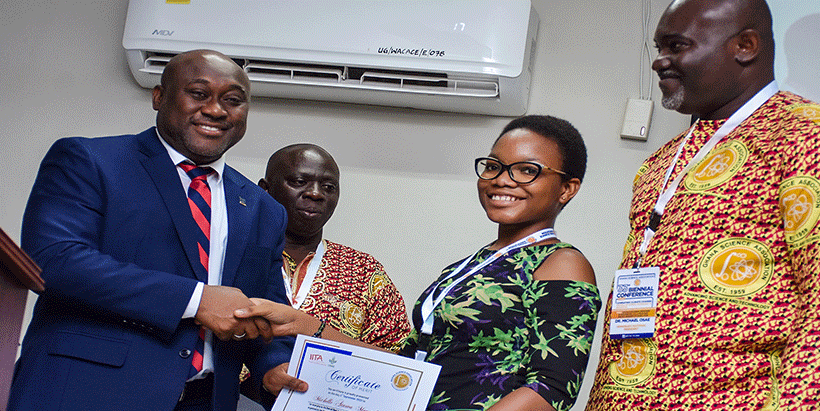
Ghana Science Association Scientific Coordinator Fordjour Dzotor said the award boosts the winners’ confidence and motivates them to continue their pursuit of science and make valuable contributions to their respective fields in Science or STEM. “By acknowledging and supporting young scientists, these awards contribute to the future of science and innovation. Encouraging talented individuals in the early stages of their education in Science or STEM will motivate them to pursue a career in Science or STEM in the future,” he said.
IITA–CGIAR Emeritus Director Robert Asiedu said the awards align with IITA’s commitment to empowering young scientists. He said that the organization has been actively building young people’s capacity for research-for-development through graduate and postdoctoral fellowships, group training in hard and soft skills vital to young scientists, the Youth in Agribusiness program, and the Start Them Early Program, which targets high school students.
“Ghana needs scientists who are even smarter than the scientists from my generation to address the current and emerging challenges and opportunities. We are encouraged by the brilliance of the young scientists we have in Ghana, and we are confident that their success will be our success,” he said
The Ghana Science Association (GSA) is a national multidisciplinary group of scientists, technologists, engineers, mathematicians, and industrialists that seeks to contribute to the socio-economic development of Ghana through scientific and technological research and the formulation and implementation of national policy in science, technology, and innovation.
The 33rd Biennial Conference themed, “Combating Climate Change: The Role of Science, Technology and Innovation,” allowed members, politicians, and other stakeholders to interact and identify ways of mitigating and adapting to the effects of climate change using science, technology, and innovations.
During discussions, stakeholders stressed the need to deepen collaboration among scientists and involve politicians, policymakers, and the public in decision-making to combat the effect of climate change effectively.
Contributed by Francisca Ocloo
Contributed by
Recent stories