
Supported by funding from the United States Department of Agriculture – Foreign Agricultural Service (USDA-FAS), a two-week training program was organized by the IITA Aflasafe Unit in Ibadan, Nigeria, for researchers specializing in aflatoxin biocontrol from the Institut d’Economie Rurale (IER) du Mali, Institut National de la Recherche Agronomique du Niger (INRAN), Pakistan Agricultural Research Council (PARC), and CAB International (CABI). Partners from Rafhan Maize, a subsidiary of the US-based Ingredion company and a leading private-sector maize company in Pakistan, also attended the training.
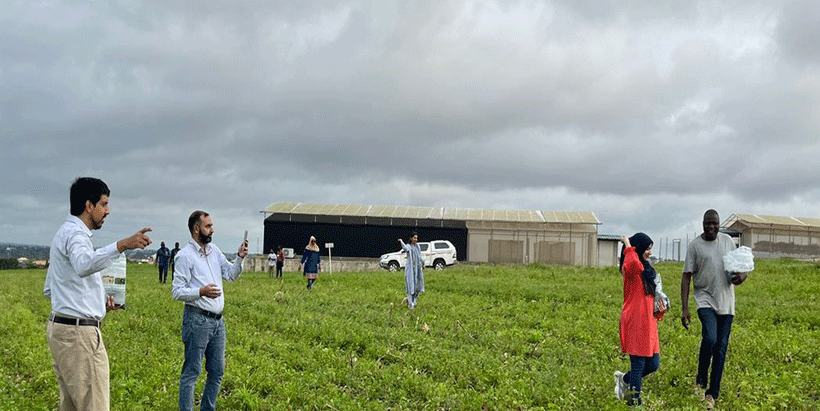
Dr Lloyd Garcia from USDA-FAS attended the training to facilitate collaborative solutions to advance enhanced projects and define ways forward on efforts to mitigate aflatoxin contamination in target crops. PARC, CABI, and Rafhan Maize have developed the aflatoxin biocontrol product AflaPak in collaboration with USDA – Agricultural Research Service (ARS) and IITA. IER and INRAN scientists have been collaborating with IITA Aflasafe Unit since 2017 and 2019 to develop, test, register, and commercially use Aflasafe in their countries as part of a USDA-FAS-funded project and under the Climate Smart Agricultural Technologies (CSAT) for Mali and Niger Project funded by the Royal Embassy of Norway in Mali.
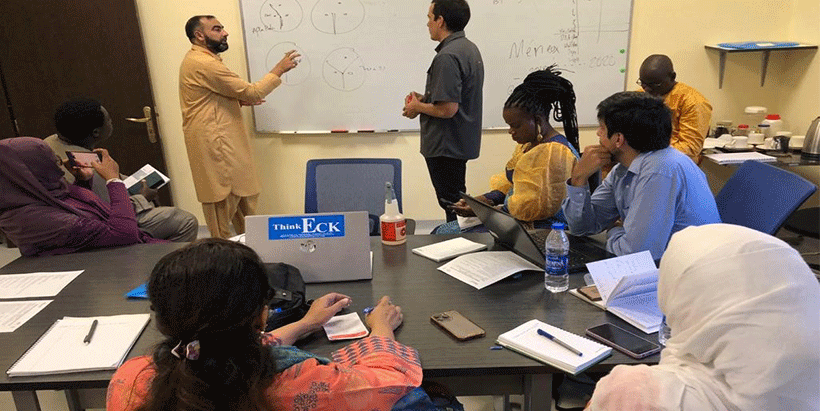
The “Hands-on laboratory, industrial manufacturing, and field experience in the development, testing, registration, and scaling of aflatoxin biocontrol technology” workshop took place from 23 Oct to 3 Nov 2023 and was organized by Alejandro Ortega-Beltran, Lawrence Kaptoge, and Titilayo Falade, and supported by IITA Emeritus Scientist Dr Ranajit Bandyopadhyay.
The program included i) practical sessions in the laboratory to discuss microbiological, chemical, and molecular aspects of strain identification for aflatoxin biocontrol product development and tracking of active ingredients; ii) formulation and quality control of biocontrol products and industrial production of active ingredient spores; iii) biocontrol field application and verification of product performance; iv) demonstrations of industrial production by HarvestField Industries Limited, the licensed manufacturer and distributor of the aflatoxin biocontrol product Aflasafe in Nigeria; v) discussions with the biocontrol product regulator in Nigeria; vi) discussions on incentivization schemes for the adoption of biocontrol used in Nigeria; vii) status of biocontrol product registration in Pakistan and experiences of IITA in registering biocontrol products in 11 countries in Africa; and viii) visits to different units in IITA (Genetic Resources Center, Germplasm Health Unit, Maize, Soybean, and Banana/Plantain Improvements Programs) to foster collaboration in areas other than aflatoxin biocontrol.
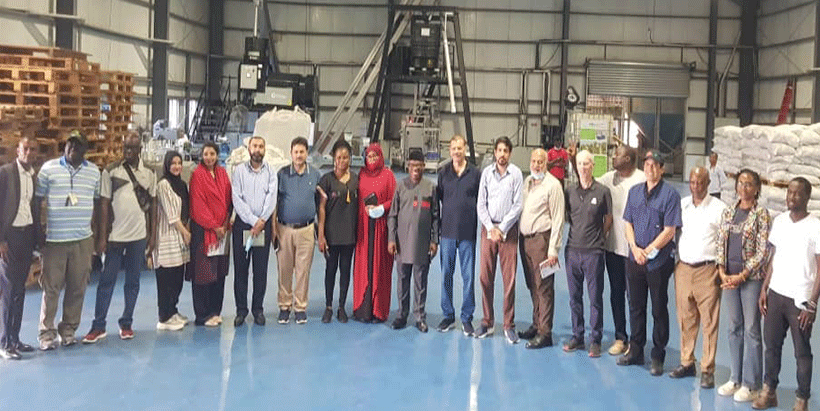
During a meeting with the IITA Senior Management Team, Dr Falak Naz from the International Coordination Division of the Pakistan Agricultural Research Council expressed the training participants’ enthusiasm for the program, elaborated on the challenge posed by aflatoxin contamination in Pakistan and the necessity of collaborating with IITA, because of the several successful stories in aflatoxin management across Africa.
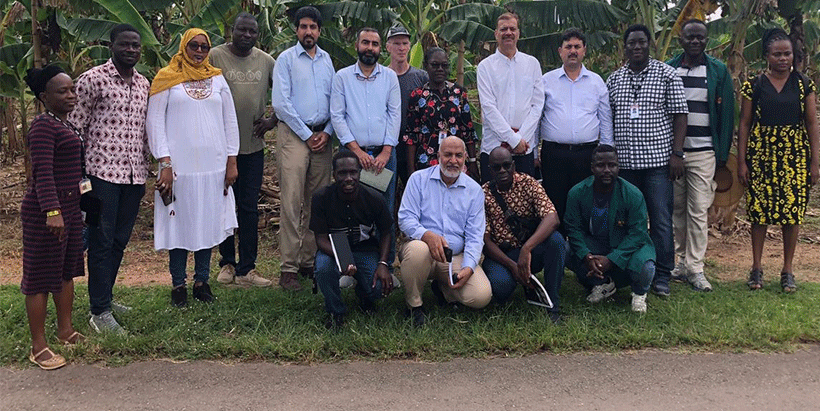
The Pakistan delegation aims to implement similar strategies to reduce losses among Pakistani farmers. Several potential areas of collaboration, in addition to aflatoxin biocontrol, were discussed. IER Sorghum Pathologist Dr Karim Dagno emphasized the need for this training and knowledge-sharing experience, especially because in Mali, aflatoxin is a great challenge, leading to the closure of numerous industries because of the inability to source enough quantities of aflatoxin-safe crops. He extended his gratitude to IITA for supporting farmers in protecting their crops. IITA Director General Dr Simeon Ehui encouraged participants to design and implement biocontrol strategies similar to those underway in several African countries and gave several recommendations to foster collaboration in years to come.
The training program is part of the actions of the IITA Aflasafe Initiative aiming to transfer know-how and experiences in the development, testing, registration, and technology transfer of aflatoxin biocontrol obtained in over 20 years in more than 20 African countries through collaboration with USDA-ARS, alongside multiple public and private sector partners.
Contributed by Alejandro Ortega-Beltran
Contributed by
Recent stories