
NEWS

West Africa crop breeders boost expertise via IITA and EiB collaboration
March 23, 2022

IITA, in collaboration with CGIAR Excellence in Breeding (EiB), delivered two professional workshops titled “EiB Breeding Scheme Design Training” and “West Africa Breeding Operations” for crop breeders and operations staff from IITA and national agricultural research systems (NARS) in West Africa from 21 to 25 February. The breeding scheme design training aimed to increase the skillset of plant breeders to design breeding schemes. It focused on helping crop breeders improve breeding programs, consider farmers’ and consumers’ needs, and position the product towards the target market. The breeding operations workshop facilitated operations teams to develop action plans to improve their stations.
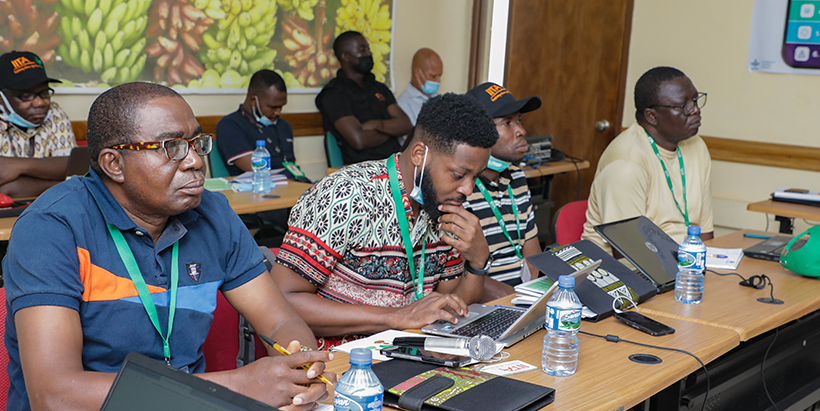
Breeding operations staff attending the “West Africa Breeding Operations” workshop.

In his welcome address, IITA West Africa Hub Director, Michael Abberton, encouraged the participants to take advantage of the workshops to initiate new avenues for strengthening research and addressing key issues such as the availability of improved varieties to ensure food security in Africa.

Agnes Mbugua, EiB’s Seed Marketing Specialist, explained the importance of market segments in identifying specific market needs and offering solutions to create an impact. She said that since CGIAR crops are quite diverse due to the different subregions, “a common set of where and how to align the appropriate choices of the market segments should be put into consideration via prioritization.”
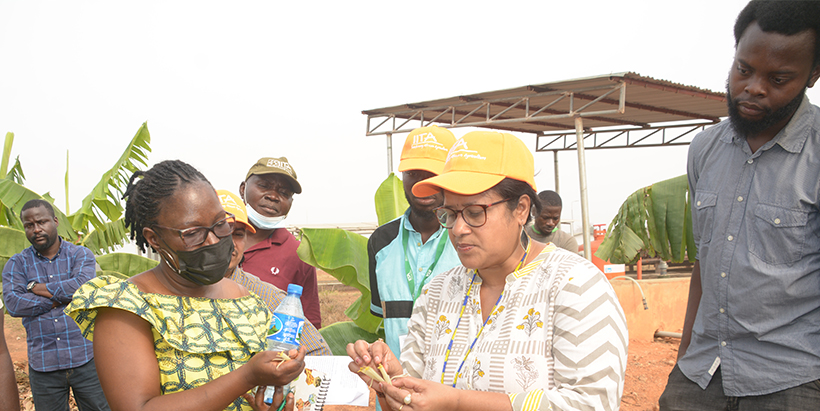
The EiB workshop participants visiting the plantain field.

EiB’s Breeding Scheme Optimization Lead, Eduardo Covarrubias, highlighted the tools and methods used in breeding scheme design. The methods highlighted include defining the problem, measuring how to make the crossing, evaluation, and selection (CES) decisions, analyzing the problem background and possible solutions, and controlling the CES decision improvements.

Quantitative Geneticists and Simulation Specialists—Christian Werner, Marlee Labroo, and Dorcus Gemenet—covered major areas such as transmitting values to the next generation, the optimal number of parents, crosses, and progeny, recycling strategy, and management of genetic variation. The training also featured a group discussion on “Applying the breeder’s equation to your program.” The participants took a tour of crop fields, seed processing facilities, and greenhouses.

As Covarrubias recapped the activities carried out during the training, he recommended implementing a check strategy and recording the breeding scheme in specialized software.
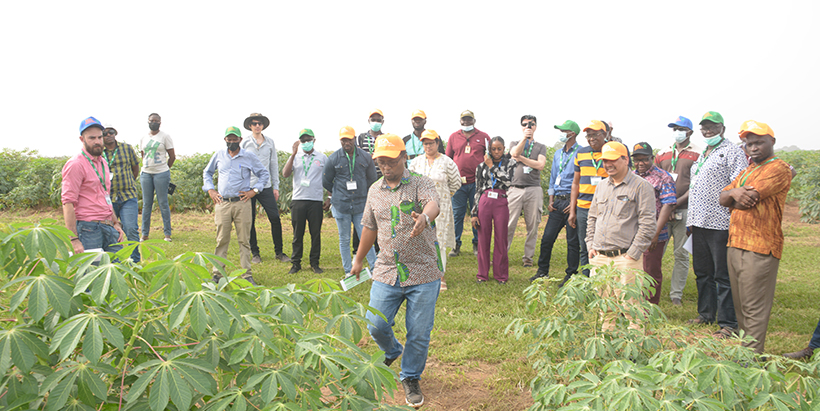
The workshop participants at the cassava breeding farm.

For the concurrent breeding operations workshop, EiB’s Breeding Operation Network for Development (BOND) brought together breeding operations staff to improve strategies that accelerate mechanization, technological capacities, and skills levels. EiB underscored the principles of building a culture of excellence – implementing continuous improvement approaches to ensure operations are focused on improving the lives of farmers.

The workshop covered topics such as moving towards centralized operations, quality management systems in breeding operations, health, safety, security and environment, plotmanship, gender inclusion, irrigation, seed processing, greenhouse management, and addressing capacity development needs.

With the paradigm shift in operations and breeding taking place under One CGIAR, the workshops considered all components, including the activities and challenges of previous organizations and learnings from their perspectives. EiB aims to give the field workers a sense of involvement in the future.

The EiB platform provides system-level coordination of breeding programs, a space for information sharing, collaborative learning, and access to tools and services for partners, including CGIAR research centers, NARS, and the private sector.

Head of IITA’s Farm Management, Alick Mulenga, gave an overview of the workshop and focused on operational excellence and support for breeders. The training also highlighted the technical work in the field, challenges faced in implementing trials for the breeders, and possible improvements.

“One of the things we are trying to do in IITA is centralizing the breeding operations. For instance, we have identified some gaps in terms of planning. We should be proactive and start our planning ahead of time to give ourselves enough time before the onset of the season,” Mulenga said.

IITA Abuja Farm Supervisor Gabriel Adedayo, who participated in the workshop, said the training exposed him to new perspectives, widening his view and understanding.

The workshop participants and speakers came from CGIAR centers, NARS programs, and CGIAR Excellence in Breeding. The workshop series is continuing with events planned for East and Southern Africa and Latin America.

Contributed by Anita Akinyomade and Oluwaseyifunmi Olumi


Contributed by

Recent stories

No items found

Leave a Reply

Your email address will not be published. Required fields are marked *

Scroll to Top
Olaosebikan, Olamide

Olamide Deborah Nwanze is a Senior Research Associate specializing in gender mainstreaming research to inform participatory and inclusive breeding, variety development, and seed systems policies regarding root, tuber, and banana (RTB) crops in the International Institute of Tropical Agriculture Headquarters, Ibadan, Nigeria. She is a PhD candidate at the University of Ibadan and holds an MSc and B. Agric in Agricultural Extension and Rural Development. Olamide is a fellow of the African Women in Agricultural Research and Development – Gender Responsive Agricultural Systems Policy (AWARD-GRASP) and the Gender Responsive Researchers Equipped for Agricultural Transformation (GREAT). She seeks to apply her gender-mainstreaming learnings, gender-responsive research, and policy development, and review expertise to facilitate women, youth, children, and vulnerable social group’s access to and adoption of agricultural Innovations that guarantee food, nutrition, income, and livelihood security in Africa. Her current roles include mentoring research fellows, development of guides and training manuals, implementation and adaptation of gender frameworks and tools, value chain actors’ engagement as citizen science partners, policy review and redesign, data management, and analysis. Her current research explores mixed methods and participatory and interdisciplinary approaches to capture and highlight gender dynamics, needs, preferences, and challenges stakeholders face within the agricultural livelihood value chain to prioritize gender-inclusive strategies in breeding programs, policy design, and implementation.

At IITA, she contributes to the implementation of the CGIAR Accelerated Breeding Initiative and Genetic Innovation Programs; participatory and gender research within the NextGen CassavaHarvestPlusRTBFoods, and Tricot-ClimMob 1000Farms Projects; and gender knowledge communication via the G-LENS webinar series, video documentary, policy briefspublications, and blogs.


Recent publications

de Sousa, K., van Etten, J., Manners, R. Bello, A., Teeken, B., Olaosebikan, O., et al. 2024. The tricot approach: an agile framework for decentralized on-farm testing supported by citizen science. A retrospective. Agron. Sustain. Dev. 44, 8. https://doi.org/10.1007/s13593-023-00937-1

Madu, T., Onwuka, S., Nwafor, S., Onyemauwa, N., Ejechi, M., Ofoeze, M., Ukeje, B., Eluagu, C., Olaosebikan, O., Okoye, B., 2024. Gender-Inclusive Consumer Studies Improve Cassava Breeding in Nigeria in: Frontiers in Sociology, volume 9, number: 1224504, doi: 10.3389/fsoc.2024.1224504

Olaosebikan, O.; Bello, A.; Utoblo, O.; Okoye, B.; Olutegbe, N.; Garner, E.; Teeken, B.; Bryan, E.; Forsythe, L.; Cole, S.; Madu, T. 2023.  Stressors and Resilience within the Cassava Value Chain in Nigeria: Preferred Cassava Variety Traits and Response Strategies of Men and Women to Inform Breeding. Sustainability 15, 7837. https://doi.org/10.3390/su15107837

Okoye, B., Ofoeze, M., Ejechi, M., Onwuka, S., Nwafor, S., Onyemauwa, N., Ukeje, B., Eluagu, C., Obidiegwu, J.*, Olaosebikan, O., Madu, T.* 2023. Prioritizing preferred traits in the yam value chain in Nigeria: a gender situation analysis in: Frontiers in Sociology, volume 8, number: 1232626, pages 1 – 9, ISSN 2297-7775, 2023. https://www.frontiersin.org/articles/10.3389/fsoc.2023.1232626/full

Olaosebikan, O., Bello, A. A., de Sousa, K., Ndjouenkeu, R., Adesokan, M., Alamu, E. O., Agbona, A., van Etten, J., Kegah, F. N.*, Dufour, D., Bouniol, A., Teeken, B. 2023. Consumer acceptability of cassava gari-eba food products across cultural and environmental settings using the triadic comparison of technologies approach (tricot) in: Journal of the Science of Food and Agriculture,

Teeken, B., Olaosebikan, O., Bello, A. A., Madu, T.*, Cole, S. M. 2023. Qualitative assessment on the positionality and preferences of dyads in relation to cassava-related activities: working with tricot trial citizen scientists https://hdl.handle.net/10568/138326 Type: Manual

Bouniol, A., Ceballos, H., Bello, A. A., Teeken, B., Olaosebikan, O., Owoade, D., Agbona, A., Fotso Kuate, A., Madu, T.*, Okoye, B.*, Ofoeze, M.*, Nwafor, S.*, Onyemauwa, N.*, Adinsi, L.*, Forsythe, L., Dufour, D. 2023. Varietal impact on women’s labour, workload and related drudgery in processing root, tuber and banana crops: focus on cassava in sub-Saharan Africa in: Journal of the Science of Food and Agriculture, pages 1 – 25, ISSN 0022-5142,

Bello, A. A., Agbona, A., Olaosebikan, O., Edughaen, G., Dufour, D., Bouniol, A., Iluebbey, P., Ndjouenkeu, R.*, Rabbi, I. Y., Teeken, B. 2023. Genetic and environmental effects on processing productivity and food product yield: drudgery of women’s work in: Journal of the Science of Food and Agriculture, pages 1 – 32, ISSN 0022-5142, 5

Cavicchioli, M., Zimbiti, T., Teeken, B., Nwanze, D.O., Liani, M., Parkes, E. & Bello, A. 2023. IITA-Gender Responsive Breeding Training Report. Genetic Resources Center, IITA-HQ, Ibadan, 21-23 September, 2022. Ibadan, Nigeria: IITA, (34 p.).https://hdl.handle.net/10568/131368

Agbona, A. Peteti P., Teeken B., Olaosebikan O. Bello, A. A., Parkes, E., Rabbi, I. Y., Mueller, L., Egesi, C., Kulakow, P. 2022. Data Management in Multi-disciplinary African RTB Crop Breeding Programs. In: Williamson, H.F., Leonelli, S. (eds) Towards Responsible Plant Data Linkage: Data Challenges for Agricultural Research and Development. Springer, Cham. https://doi.org/10.1007/978-3-031-13276-6_5

Lora Forsythe, Pricilla Marimo, Sarah Mayanja, Olamide D. Olaosebikan, Esme Stuart, Bela Teeken, Benjamin Okoye, Tessy Madu, (2021). Cross-product Gender Analysis of RTBfoods Step 2 Gendered Food Mapping on RTB Products. Understanding the Drivers of Trait Preferences and the Development of Multi-user RTB Product Profiles, WP1. London, UK: RTBfoods Field Scientific Report, 30 p.

Teeken, B., Garner, E., Agbona, A., Balogun, I., Olaosebikan, O., Bello, A., Madu, T., Okoye, B., Egesi, C., Kulakow, P. and Tufan, H.A. 2021. Beyond “Women’s Traits”: Exploring How Gender, Social Difference, and Household Characteristics Influence Trait Preferences. Frontiers Sustainable Food Systems 5:740926. https://doi.org/10.3389/fsufs.2021.740926

Teeken, B., Agbona, A., Bello, A., Olaosebikan, O., Alamu, E., Adesokan, M., Awoyale, W., Madu, T., Okoye, B., Chijioke, U., Owoade, D., Okoro, M., Bouniol, A., Dufour, D., Hershey, C., Rabbi, I., Maziya‐Dixon, B., Egesi, C., Tufan, H. and Kulakow, P. (020. Understanding cassava varietal preferences through pairwise ranking of gari‐eba and fufu prepared by local farmer–processors. Int J Food Sci Technol. https://doi.org/10.1111/ijfs.14862

Bela Teeken, Olamide Olaosebikan, Ireti Balogun, Benjamin Okoye, Tessy Madu, Steven Cole, Abolore Bello, Elizabeth Parkes. (2020). Piloting the G+ customer and product profile tools for gender-responsive cassava breeding in Nigeria. Nigeria: International Institute of Tropical Agriculture (IITA). https://hdl.handle.net/20.500.11766/13000