World Bank and CGIAR strategize to transform agriculture
20 February 2024
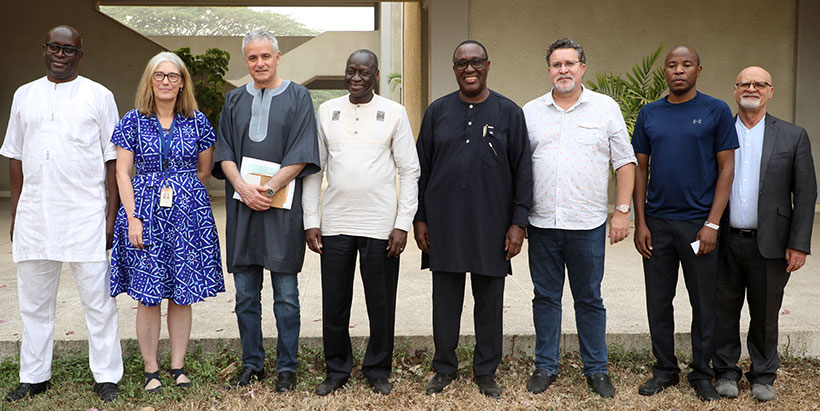
Towards exploring collaborative ways to improve resource mobilization and discuss strategic measures for transforming agriculture research, innovation scaling, and food and nutrition systems in West and Central Africa, World Bank Vice President for West and Central Africa Ousmane Diagana led a delegation on a working visit to IITA–CGIAR headquarters on 9 February.

The visit created avenues to discuss key issues that require urgent attention in Africa’s food and nutrition systems while highlighting some of IITA’s important research innovations.
Discussions during the 2-day working visit reinforced the need to focus on infrastructure development, capacity building, and solid business development mechanisms under collaborative efforts around plant health, breeding, resource mobilization, and climate-smart agriculture.
Diagana, while commending the impact of IITA’s research in Africa, said there is a need for institutions like IITA to build and develop capacity, foster partnerships, and provide support for policy-making on the continent.
On the significance of increasing visibility in Central Africa to aid innovation scaling, discussions focused on operationalizing research for development (R4D) around soil health, irrigation, seed systems, business investment, and working with the private sector.
Speaking on the importance of establishing a presence in regions and countries to provide technologies and innovations, CGIAR Regional Director for Continental Africa and IITA Director General Dr Simeon Ehui said these recommendations are valid for every region as none of Africa must be left behind in the journey to ensure a food-secure continent.

IITA Deputy Director General, Research for Development (DDG-R4D) Bernard Vanlauwe speaking on the role of the CGIAR as a broker, said IITA, as a representative of CGIAR, ensures the scaling of knowledge, innovations, and capacity to end-users and this is a key role in extensive collaborative research and knowledge sharing.
Highlighting critical areas like climate change’s impact on maize yield, prevalence of malnutrition, and impact of improved cassava varieties on Africa, Vanlauwe added that over 50% of the economic impact of CGIAR-related crop technologies in Africa is linked to IITA.
Giving a background to IITA and CGIAR’s activities in Africa, some of the presentations targeted reinforcing research and development (R&D) in climate adaptation, irrigation and need for water, capacity building, and the need to look at opportunity crops like fonio, sesame, and bambara in the Sahel.
Speaking on the impact of rice research on the livelihood of farmers, AfricaRice Regional Representative and Coordinator for Nigeria Francis Nwilene said some of the innovations have changed the value chain game for end-users, especially women in rural areas.
ILRI Country Representative for Nigeria Tunde Amole highlighted some of the institute’s activities focusing on livestock feed improvement and improved forage production, adding that millions of livestock farmers are yet to benefit from some of these technologies until partnerships are strengthened on the continent.
During his presentation on deploying proven aquaculture technologies under the TAAT program, WorldFish Programme Coordinator for Nigeria Sunil Siriwardena said some of their activities have helped farmers reduce feed costs while ensuring nutrition quality and improving farm efficiency.
Speaking on the impact recorded by the CGIAR centers, World Bank Regional Director for Sustainable Development for West and Central Africa, Chakib Jenane, said despite the commendable success stories, it is important to focus on scaling by looking at agribusiness types of investments.
Diagana, who expressed delight at the various technologies being scaled by the CGIAR centers, said the World Bank is committed to working with IITA and CGIAR, adding that in the future, the World Bank team will be following up with the discussions and plans for areas of collaboration.
Wrapping up the 2-day meeting, Dr Ehui reassured the World Bank team of IITA and CGIAR’s commitment to strong partnerships, adding that there will be continuation towards concretizing some of the discussions.
Contributed by Timilehin Osunde
