This series of three webinars focuses on the collaboration between research institutions and private companies to commercialize agricultural technologies.
Background | Why the webinars? | Convenors and discussants | Details on the webinar series
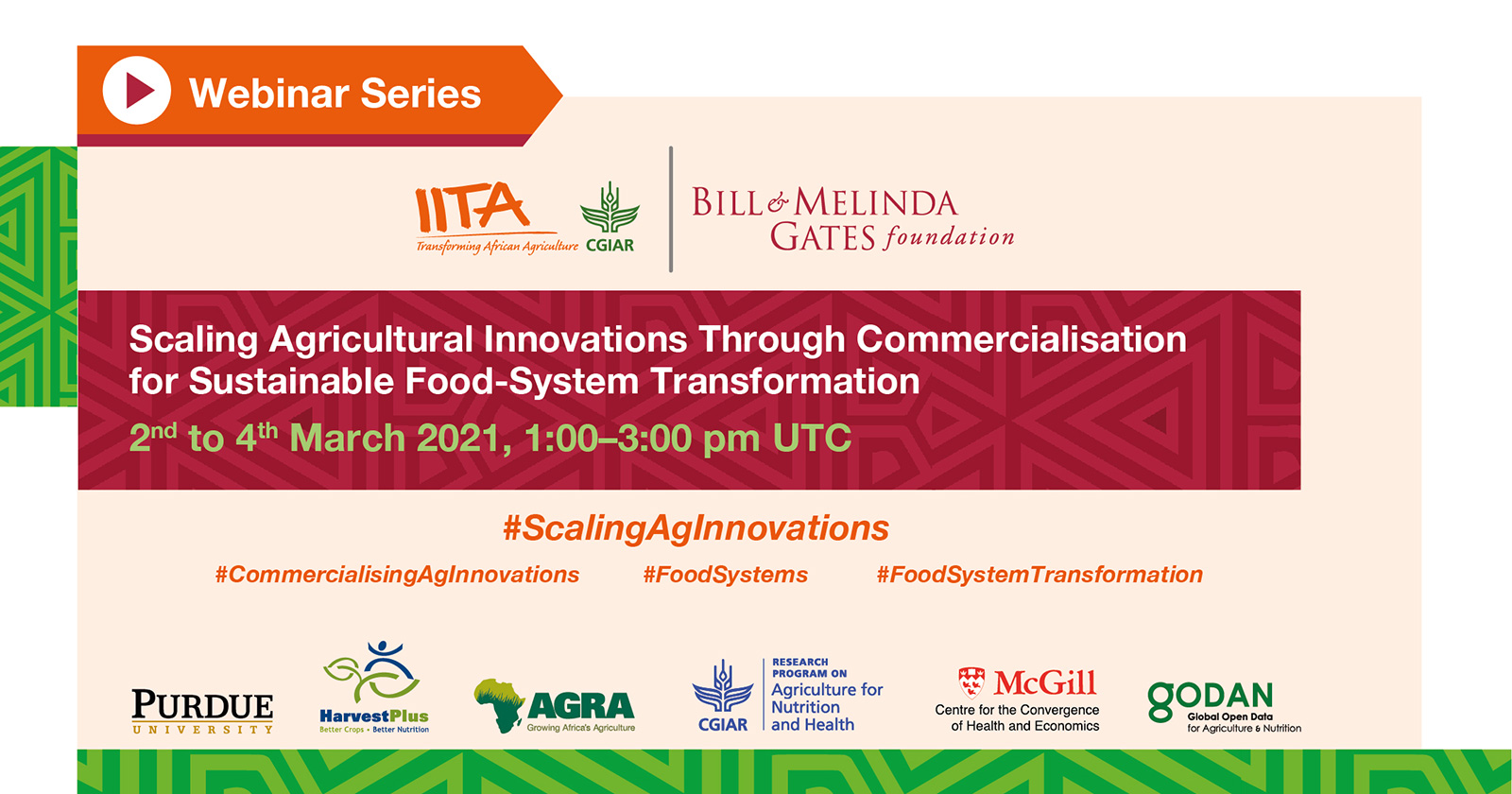
The webinars will run from 2nd to 4th March 2021, all at 1:00–3:00 pm UTC.
- 2nd March – WEBINAR 1: Private-sector engagement in commercialising agricultural innovations to improve food safety and nutrition | Register for this webinar
- 3rd March – WEBINAR 2: Creating an enabling environment to facilitate the commercialisation of food-safety and nutrition-related agricultural innovations | Register for this webinar
- 4th March – WEBINAR 3: Shaping the future development and commercialisation of innovations to improve food safety and nutrition in the context of food-system transformation | Register for this webinar
Target participants
The webinar series will be of interest to:
- Agricultural and food-system technology manufacturers and distributors
- Agricultural commodity producers, processors and bulk traders
- Government representatives, including regulatory agencies
- Development partners, development finance institutions, impact investors
- Manufacturing and testing equipment suppliers
- Regional economic communities
- Research and product development organisations
Background: Africa’s food security, safety, nutrition and trade today
Africa’s food systems are at an inflection point. Food demand in sub-Saharan Africa is expected to at least double between 2015 and 2050. Moreover, income growth and urbanization are driving significant changes in consumer demand, including for more varied, nutritious, and value-added foods. Meanwhile, food security remains a challenge—according to the United Nations Food and Agriculture Organization, every day, 256 million Africans go hungry, 93% of them in sub-Saharan Africa. Production volatility is expected to grow as climate change increases variability and alters growing conditions. These challenges have been exacerbated by COVID-19-related supply chain disruptions and associated economic downturns. Without significant transformation, Africa’s food systems will not be able to meet the growing and changing needs of consumers, increase food security and resilience, and deliver on the promise of inclusive agricultural transformation.
Improved international and regional trade could play a significant role in strengthening Africa’s food systems. The African Continental Free Trade Area came into force in January 2021 and presents an opportunity to strengthen regional trade integration across the continent.
Food safety is a precondition for access to global food markets, and increasingly, to high-value domestic markets in developing countries. Foodborne diseases afflict 91 million Africans every year, with 137,000 dying—one-third of the global death toll. If left unaddressed, food-safety barriers will continue to impede intra-African trade. Therefore, as we rethink the future of Africa’s food systems, food safety is a top priority.
One of the main hindrances to food safety is aflatoxin contamination, which afflicts some of the continent’s key staples such as maize, groundnuts and sorghum. Aflatoxin is a natural poison from toxin-producing types of the Aspergillus fungus. Because aflatoxin contaminates food, consistent exposure results in poison building up in our bodies and damaging health, sometimes leading to rapid death when build-up is acute.
According to the African Union’s Partnership for Aflatoxin Control in Africa, aflatoxin alone is responsible for 30% of liver cancer cases globally, with the highest incidence (more than 40%) occurring in Africa. Trade-wise, Africa loses an estimated USD 670 million in potential export trade alone due to aflatoxin contamination. If we are to effectively fight aflatoxin, there must be cross-sectoral convergence in technology, markets, policy and institutions, as well as behaviour change.
Researchers have developed smallholder-friendly technologies and practices that – together – reduce aflatoxin contamination along the agricultural value chains from plot to plate. Proper post-harvest grain drying, sorting and storage all control aflatoxin contamination. Hermetic storage technologies developed and promoted by several organisations such as the Purdue Improved Crop Storage (PICS) from Purdue University (USA) halt contamination. There are new tools for farmers themselves to monitor post-harvest grain moisture content. There is also Aflasafe® – the commercial name for a natural product applied pre-harvest, already in use in several African countries. Aflasafe was developed by the International Institute of Tropical Agriculture (IITA), in partnership with the Agricultural Research Service of the United States Department of Agriculture (USDA–ARS) and respective national institutions in Africa. Aflasafe consistently reduces aflatoxin contamination in groundnuts, maize and sorghum by between 80% and 100% when the crop is in the field.
An integrated aflatoxin management system, combining these technologies along the entire value chain, would significantly contribute to producing safe and nutritious food in Africa.
Why the webinar series?
Technology and innovation play a critical role in building 21st century food systems. However, no matter how technically perfect they may be, agricultural innovations lying unused on the shelf, or used only by an exclusive few, are of little or no value. To be of value, they must be available, accessible, and affordable to a critical mass of smallholder farmers. For this to happen, it is imperative to identify and pave appropriate pathways for effective diffusion and scaling of innovations.
Generally, research results from publicly funded international agricultural centres reach users through the national agricultural and extension systems. However, in recent years, an increasing number of breakthroughs reach users through commercialisation. Development funders, research organisations, and academia are partnering with private-sector companies, government agencies, and civil-society actors to facilitate the commercialisation of agricultural innovations to improve food safety and nutrition at scale.
IITA and the Bill & Melinda Gates Foundation are co-hosting a series of interconnected virtual workshops to exchange experiences and lessons learned in commercialising technologies to improve food safety and nutrition in smallholder contexts. The insights from the discussions will inform future activities to scale these and other critical smallholder-relevant agricultural innovations. The webinar discussions will also be highly relevant to the upcoming United Nations Food Systems Summit, especially Action Track 1: Ensure access to safe and nutritious food for all.
Specific objectives
- Review experiences to date with the development and commercialisation of agricultural and food-system technologies related to food safety and nutrition
- Discuss approaches to sustaining the commercialisation of agricultural and food-system technologies
- Discuss the lessons learned from donor, public and private sector investments and collaborations aimed at commercialising agricultural technologies
- Discuss how the lessons learnt can inform future policies and investments
Conveners and partners
Co-conveners
Partners
- Purdue University
- HarvestPlus
- Alliance for a Green Revolution in Africa
- CGIAR Research Program on Agriculture for Nutrition and Health
- McGill Centre for the Convergence of Health and Economics
- Global Open Data for Agriculture and Nutrition
The Webinar Series
WEBINAR 1 (of 3): Private-sector engagement in commercialising agricultural innovations to improve food safety and nutrition
2nd March 2021, 1:00–3:00 pm UTC
We will examine the collaboration between research institutions and private companies in commercialising agricultural technologies that address food safety and nutrition challenges. Based on empirical evidence and actual experiences, the keynote speaker and panellists will discuss why and how these partnerships are built and nurtured for sustainable market models. They will also discuss accountability mechanisms for these relationships. Companies which have invested in the manufacture, distribution and marketing of research results will elaborate how they use the business model innovation to adapt to a rapidly changing environment to deliver the technologies, how they overcome challenges, and the success factors to achieving favourable outcomes.
WEBINAR 2 (of 3): Creating an enabling environment to facilitate the commercialisation of food-safety and nutrition-related agricultural innovations
3rd March 2021, 1:00–3:00 pm UTC
While critical for solving pressing agricultural challenges, technological breakthroughs alone are not enough. Considering the nature and profile of intended users – mostly smallholder farmers – ensuring these technologies are accessible requires deliberate and consistent interventions along the entire value chain, and in the larger ecosystem. This webinar focuses on the role of policies and other incentives in creating an enabling environment to support the delivery of technologies. Panellists from governments, NGOs, development finance organisations and funders will discuss the ins and outs as well as how to set up and manage enabling policies and institutions for successful commercialisation of technologies.
WEBINAR 3 (of 3): Shaping the future development and commercialisation of innovations to improve food safety and nutrition in the context of food-system transformation
4th March 2021, 1:00–3:00 pm UTC
The last webinar will consider the implications of past experiences and lessons for the design of future research, development and commercialisation initiatives aimed at improving food safety and nutrition in 21st-century food systems. Panelists will discuss pragmatic guidance for accelerating scaling of key innovations, including opportunities and pathways for commercialisation. Stakeholders from key agricultural research and delivery institutions on the continent will conclude the webinar series with recommendations for future policies and investment.
