Agroecological concepts and principles have gained importance in scientific, agricultural, and policy fields in recent years.
In the South-Kivu province – in the Democratic Republic of the Congo –, some research institutions, academia, NGOs, and farmers’ organizations are currently carrying out various activities and programs relating to agroecology. Part of these activities are carried out in partnership while others are implemented in a stand-alone manner.
In line with the DELIBERATE project, for instance, the International Institute of Tropical Agriculture (IITA) and the Swiss Federal Institute of Technology Zurich (ETH Zurich) jointly embarked on research undertakings in agroecology in the South-Kivu province.
This also applies for CANALLS Project, in which several national and international partners are engaged in the joint search for solution approaches towards an agroecological transition. Some local universities – including the Catholic University of Bukavu (UCB), the Université officielle de Bukavu (UOB) and the Université évangélique en Afrique (UEA) – also administer diploma (Degree) curricula in agroecology.
Hence, in a bid to share the results of the research carried out, IITA and ETH Zurich – in collaboration with the Catholic University of Bukavu (UCB) – are organizing an Agroecology Day, under the DELIBERATE project which sets a nexus between quality deliberative discussion regarding soybean and coffee value chains and the ecological “food footprints” in South-Kivu and Kasaï provinces.
It is in that light that a Conference is planned, as a forum for sharing experiences and knowledge on agroecology, so as to have a wholesome picture of activities relating to this area in the South-Kivu.
The said Conference will be held on May 7, 2024, at the Olusegun Obasanjo Research Campus (IITA Station) in Kalambo, South-Kivu, and is expecting about 120 attendees.
It is worth noting that, as side events of the Conference proceedings, two workshops are planned in collaboration with soy and coffee producer organizations, for the purpose of strengthening the cooperatives’ potential and discuss the roles and ways of improving the peasant organizations’ functioning for sustainability.
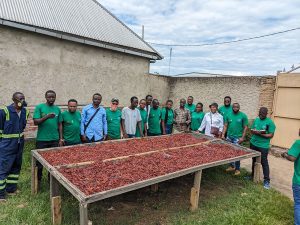
Youth entrepreneurs at the chilli pepper drying stand.
In line with the mandate of the PICAGL integrated agricultural growth project in the Grand-Lakes region, implemented by IITA as part of its youth entrepreneurship development program in the cassava component, young entrepreneurs from the DRC, Rwanda, and Burundi took part in exchange sessions, intending to boost their activities by drawing inspiration from the models of other young people who are sufficiently advanced in entrepreneurship.
These exchange visits enabled young people from the countries of the Great Lakes region to learn about the reality and operation of their small and medium-sized enterprises (SMEs).
In Kigali, Rwanda, young people from Bukavu and those from the Kabare territory in South Kivu in the DRC took an interest in livestock breeding and fish farming.
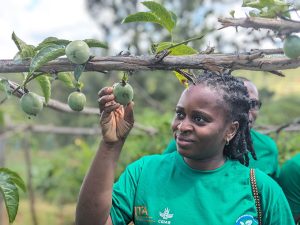
A female entrepreneur inspecting a macaruja fruit before harvest.
Accompanied by their colleagues, they visited GASOGI FISH RABBIT PIG (over five years experience) FARMLTD, a fish farm with a semi-modern hatchery with a production capacity of modern hatchery with a production capacity of 30,000 alvins per week and rabbit breeding, and the SEVERINE BUSINESS company (five years experience) specializing in laying hen breeding, with a henhouse with a capacity of almost 6,000 laying hens, which it delivers to its various customers in Rwanda and the DRC.
In Burundi, on the other hand. The youths that came from the RDC, promoted by IITA works in the production, transformation and commercialization of agricultural products were able to visit the fruit and pepper plantations for the purpose of exchanging experience and learning from their agripreneur colleagues in the country.
The companies in question are Best Food Solutions Plus and SIFA Business (SAFIBU), which specialize in the processing of chili pepper and maracuja juice, and tangawizi – ginger and infant flour, respectively.
The young people discussed the opportunities offered by the environment and the challenges they face daily, as well as the good agricultural practices used to produce fruit for the processing of maracuja juice in Bujumbura.
SIFABU, for example, produces an average of 80 cases of 30 bottles a week and employs at least 100 people in the various raw material production sites and the factory.
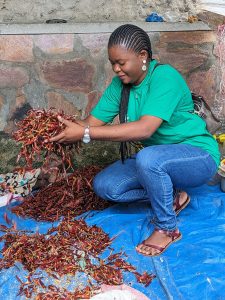
A female entrepreneur inspecting the chilli pepper during the drying process.
At the same time, in Burundi, the team of entrepreneurs from Bukavu, Plaine de la Ruzizi in South Kivu, and Kalemie in Tanganyika province exchanged views with MDE (Maison De l’Entrepreneur), a youth business incubator in Burundi.
It supports young people working in the market-oriented value chain, especially in fruit, pepper, and vegetable production. MDE’s support includes technical training, coaching, and facilitating access to credit.
Contributed by Isabelle Buhoro
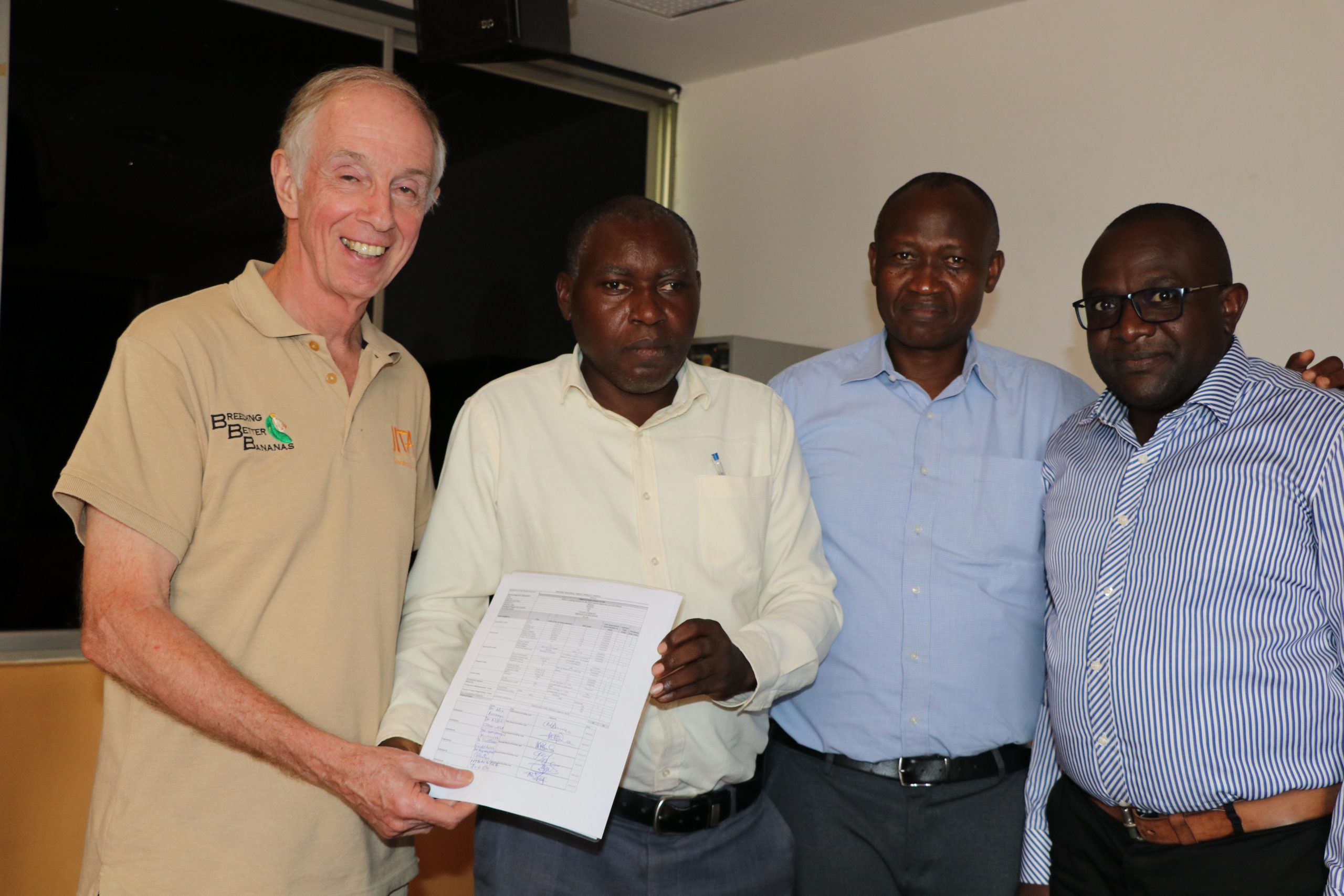
IITA–CGIAR and six national agricultural research centers have signed the Mchare and Matooke Regional Target Product Profiles to enhance banana breeding and breeding impact in East Africa to better serve smallholder farmers and their families. This agreement, signed during the recent East Africa Banana Network Meeting in Kampala Uganda, aims to develop and test new banana hybrids jointly in the highlands of Eastern Africa, following standardized breeding and testing procedures.
The country banana research leads signing the Mchare and Matooke Regional Target Product Profiles. (Photo: G.Ndibalema/IITA).
The agreement was signed by country banana research leads from Burundi, the Democratic Republic of Congo, Kenya, Rwanda, Uganda, and Tanzania in the presence of IITA Head of Breeding Hapson Mushoriwa and representatives of Genetic Innovation’s Accelerated Breeding Initiative. These countries represent about 40% of banana production in Africa, and this initiative marks the establishment and launch of the East African Banana Breeding Network, which aims to accelerate the delivery of improved banana varieties in the region.
IITA Banana Crop Lead Rony Swennen highlighted the significance of the network, noting that traditional banana breeding processes are time-consuming and costly. He emphasized that through the network, breeding and testing can be expedited, with a focus on meeting specific country needs rather than solely relying on what breeders can offer. In the end, farmers will benefit more quickly from the new varieties.
The country banana research leads handing over the signed protocol to Dr Rony Swennen. (Photo: G.Ndibalema/IITA).
Just like the breeding of all RTB crops—banana, cassava, potato, sweet potato, and yam—is being tackled together instead of on an individual crop basis, through the Bill & Melinda Gates Foundation-funded project, RTB Breeding, it is important and practical for NARS to also work together despite the different countries and realities they represent, so all benefit from the shared learning and intellectual cross pollination.
The network aims to streamline the breeding process by sharing breeding data collected by a few breeders. This collaborative effort will focus on product profile and market segmentation, product design, on-farm testing, product registration, and product launch in their respective countries.
To ensure a standardized and systematic flow of information for decision-making, the network will follow stages and gates of communications throughout the breeding process using the RAPID (Recommend, Input, Agree, Decide, Perform) model. These stages involve product design, trait deployment, crossing and screening, early testing, pre-commercial testing, product registration, and product introduction. Breeders must pass through gate decisions, including crop strategy and product profile agreement, defining trait deployment strategy, selecting clones for preliminary yield trials, advancing candidates for on-farm trials, and advancing candidates for variety release to move to the next stage.
IITA Molecular Breeder Brigitte Uwimana advised, “NARS and breeders are encouraged to apply the stages and gates depending on what suits their work to adopt the framework of the communication flow.”
The banana network was well-received and commended by participants as a transformative initiative in accelerating regional banana improvement. NARS representative from Burundi Celestine Niyongere suggested, “I recommend we start by prioritizing the countries’ needs and demands and use the already available resources.”
Jules Bagula, the NARS representative from the Democratic Republic of Congo, expressed, “INERA is willing and ready to follow the Mchare and Matooke dissemination procedures. Moreover, the new network is an opportunity for DRC to improve its collaboration with CGIAR and other NARS involved in the region.”
Generose Nziguheba of VIB-IPBO emphasized that the participants should consider harmonization and data/protocol sharing by observing country policies and accepting the data from specific countries to enhance the efficiency of the network.
During the meeting, participants defined the network’s main activities and members’ responsibilities. All country representatives had the opportunity to nominate the network steering committee representative for their respective countries. The chair of the steering committee is Rony Swennen (IITA) and members are Alex Barekye (NARO-Uganda), Mpoki Shimwela (TARI-Tanzania), Benjamin Kivuva (KALRO-Kenya), Mary Mwanga (KU-Kenya), Immaculee Nishimwe (RAB-Rwanda), Celestin Niyongere (ISABU-Burundi), Jules Ntamwira Bagula (INERA-DR Congo).
This collaboration marks a significant step towards enhancing banana breeding efforts in East Africa, focusing on meeting the specific needs of the region’s farmers and increasing food security and income through farming of improved cooking banana.
Contributed by Gloriana Ndibalema
On 5 March, the Ruzizi Plain site of the Agenda for Agricultural Transformation in the Democratic Republic of Congo (ATA-DRC) program launched the harvest campaign for season A and crop season B.
The Minister of Agriculture, Fisheries and Livestock in South Kivu province, Jean Bosco Ruteye Kitambala, attended the launch as part of the realization of the Head of State’s vision to strengthen agricultural production above mining operations.
The program is run by the Ministry of Agriculture, with technical support from IITA, BAB, AALI, and other state institutions, including INERA, SENASEM, the Agriculture Inspectorate, and SNV.
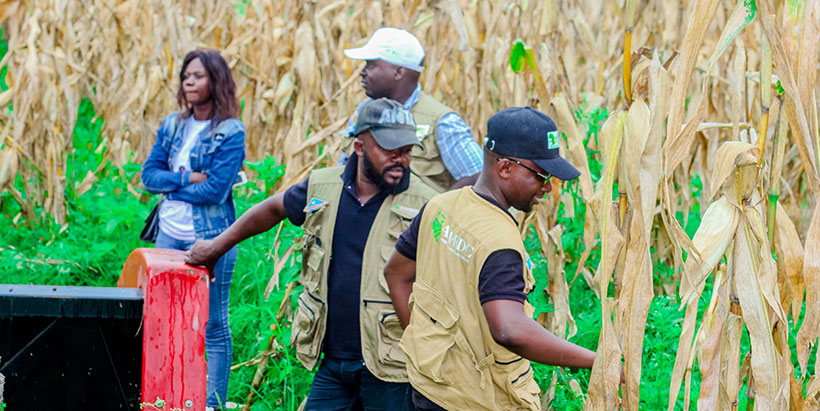
The maize field before the harvest.
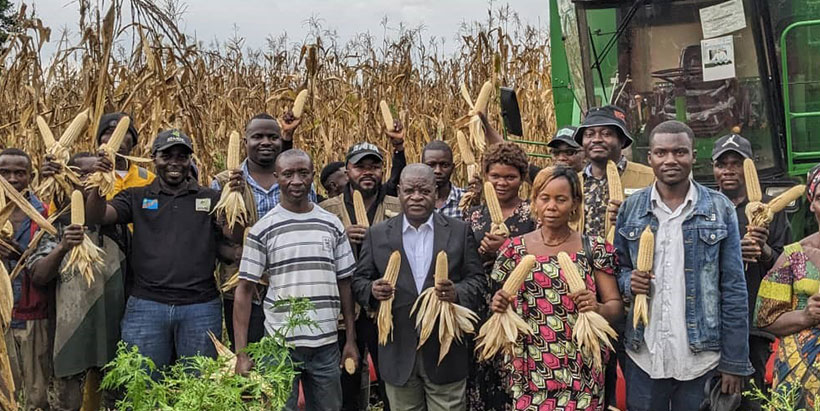
In the Ruzizi Plain, in MATABA, this project has cultivated 30 ha of maize and 30 ha of soya, and other households in the Ruzizi Plain have benefited from fortified organic maize seed. They will return 10% of the harvest, which will be processed locally to provide the community with high-quality flour.
The community corn hybrid production field belonging to the Association for the Development and Promotion of Peace (ADPP) has been chosen as the pilot site for this activity.,
Participants in the field during the launch of the harvest season campaign.
Ruteye Kitambala said the initiative aims to improve household and local population income, increase farm household incomes, and significantly reduce food imports into the country. He expressed his satisfaction with the work accomplished by the government’s partners in this initiative.
ATA-DRC is currently being carried out in 4 pilot provinces, including Mongata in the city-province of Kinshasa, Nkuadi in Kasaï Oriental, Nkudi in Central Congo, and Plaine de la Ruzizi in South Kivu.
Farmers holding harvested maize cobs.
The program aims to prioritize agriculture over mining, aligning with the Head of State’s vision to transform agriculture into an economic powerhouse.
Contributed by Isabelle Buhoro
Dr. Casinga facilitating a session during the training.
A three-day training workshop was held in Kamanyola, on the Ruzizi-South Kivu plain, for 15 agricultural inspectors from the Uvira and Fizi territories on the viral diseases that often attack cassava, a vital crop in most of the territories of South Kivu.
This training will enable them to acquire knowledge and skills in disease diagnosis through mobile applications, including the PlantVillage Nuru mobile application for comprehensive epidemiological surveillance, enabling the implementation of appropriate contingency measures for abundant and sustainable agricultural production in the province of South Kivu.
IITA researcher and virologist Clerisse Casinga explained how, after collection, the data is transferred directly to the servers installed at the Kalambo laboratory in the DRC, from Nigeria and the one installed in the United States of America via the smart phones given to them at the end of the training.
“IITA is implementing one of the largest agricultural recovery programs in the world, called the Agenda for Agricultural Transformation. With this in mind, we are here to train agricultural inspectors,” he explained.
Casinga continued, “We know that diseases hinder agricultural production. To get around this, we need to train inspectors in different areas. The aim is to train them in agricultural digitization and give them applications that will enable them to detect diseases in real time. The tools handed over are not for communication but rather for work. Still, within the digitalization framework, there is artificial intelligence that they will use to detect diseases.”
Beneficiaries and Facilitators of the training.
Among these viral diseases, Casinga cites mosaic and brown stripe. Other challenges at the root of low cassava production were mentioned; they include inadequate agricultural policy, the lack of innovative technology, the persistence of old agricultural technologies, insufficient budget allocations to agriculture, soil degradation, and the lack of up-to-date agronomic research.
The training was part of the Agenda for Agricultural Transformation in the DRC (ATA-RDC), led by IITA in collaboration with USAID Feed The Future and PlantVillage Nuru.
Contributed by Isabelle Buhoro
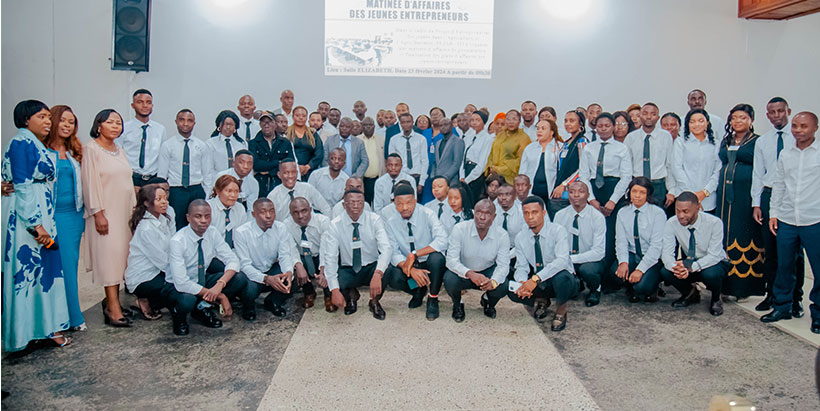
Over 60 young people from South Kivu have been trained in agricultural and agribusiness entrepreneurship by IITA–CGIAR as part of the Projet d’Entrepreneuriat de Jeunes dans l’Agriculture et l’Agrobusiness (PEJAB) project.
The closing ceremony and the presentation of business plans were organized on 23 February during a business morning in Bukavu.
Beneficiaries of the training.
According to IITA-Kalambo Administrator Julie Lunzihirwa, these young people received technical and entrepreneurial training on several cross-cutting modules, mentoring and coaching, and visits to exchange experiences and learn from each other to promote the young graduates the spirit of creating profitable businesses, integrated into promising agropastoral sectors.
“At the request of the Government of the Democratic Republic of Congo, the International Institute of Tropical Agriculture (IITA) was asked to provide technical assistance to PEJAB. The AfDB was to finance the technical assistance to be rendered by IITA. This request was justified by IITA’s experience in implementing similar projects in Madagascar, Côte d’Ivoire, and Sudan, and the offer for technical assistance was prepared in this regard. Today, IITA presents over 60 young people who have been trained in collaboration with its partner, COSECOT, for six months, some of whom are going to present their bankable business plans, which we hope will attract your attention and receive financing from investors and certain financial institutions,” she declared.
For his part, the provincial minister in charge of agriculture, Jean Bosco Ruteye Kitambala, promises to support these young people and hopes they will flood the market to reduce unemployment and food insecurity.
“The efforts made by IITA to train young entrepreneurs in South Kivu with cross-cutting themes align with the provincial government’s aim to offer young people the space to develop their entrepreneurial skills in a healthy business climate. It is the duty of those in authority, who also serve as guardians, to accompany young people in their daily entrepreneurial activities to limit the rate of unemployment, banditry, and perdition for their better future and that of our beloved province. Our concern is to see these young people flood the city and regional markets with local production and no longer rely on imports, which do nothing to enhance our pride and joy,” he declared.
The trainees were satisfied with the knowledge they had acquired and hoped to find financial partners to turn their projects into reality.
PEJAB’s representative, Marie Caroline, was pleased to see that 68 companies, newly created by these young trainees, had legalized their documents at the end of the business morning.
This intense training program began on 26 October 2023 in Kalambo, South Kivu province, lasting over three months.
Contributed by Isabelle Buhoro
As a reflection of his outstanding contributions to agriculture and food security in Africa, the immediate past Director General of IITA and President of the Africa Agricultural Leadership Institute (AALI), Dr Nteranya Sanginga, has been appointed as Emeritus Director General of IITA.
Sanginga’s appointment comes at a time when the Institute is aligning its vision with strategic partnerships towards transforming the seeds and food systems on the continent.
With his other positions as Special Envoy for Feed Africa, Champion for Fertilizer and Soil Health Summit, and Special Adviser to the DRC President on agriculture matters, Sanginga will bring to bear decades of experience in leadership and research to his new appointment.
Speaking about the new role, Sanginga said he would do his best to deliver with excellence on the responsibilities that come with the role. “It means a lot to me and shows how special IITA is. I have taken note of the responsibilities associated with my new role and will do my best to deliver,” he said.
Congratulating Sanginga, IITA Director General and CGIAR Regional Director for Continental Africa, Dr Simeon Ehui, said the recognition is well deserved and Sanginga’s dedication to IITA’s mission has been invaluable.
“I look forward to his continued support for the Institute on the continent in his capacity as the Emeritus DG,” he added.
Contributed by Timilehin Osunde
In the heart of the Democratic Republic of Congo (DRC), where vast landscapes hold immense agricultural potential, the Great Lakes Accelerated Innovation Delivery Initiative Rapid Delivery Hub (AID-I GLR) has been making strides since early 2023. Initially launched in the South Kivu province, this transformative initiative has been exposing and delivering improved agricultural and nutritional technologies to smallholder farmers, enhancing the value chain of food-security crops such as cassava, maize, rice, banana, orange-fleshed sweet potato, beans, vegetables, and livestock.
Participants of the kick-off workshop.
As we approach the end of the first year of its implementation, AID-I GLR is poised for expansion into Haut-Katanga province, where challenges to agricultural development loom large. In this new frontier, the project aims to promote maize, cowpea, and soybean value chains, addressing the agricultural deficit and confronting the threats posed by mining activities, traditional farming practices, and the absence of financial support. This ambitious endeavor is set to redefine Haut Katanga’s landscape, exposing farmers and promoting sustainable agricultural practices.
On 8 December, IITA-CGIAR orchestrated a pivotal workshop in Lubumbashi, marking a crucial step in AID-I GLR implementation in Haut-Katanga.
Haut-Katanga, known for its huge arable land covering 2,760,300 million hectares, faces a paradox where abundant resources coexist with insufficient agricultural output. The population in Haut-Katanga heavily relies on imports for basic food staples, highlighting its vulnerability to external factors. The AID-I GLR initiative steps into this void, recognizing the untapped potential and aiming to reverse the tide. However, numerous challenges include violating mining operations on farmland and migrating farm labor to small-scale mining. The looming threat of fall armyworms damaging maize crops, the dominance of subsistence farming, and the lack of agricultural financing institutions pose significant challenges.
Dr Jacob Mignouna, AID-I GLR Project Coordinator in DR Congo presented the scope of the project and expected deliverables in Lubumbashi.
AID-I GLR National Coordinator Dr Jacob Mignouna urged the selected scaling partners to propel innovations in the province. The aim is to foster a collaborative approach, establishing a partnership led by COOPAGEL (Coopérative Agricole et d’Elevage) to expedite the delivery of enhanced agronomic technologies to smallholder farmers.
This collaboration builds upon existing networks involving grassroots farmers’ organizations, including Ferme Agropastorale Bon Berger, Lugo Farm, and Mimosa, focusing on maize, cowpea, and soybean value chains. The significance of this partnership lies in its potential to catalyze agricultural innovation and transform the lives of the rural population.
The initiative seeks to invigorate agriculture, enhance food security, and promote nutritional well-being by widely adopting proven technologies and innovations. Developed in collaboration with CGIAR and its partners, these technologies include hybrid varieties, bio-fortified OPV (Open-pollinated Varieties), and QPM (Quality Protein Maize) varieties.
Demonstration fields in local communities will serve as living laboratories, while capacity-building programs will educate farmers on improved agronomic practices, soil fertility, and disease management.
The overarching goal of AID-I GLR in Haut-Katanga is to reach 12,000 households, focusing on women and youth. This outreach will be realized through a consortium comprising strategic scaling partners—Ferme Agropastorale Bon Berger, Lugo Farm, and Mimosa—led by COOPAGEL. These organizations boast over a decade-long presence in the target areas, possessing extensive networks of small-scale farmers and well-resourced extension networks.
COOPAGEL Chief Executive Officer Lydiane Nabami emphasizes the importance of peer-to-peer training in ensuring smallholder farmers’ long-term, sustainable adoption of innovations. Acknowledging the low levels of education among farmers in Haut-Katanga, she underscores the need for relatable and accessible training approaches. Madame Nabami advocates for presenting successful case studies from fellow farmers who have embraced change, believing that this approach fosters a sense of ownership and confidence among the farming community.
Baudouin Kakudji, the Provincial Inspector of Agriculture in Haut-Katanga, echoes this sentiment, highlighting the effectiveness of community-driven dissemination of agricultural technologies. Demonstrations, exchange forums, and open discussions among farmers, facilitated by existing partners, are identified as vital tools for fostering adoption. Kakudji urges farmers to rally behind those bringing transformative technologies, ensuring their voices are heard and their opinions are considered in the project’s implementation.
Before implementation in DRC, AID-I GLR began in Burundi and Rwanda and aims to contribute to improving food and nutrition security in the region through the rapid adoption at scale of proven technologies and innovations developed mainly by CGIAR and partners.
The densely populated city of Bukavu faces increasing environmental decay, while the surrounding rural areas are experiencing an increasing soil fertility depletion. Projects to improve waste management in the town, although insufficient, are underway. However, they are being implemented in a scattered and uncoordinated way with overlapping efforts and weakened impact.
Participants during one of the workshop sessions.
IITA–CGIAR and the Municipality of Bukavu Town, under the RUNRES project—funded by the Swiss Cooperation Agency—organized a workshop to share experiences and set up joint actions and ways to improve the management and recycling of organic waste for more productive and resilient agriculture in the Bukavu rural areas.
The workshop took place at the Olusegun Obasanjo Campus, IITA-Kalambo, on 27 and 28 September 2023. The South Kivu provincial minister of agriculture, provincial minister of environment, officials from Bukavu municipality, local and traditional authorities such as the king of Kabare territory (Mwami), the administrator of Kabare territory, representatives of public research and developments services (INERA, SNV, etc.), civil society, representatives of the Federation of DR Congo’s enterprises (FEC), stakeholders who are involved in garbage collection and recycling, farmers, media, academia, researchers and delegates from international organizations attended the event.
Participants of the workshop.
About 70 people attended the two-day event, with presentations on past and ongoing waste recycling-related initiatives being implemented by research-oriented institutions and private organizations in Bukavu. RUNRES experiences in other countries (such as Rwanda) were shared with the participants, and one of the three waste processing sites set up by RUNRES in DRC was visited. There were group works during which participants set up roles and responsibilities of different actors, including the government, to strengthen waste nutrient recycling from organic waste in Bukavu and its rural areas.
Insightful debates and discussions followed presentations, field visits, and group work. The participants welcomed the collective and concerted initiative, which began in waste collection and recycling, and strongly expressed the wish to see the initiative carried on under the guidance and leadership of the provincial political and administrative local bodies.
Representatives of the local authorities made concrete pledges to support the initiatives, such as His Majesty the Mwami (Chief) of Kabare pledging to locate a waste processing site in the Kabare district. The Université Evangelique en Afrique (UEA), through Professor Katcho Karume, pledged to carry out the environmental study of the site that the chiefdom will allocate.
Participants urged donors, international institutions, the government, and all other actors to leverage and support the dynamics of multi-actor consultation and co-design to increase and sustain nutrient recycling from organic waste to establish a bio-circular economy in Bukavu City and its surrounding areas.
An adhoc committee was set up to monitor compliance with the resolutions and guidance from this workshop.





 Sanginga’s appointment comes at a time when the Institute is aligning its vision with strategic partnerships towards transforming the seeds and food systems on the continent.


