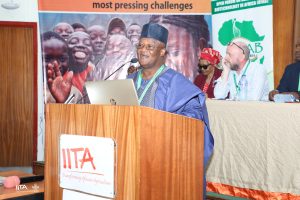
The Executive Governor of Oyo State, Seyi Makinde, joined state officials and other stakeholders in the agricultural sector at a retreat in Cotonou, Republic of Benin to chart a course for transforming agriculture in the State. The meetings, which took place from 15 to 19 August, were to design an agribusiness implementation plan for Oyo State.

Oyo State Government commits to transform agriculture
L–R: Speaker of the Oyo State House of Assembly, Rt Hon. Debo Ogundoyin; Oyo State Governor, Engr Seyi Makinde; and
IITA Deputy Director-General, Partnerships for Delivery, Kenton Dashiell during the three-day retreat on agribusiness
in Cotonou, Republic of Benin.

The Governor promised officials of the State that the administration will give agriculture the necessary attention  to play its role and transform the economic fortunes of the State.

“I want to assure all the participants that Oyo State will provide the political will needed to make the State the agribusiness hub of Nigeria,” Governor Makinde said at the retreat, which IITA facilitated.

Governor Makinde also promised to attract more private investment to agriculture by providing an enabling environment. He said the State would ensure agribusiness-friendly policies that would boost investor confidence.

Since assumption of office on 29 May 2019, the Governor has pledged to transform the narrative of agriculture with the view to making it the pillar of the State’s economic development. The retreat provided an opportunity for the Governor to unveil his vision for agriculture.

IITA Deputy Director-General, Partnerships for Delivery, Dr Kenton Dashiell, commended the Governor for demonstrating an uncommon leadership style by participating in all the sessions of the three-day retreat.

“I have never seen such a commitment from a Governor… and I believe the document coming out of this retreat will help the State to achieve the vision of an agribusiness hub for Nigeria,” he added.

Dr Martin Fregene, Director for Agriculture and Agro-Allied division at the African Development Bank (AfDB), said the commitment of the State to agriculture was a step in the right direction.

Addressing the Governor he said, “Let me also commend you for organizing this very important meeting and participating fully in it to have a vision and an implementation plan for agribusiness in the State,” he said via Skype. “For Oyo State to move forward in agriculture, you must treat agriculture as a business,” he added.

According to the AfDB director, the Bank would be willing to support the State in its quest to transform agriculture.

The retreat had four sessions comprising: Developing a vision for the State in agriculture, Identifying the obstacles

to the vision, Developing strategic actions to deal with the obstacles to the vision, and Developing an implementation plan.

Adebowale Ak ande, Executive Adviser to the Governor on Agriculture gave a thumbs up to the retreat, adding

that recommendations from the retreat would help the State to achieve its vision of becoming an agribusiness hub.
As part of its effort in extending agribusiness opportunities to more youth in Africa, ENABLE-TAAT, the youth enabler compact of the Technologies for African Agricultural Transformation (TAAT) in collaboration with the Togolese government, organized a 4-day comprehensive training for trainers at Centre Pilote des Techniques Agricoles du Togo (CPTA), in Lomé, Togo 11–14 June.

The training, which was a follow up on the sensitization and awareness creation carried out by ENABLE-TAAT at the National Farmers’ Forum organized by the Togolese government in April 2019, is the first step leading to the implementation of the TAAT youth program in Togo.

ENABLE TAAT Trainer-Valentina Ekun facilitating-one of the sessions

It was organized to ensure that trainers, who would be training youth during the ENABLE-TAAT pilot phase, are well-equipped with the skills to run an incubation program, and enlighten them on the technologies promoted by TAAT.

With this expansion, ENABLE-TAAT will develop agribusiness skills, change counterproductive mindsets, and provide economic opportunities to rural youth in agribusiness, including young women.

The compact will also work with other TAAT commodity value chains to establish a range of innovative, youth-led agricultural enterprises and consolidate the gains along value chains, including higher-value crop production, marketing, value addition, and a range of agricultural services.

In addition, it will support rural enterprise networks that provide youth-led initiatives with interactive agribusiness and financial information and raise the creditworthiness of aspiring youth going into agribusiness.

Addressing the participants at the training, the Head of TAAT Clearinghouse, Mpoko Bokanga, stated that the training marks the beginning of agricultural transformation in Togo.

“Africa has to feed itself. We cannot wait for other continents to feed us. We have the land mass, climate, and weather, but what is hindering us I believe is the technology. Hence, TAAT has come to introduce improved agricultural technologies so that there can be an agricultural transformation in Africa and in Togo especially,” he said.

The representative of the Minister of Agriculture in Togo, Mr Kpadenou Kodjoga, advised the trained youth to be dedicated and tap into the vast agricultural technologies being promoted by TAAT through the young people working under ENABLE-TAAT.

The training had about 54 participants who were trained on topics that included youth marginalization, its negative impact on the economy and ENABLE-TAAT as a solution, the Agripreneurs movement, youth incubation, and agribusiness rural enterprise which covers topics on Agribusiness and incubation, Value chains, Mentorship, Financial management, ICT in agribusiness, and Marketing.

One of the participants, Tsibi Blakeur, a trainer at Institut National de Formation Agricole (INFA) said the training had enlightened him about the available opportunities along the agricultural value chains focusing on improved technologies. He further said that he is ready to transfer the knowledge to other youth.

The Biotechnology Society of Nigeria (BSN) held its 32nd Annual International Conference at IITA-Ibadan on 18–22 August. The conference assembled people from mainstream biotechnology and related disciplines to discuss ways to enhance food security in sub-Saharan Africa through biotechnology.

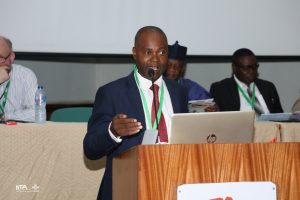
Prof Vincent Ado Tenebe, Chairman, BSN Board
of Trustees, addressing the attendees.

BSN celebrated 38 years since its inception on 11 August 1981 at the University of Jos. It now has 16 working groups/thematic sessions representing the pool of experts reflecting the multidisciplinary nature of biotech. This allows for greater networking and collaborative opportunities among researchers involved in those disciplines in Nigeria and the international community.

The Society has grown over its nearly four-decade history as a foremost scientific society of biotechnologists in Nigeria. One of the major functions of BSN is to encourage the exchange of ideas among scientists of different disciplines on the concept and application of biotechnology through meetings such as conferences, symposia, workshops, public lectures, exhibitions, and publications.

BSN, working towards achieving its goal of enhancing food security in sub-Saharan Africa, plans to replicate partnerships with CGIAR centers like IITA and the national agricultural research systems (NARS) of Nigeria, as this has always provided international focus and direction for productivity through research.

BSN President Prof Benjamin Ewa Ubi giving a presentation

While delivering his keynote address, Benjamin Ewa Ebi, President of BSN, emphasized IITA’s contribution and the strategic role it has played in BSN through capacity development and other deliverables. “IITA does not only give fish but also teaches how to fish,” he said.

In validation of the relationship between BSN and IITA,  May-Guri Saethre, IITA Deputy Director General, Research for Development, noted that biotechnology is an integral part of IITA’s research program. “I really hope this conference will provide an arena for group discussions and some new research topics to ensure productivity between BSN and IITA,” she said.

In the course of the meeting, the keynote speaker—Executive Director of Forum for Agricultural Research in Africa (FARA), Dr Yemi Akinbamijo—highlighted the importance of food to man and importance of biotechnology to enhancing African agriculture. He said, “For the 800 million people going to bed hungry, food is medicine. Although there is a strong demand on Africa’s agriculture to do twice as much with half the resources, this is doable if biochemists will rise.”

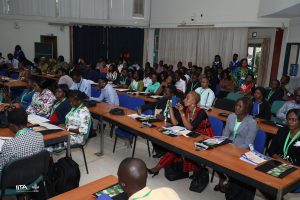
Participants at the conference.

Also stating the importance of biotechnology, the Chairman BSN Board of Trustees, Vincent Ado Tenebe, mentioned the problems of food security and unemployment in Nigeria, and biotechnology being the only solution to these problems. “The major problem we have is jobs for the youth. If we can provide a solution to unemployment through the different aspects of biotechnology and get the youth engaged, they will be productive,” he said.

While addressing participants, Michael Abberton, Head of IITA’s Genetic Resources Center and Chairman, Local Organizing Committee, said he hoped the meeting, both in its formal and informal parts, would lay the foundations for new research and inspire a new generation to take that research forward.

One of the oversight functions of the commodity value chains in the Agricultural Transformation Agenda Support Program, Phase One (ATASP-1) is to link farmers and producers to off-takers of their products. Based on this, a team from Dufil Prima Foods Plc., Lagos, makers of Indomie Noodles, Power Oil, and Hypo bleach, was in Niger State a few months ago to explore the establishment of a cassava factory that will produce starch for their factory. ATASP-1 Cassava Commodity Specialist, Dr Richardson Okechukwu, facilitated this trip and linkage.

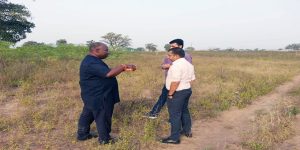
Dr Okechukwu and officials of the Dufil Prima Foods PLC on a field visit in Niger state

Diwakar Yadavalli and Narayan Agarwal represented Dufil Prima Foods. The team arrived at Duma community for an overview and cognizance survey of cassava farms and land availability. They were happy with the cassava farms they saw and returned the following day for more discussions. The team met with the Permanent Secretary, Niger State Ministry of Agriculture, Dr Ibrahim Garba Musa, ATASP-1 Zonal Outreach Officer, Aishetu Aliyu, ATASP-1 Agribusiness Officer, John Yisa, and other officials from the Ministry’s office at Minna.

At the meeting, Okechukwu explained to the Permanent Secretary the purpose of the visit which was to intimate the government of the choice of Niger State as a potential location for siting a cassava factory.

The Permanent Secretary welcomed the investors and informed them that Niger State has the largest land mass in Nigeria and that cassava is a main crop cultivated throughout the State. He said the government would be glad if they invested in the cassava sector to solve the problem of off-take usually experienced by farmers in the State. Musa thanked IITA and ATASP-1 for this initiative and said that in addition to the Suleja zone, cassava is also abundant in the Wushishi zone of the State. The field visit took the visitors and ATASP-1 officials to Chadozhiko in Wushishi LGA and Duma in Suleja LGA.

They drove through Bida-Agaie-Gulu communities where cassava is also largely grown. There were group discussions with famers and elders in both communities and cassava samples were harvested from farmers’ fields which the Dufil team took for further analysis. During the interaction with famers, Dufil was told that farmers in Chadozhiko numbered about 1000, while those in Duma were about 1500. The average farm size was 1.5 ha in both locations. The Dufil team also asked the farmers if they had existing contracts for root supply with any off-taker and the answer was negative. The farmers requested the investors to visit again and spend more time in the field to see their farms. They enumerated their challenges in cassava cultivation as inadequate tractors for land preparation and lack of credit facilities to expand their farms.

Presently they produce and sell to anyone who is interested but will want to have a company built in their locality. The team left Minna for Lagos with a promise to return for more detailed evaluation.

The IITA Youth Agripreneurs (IYA) and Business Incubation Platform (BIP) joined the rest of the world to celebrate International Youth Day (IYD) 2019 with a symposium themed, “Transforming Education,” on 15 August. This year’s IYD highlighted the need for transformation in education systems to make them more inclusive, equitable, and relevant for the 21st century.

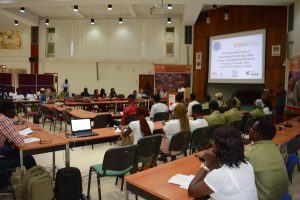
Youth attendees at the conference center.

The annual IYD is part of public information activities to bring awareness to the role of young people as essential partners in regional and global change. It serves as an opportunity to highlight the challenges and problems facing the world’s youth.

Program Coordinator of Technologies for African Agricultural Transformation  (TAAT), Chrys Akem opened the symposium during which he discussed the objectives of TAAT and the need for youth to take agribusiness as a passion. He said to the youth, “Don’t give up on agribusiness, good things don’t come easy, but we will do all we can to help you. I assure you that TAAT is strongly behind you.”

Paul Woomer, Technical Adviser to IYA, praised IITA’s commitment to youth involvement in agribusiness. He also encouraged the youth to come up with stronger business plans that can facilitate funding. He said, “We have a huge challenge before us, but we also have the tools and teamwork needed to meet those expectations.”

IITA encourages youth engagement in agribusiness in Africa with its “agripreneur” model of youth in agribusiness. Many countries in sub-Saharan Africa have adopted this model and the Institute is actively involved in socioeconomic research that has contributed significantly to advance the world’s research agenda to include mentoring and coaching youth.

Presenters at the symposium emphasized that empowering youth to become innovators and “agripreneurs” is key to solving some of the most binding constraints to the growth of a prosperous agricultural sector, thriving agribusiness value chains, and improved food and nutrition security.

Representatives of IYA, BIP, and the Nigerian National Youth Service Corps (NYSC) encouraged the youth to embrace agribusiness as a means of sustaining themselves instead of looking for white collar jobs that might not allow them to discover their real capabilities.

Smallholder farmers in Africa can increase their productivity and improve their means of livelihood if they are able to access agricultural information, which is a key factor in IITA’s goal of transforming African agriculture.
Using radio to disseminate vital agricultural messages, especially for rural dwellers, is one way of achieving this.

Applause as DG Sanginga switches the On Air sign (above).

To harness this advantage, IITA formally launched a radio broadcast service, Radio IITA, on 14 August, at the Ibadan headquarters of the Institute. The launch took place as part of the IITA Communication Open House, an event to highlight the capacities and activities of the communication function in the Institute.

Deputy Director General, Research for Development May-Guri Saethre, in her opening remarks, said, “Communication is our most important tool for indirect resource mobilization.”

In her presentation, Head of Communication Katherine Lopez shared the big dream of the Communication team, which is to “make IITA the center of excellence for science communication.” She described Radio IITA as a collaborative effort between different directorates and units of IITA.

IITA Director General Nteranya Sanginga officially launched the radio station when he switched the “On Air” sign at the Conference Center. The first scheduled program was a live studio interview featuring Sanginga and Director of the Development and Delivery Office, Alfred Dixon in a show called “Good morning, IITA!”

IITA Director General Nteranya Sanginga
speaking in his first live Radio IITA interview.

The DG described the celebration as “historic” and gave kudos to the project implementation and Communication teams, and everyone who was involved in facilitating the foundation of Radio IITA. He said, “As we are scaling up IITA’s initiatives and innovations, Radio IITA is going to be an opportunity to reach a larger number of people.”

While speaking on the current phase of implementation of Radio IITA, Dixon said, “We have the expertise that can make Radio IITA the CNN of Africa, which is the DG’s vision.” He also spoke about the broadcast license approval of the Nigeria Broadcasting Commission (NBC) and noted opportunities for collaboration with other organizations interested in agricultural broadcasting.

Deputy Director General, Corporate Services Hilde Koper and others attending the event provided feedback and reiterated the significance of radio to smallholder farmers. They noted that with radio transmission, agricultural information is more likely to reach the target audience.

Radio IITA broadcasts test transmissions twice weekly, on Tuesdays and Thursdays. It currently operates as an Internet radio station with plans to upgrade to full service broadcast.

R4D Special
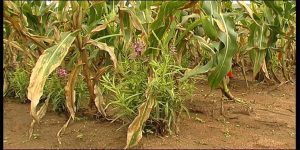
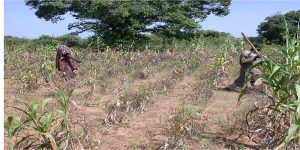
Scientists say that genomic selection is effective for yield improvement in bi-parental maize populations infested by Striga and drought. This conclusion was made in a study titled “Yield gains and associated changes in an early yellow bi-parental maize population following genomic selection for Striga resistance and drought tolerance.”

Striga infestation in maize field.

The study was carried out after a new bi-parental maize population, TZEI 17 x TZEI 11 with combined tolerance to drought and resistance to Striga, was developed by IITA.

Maize (Zea mays L.) is an important cereal crop in sub-Saharan Africa, and one of IITA’s mandate crops. It plays a crucial food and nutrition role and serves as feed and industrial crop in the subregion.

However, its production is limited by factors such as drought (a regular occurrence in most agroecologies of sub-Saharan Africa due to irregular rainfall patterns and climate change in the subregion) and the Striga hermonthica parasite, which threatens the livelihood of over 300 million people in the region.

Yield loss due to drought stress could be as high as 90%, while Striga accounts for an estimated loss of staple food crop valued at $7 billion yearly.

To determine yield gains and associated changes in early maturing yellow bi-parental maize populations, 200 test crosses were evaluated under drought, artificial Striga-infested, and optimal environments.

Maize plants infected by Striga in experimental maize plot.

The results of the study show that yield gains of 498 kg/ha/cycle (16.9%/cycle) and 522 kg/ha/cycle (12.6%/cycle) were obtained under Striga-infested and optimal environments, respectively.

Some changes in early maturing yellow bi-parental maize populations are increased plant and ear heights, improved root lodging, and Striga resistance.

The study concludes with a call for new sources of genes for Striga resistance and drought tolerance because of low genetic variability of most traits in the population.

The article was published in Volume 19 of BMC Plant Biology Open access journal. Find the full article here: https://bmcplantbiol.biomedcentral.com/articles/10.1186/s12870-019-1740-z

IITA participated in a two-day National Micronutrient Conference organized by the Nigerian Federal Ministry of Health (FMoH) in Abuja. The conference took place on 1–2 August and aimed to create an interface and generate discussions among multiple stakeholders representing different sectors on leveraging strengths to scale up micronutrient interventions within the country and contribute to the attainment of the Sustainable Development Goals (SDGs). The theme of the conference was “Nourishing Nigeria: Micronutrient for Equitable and Sustainable Development”.

Research Associate Adekunle Yusuf
listening along with other participants.

IITA was represented at the conference as one of the key development partners and sponsors of the event. Research Associate in the Nigeria Country Coordination Unit of the Agriculture for Nutrition and Health (A4NH) Research Program, Adekunle Yusuf, represented the Country Team Leader, Bussie Maziya-Dixon.

The program highlighted the worrisome malnutrition profile in Nigeria, which shows that over 13 million children are stunted, with more than 2.6 million severely malnourished. It also showcased the current strategies used to address micronutrient deficiency in the country to include supplementation, food fortification, and dietary diversification.

Several lessons were gathered from the event such as slow achievement of robust malnutrition goals in the country due to an implementation gap rather than a lack of policies. It was also noted that strong political will and commitment are required to deliver on the gains of micronutrient-focused programs.

Other key points included the need to evaluate various programs addressing micronutrient deficiency in the country to provide valuable insight on their progress and effectiveness as well as providing a roadmap on future priorities. Also emphasized was the need for better collaboration among academia, development partners, and other stakeholders in the nutrition sector so that relevant research outputs on malnutrition can provide a baseline with which to chart workable solutions to hidden hunger in Nigeria.

The importance of coordination among the organizations delivering micronutrient-entrenched interventions was reiterated. This would help prevent duplication and ensure increased coverage of the target population across the country. Also vigorously emphasized was the low or lack of awareness about fortified foods among nutritionally poor households, especially children and women of reproductive age in the rural areas.

The ongoing National Food Consumption and Micronutrient Survey (NFCMS) led by IITA was highlighted. The survey was lauded by participants as it helps unearth the state, extent, and nature of micronutrient deficiency across geopolitical zones of the country and indicates where the burden is highest.

The program also featured representatives from the office of the Vice President of the Federal Republic of Nigeria, Scaling-Up Nutrition Movement, the Federal Ministry of Agriculture and Rural Development (FMARD), the Federal Ministry of Budget and Planning, FMoH, and counterparts across Nigerian states. Other organizations include HarvestPlus, UNICEF, the Global Alliance for Improved Nutrition (GAIN), Nutrition International, the Food and Agricultural Organization (FAO), UK Aid, and a host of other professionals from the academia, local NGOs, and private enterprises.

Invited enterprises at the conference were also given an opportunity to exhibit and market their micronutrient-driven products at an exhibition.

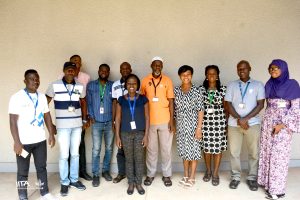
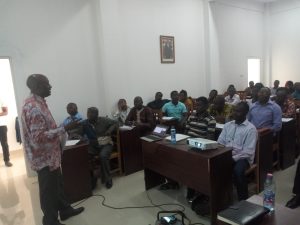
From 5 to 9 August, IITA yam breeders were trained on the use of Yamcross, a mobile application for data management in yam breeding. The application manages the activities of seed and tubers in yam breeding programs. The training was held in IITA Ibadan and was facilitated by Margaret Karanja, Research Assistant and Associate at IITA Nairobi.

Aside from helping to automate and enhance data management with activities in yam breeding programs, Yamcross also provides seamless and centralized access to data for analysis and reporting. Yamcross is an integration of three systems; namely, a mobile application installed on mobile phones, Yambase for generating field records, and the Yamcross dashboard for analytics.

The training was designed to meet the capacity building needs of yam breeders. It is also necessary for accurate data management to make breeding more efficient in generating accurate data that can be shared across all the countries of West Africa where AfricaYam collaborates.

Karanja said, “Yamcross is important and beneficial to yam breeders as it will ensure accurate, timely, and efficient data collection; provide seamless data and report access; and enable management analysis and interpretation of results that are crucial at all stages of the crop improvement cycle in yam.”

Seminar participants with training facilitator, Margaret Karanja.

However, she noted that to access data on mobile for Yamcross, users need to register. Participants were taught how to set up user accounts linked to their personal email address.

At the end of the training, Molecular Breeder at IITA Yam Breeding, Paterne Agre, oversaw a brief interview and auto evaluation session to determine how much participants had learnt and how best participants would be able to use Yamcross. He noted that this would ensure that the training is beneficial to the participants and IITA.