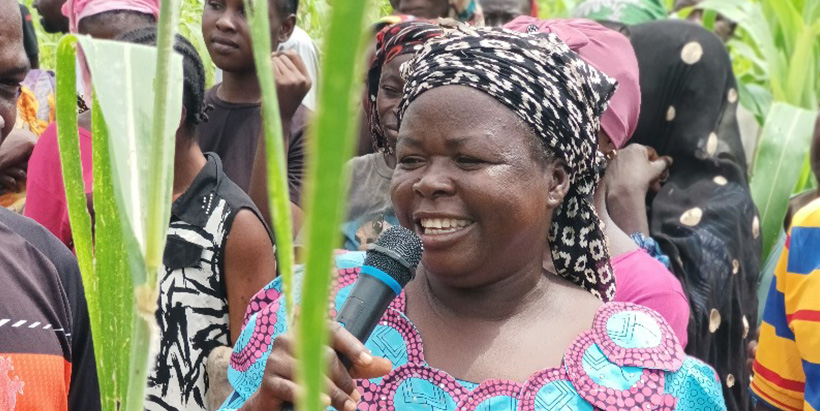
The role of women and youth in the collective efforts to bolster Africa’s agrifood systems through innovations in a changing climate cannot be overemphasized. Africa has the largest youth population globally, with over 400 million people between 15 and 35 years. The strength, vibrance, and fresh perspective of youths provide a rich bank of innovative potential waiting to be tapped. Young people are the driving force of innovation. Women, on the other hand, make up 66% of Africa’s workforce. Women are resilient and possess excellent problem-solving capabilities.

Emphasizing the role of women and youth in driving science-led innovations for climate actions in Africa’s agrifood systems, FAO Chief Scientist Ismahane Elouafi said, “Whether it is developing drought-resistant crop varieties, promoting sustainable and measurement practices, or harnessing digital solutions for precision agriculture, innovation is our ‘beacon of hope’ in a changing climate.” She enjoined all to harness the power of youths, the wisdom of women, and the transformative potential of innovation to create more efficient, inclusive, resilient, and sustainable ways to improve Africa’s food systems.
Speaking on the role of science in the transformation of Africa’s agrifood systems, IITA Deputy Director General, Partnerships for Delivery (DDG-P4D), Kenton Dashiell, representing IITA Director General and Regional Director for Continental Africa Simeon Ehui, said, “The youth and the women of Africa are ready, given the right policies and enabling environments to increase yields across Africa.” The CGIAR has many technologies scaled up for farmers and partners with FAO and other organizations to co-create and deliver technologies at scale. IITA-CGIAR has developed climate-resilient maize (and other crop) varieties that have lifted over 2.1 million Nigerians out of poverty. The Technologies for African Agricultural Transformation (TAAT) initiative has empowered 12 million farmers in 27 countries over the last three years to greatly improve their productivity. Forum for Agricultural Research in Africa (FARA) and Accelerating Impacts of CGIAR Climate Research for Africa (AICCRA) are doing great work to help farmers adopt climate-smart technologies and innovations.
Dashiell said, “All our technologies have a long-term perspective—to be resilient, sustainable, and inclusive of water, land, and food to transform Africa’s agrifood systems. They are also demand-driven by youth and women.” He added that since youths are creative with technology, leveraging innovations in agriculture will be attractive to them. This will prove an effective strategy to reap youth’s engagement in profitable agriculture.
Other panelists presented youth-led climate-smart innovations that leverage artificial intelligence and available digital technologies to alert farmers of pests and diseases on their farms. They recommend improved and climate-resilient seeds suitable for specified climates and soil. One youth-led innovation has integrated agriculture and fashion by creating clothing fiber from plants and other nutritious foods from the same. Innovation is our solution to the changing climate.
Contributed by Folake Oduntan
Related stories: https://www.iita.org/news-item/iita-fara-renew-commitment-work-together-pull-together-deliver-together/
https://www.iita.org/technologies-for-african-agricultural-transformation-taat/