IITA accession map contains locations of origin of four IITA mandate crops, cowpea, maize, yam and cassava as well as agro-ecological zones where they were found. This app was compiled from the Genetic Resources Unit (GRC) germplasm origin database.
It provides a visual presentation of the accession origin of GRC collections. It is also used to plan further germplasm collection survey in the geographical area where gaps exist.
Manduwa (R) briefing the visitors on research activities at IITA.
The Embassy of Ireland in Malawi has stressed the need for strengthened collaboration to improve seed systems, technology development, market linkages, value addition, and food and nutrition activities in the ongoing phase of the RTC-MARKET Project in Malawi.
The embassy and various project partners were visiting IITA–CGIAR in Malawi on a joint field visit to appreciate cassava activities under the Root and Tuber Crops RTC-MARKET Project.
The team, led by the head of operations, Sarah McCan, was impressed with the positive contribution IITA and partners are making to cassava farmers through the RTC-MARKETS in improving seed systems, technology development, market linkages, value addition, and food and nutrition activities. McCan expressed her satisfaction with the demand-driven interventions demonstrated by IITA, citing their importance in ensuring sustainability.
“It is good to see all the partners working together. Ireland has a long history of supporting agriculture in Africa. We are also an agriculture-based nation. For us, it is important to support technologies and extension work. We have enjoyed partnering with the International Potato Center (CIP) and the government of Malawi, and we would like this to continue. We believe there must be demand for products and that we should attain sustainability at the end of the project,” said McCan.
Irish Aid has been providing financial support for root and tuber crops, focusing on delivering productive root and tuber crop technologies and management practices. Under the RTC-Market, Irish Aid is now focusing on markets, aiming to harness market incentives, and working with the private sector to create increased and equitable income opportunities in the RTC sector for farmers and micro, small, and medium-scale enterprises. It aims to contribute to a productive and sustainable agricultural sector in Malawi that generates increased employment and income opportunities and supports food security and healthy, more diverse, and affordable diets for all Malawians.
Mounted displays of processors and Cassava products.
During the visit to Lilongwe, visitors were shown how IITA and the Department of Agriculture Research Services (DARS) use the Semi-Autotrophic Hydroponics (SAH) laboratory for rapid clean seed multiplication of farmer-preferred cassava varieties. They were drawn to the effectiveness of the SAH technology in producing a high number of clean planting materials within a short period and in a small space.
McCan and the team were updated on the ongoing experiments comparing the performance of plants generated from single-node cuttings versus those from conventional cuttings. Preliminary data suggests that plots with single-node cuttings yielded higher than those with conventional cuttings. The second-round trials, to be harvested in December, will have to confirm the first round before concluding.
IITA and DARS are working towards increasing the nutritional value of cassava by fortifying it with beta-carotene through yellow—or orange-fleshed cassava breeding. The vision is to incorporate the high beta-carotene varieties into school feeding programs and food security interventions in cassava-consuming areas.
Under the commercialization drive, IITA demonstrated how it is working to boost the cassava value chain by supporting processors like Kankhuyu Creations and Perisha Agro and Packaging Enterprise in enhancing their supply chain and exposing them to high-end markets.
Perisha Agro is one of the small-scale organizations working with IITA to help empower farmers in cassava and sweet potato value chains. With over eighty-five farmers around Lilongwe, Perisha cultivates over thirty acres of land with an emphasis on new varieties. Perisha and its farmers plan to venture into winter cropping for root and tuber crops.
In Nkhotakota, over three hundred farmers sell their cassava roots to Kankhuyu Processors. Kankhuyu Processors, owned by Lester Kasiya Maliro, has established itself as a formidable, budding business along the lakeshore districts of Malawi. He prides himself on having the capacity to produce four tons of cassava flour per month. This follows the growing demand for Kondowole (cassava flour), which people are now mixing with scarce maize to cook the staple nsima. Maliro was taken to the National Agriculture fair by IITA, with support from the Government of Ireland-funded RTC-MARKET Project. Since then, his Kankhuyu Creations have seen increased demand for his HQCF.
“We have collaborated with DARS to train farmer clubs, processors, and businesses to increase awareness and utilization of cassava-based foods for households and small and medium enterprises,” explained Daniel Manduwa, who is a research associate working with IITA under the RTC-Markets Project.
Sika Gbegbelegbe, IITA Malawi Country Representative, thanked McCan and the team for the visit, which strengthened the partner relationship and highlighted activities to achieve value for money. She expressed optimism that the current partnership with the national program and other partners will continue to grow and that Malawi will also attain and be able to help other countries in need, just like Ireland is doing.
Taking his turn, the station manager for Chitedze Research Station, Dr Lawrent Pungulani, thanked Irish Aid for supporting the government in research and development.
“We do recognize the strong collaboration between the DARS AND CGIAR communities. We are here to solve problems for our common farmers. We need to drive that agenda together to address persistent problems with farmers. The support we get from Ireland is important to the country. You have placed interest in the agriculture sector, particularly in agriculture research. We know that we must justify funding for research, and it’s pleasing to note that Ireland is flexible in research. We hope this continues because this is where farming systems start,” added Pungulani.
CIP leads the RTC Market project and coordinates the Irish and sweet potato component. The cassava component is led by IITA. DARS co-implements all the research and technology development components. Partners who joined during the joint visit included CIP, Agriculture Commodity Exchange (ACE), Tradeline, DARS, Department of Agriculture Extension Services (DAES), Department of Crop Development (DCD), and the Ministry of Trade and Industry.
Contributed by Emmanuel Mwale
Participants during the launch in Togo.
IITA–CGIAR and the Ministry of Agriculture, Village Water Supply, and Rural Development, Togo, have officially launched three new seed certification protocols on 30 September under the Agricultural Transformation in Nigeria’s Federal States and Togolese Regions Towards Achieving Zero Hunger Project. This project is funded by the International Fund for Agricultural Development (IFAD), a key supporter of agricultural development initiatives worldwide. These protocols focus on yam, cassava, and sweet potato and aim to boost the quality of seeds produced in the country, ensuring a more robust agricultural system that can improve food security and enhance farmers’ incomes.
Speaking at the launch, Anani Kodjogan Kpadenou, Director of Plant Sectors, Ministry of Agriculture, welcomed Togo National Association of Certified Seeds representatives and other ministry officials. He expressed enthusiasm for the new protocols, noting that they are a significant addition to the existing ones for crops like rice and soybean. These new protocols are crucial as they ensure seed producers comply with standards and users adopt the correct practices, enhancing the quality of seeds and the robustness of the agricultural system.
IITA Business Incubation Platform CEO and Director of Private Sector Engagement, Debo Akande speaking at the launch.
Kpadenou underscored the longstanding collaboration between IITA and the Togolese government. IITA has been a key player in supporting the presidential initiative on agricultural transformation and establishing the Semi Autotrophic Hydroponics (SAH) Laboratory through the Technologies for African Agricultural Transformation (TAAT) program. This collaboration has significantly contributed to providing clean planting materials. The new protocols are expected to build on these efforts, ensuring that farmers and private sector actors are well-equipped to produce and access high-quality seeds.
Solisama Djobo, Director of Agricultural Seeds and Plants for Togo (DSP), expressed his gratitude to IITA and IFAD—Zero Hunger Project donors—for their continuous financial and technical support. He noted that the seed certification protocols conform to international standards and will improve access to quality seeds, which is essential for food security. Djobo also highlighted the inclusive nature of the protocol development process, which involved input from seed certification officers across the country and technical leadership from IITA, making them an integral part of the project.
IITA Business Incubation Platform CEO and Director of Private Sector Engagement, Debo Akande, who also leads the Zero Hunger Project, emphasized the importance of science-driven agriculture in Togo. He highlighted that agriculture is not guided by science in many countries, which affects productivity. The introduction of science-driven agriculture brings innovation, and this project focuses on strengthening the seed system in Togo. Akande’s insights aimed to enlighten the audience about the project’s innovative approach.
Participants after the launch of the seed certification protocols.
He further emphasized that Togo, and not IITA, owns the project. The protocols will guide private sector engagement in the seed sector. “This is a pilot initiative, and we hope it can be scaled up to reach more farmers. IITA will continue to offer its support, but the success of this project lies in the country’s ability to take it forward,” he added.
The new seed certification protocols mark a significant step forward in improving agricultural productivity and food security in Togo. They promise a more sustainable and prosperous future for the country’s farmers, instilling hope and optimism in all involved.
Cassava production in western Kenya is being threatened by an army of pests and diseases that could decimate harvests. This starchy crop—the second most important in Kenya’s western and coastal regions, after maize—feeds over 500 million people in sub-Saharan Africa, and the challenge from these threats could have devastating consequences for food security in the region. But, new research offers hope for both farmers and consumers.
Senior KALRO researcher Vincent Woyengo in a cassava field with improved varieties—MM96.4271 and Migyera.
In a recent study titled “Occurrence and Distribution of Major Cassava Pests and Diseases in Cultivated Cassava Varieties in Western Kenya,” scientists from IITA and the Kenya Agricultural and Livestock Research Institute (KALRO) conducted field surveys across six major cassava-producing counties to understand how two devastating diseases—Cassava Mosaic Disease (CMD) and Cassava Brown Streak Disease (CBSD)—and pests like whiteflies and cassava green mites (CGM) are affecting cassava production. Their discoveries highlight both the challenges and potential solutions to these “invisible” enemies.
CMD and CBSD are spread by whiteflies—tiny insects that feed on cassava plants. CMD causes yellow, twisted leaves, stunting plant growth, while CBSD—which causes extreme yield loss—results in brown streaks inside the cassava roots, rendering them unmarketable and inedible. These diseases are a major cause of food loss in the region.
The surveys—conducted in 2022 and 2023—revealed that CMD is widespread, but thanks to improved cassava varieties, it is not as rampant as it once was. On average, CMD affected 26.4% of plants in 2022, but improved varieties, like MM96/4271, showed far lower infection rates—only 5.9%. This variety is popular among farmers and is resistant to CMD and tolerant of CBSD, helping protect cassava yields.
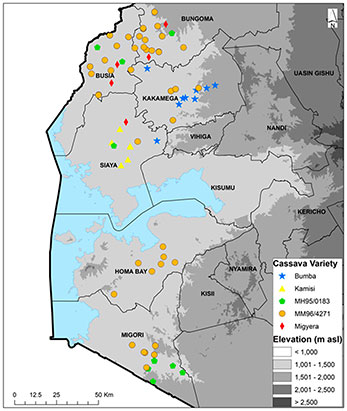
Geographic distribution of the top five cassava varieties cultivated in 2022 and 2023 in six counties of western Kenya.
One of the scientists, Senior KALRO researcher Vincent Woyengo, was pleased with the widespread adoption of KALRO-promoted improved varieties. He said, “KALRO improved varieties are tolerant to the effects of the major cassava virus diseases as well as being high yielding and adapted to environments in western Kenya. However, KALRO is keen to build on improved variety adoption by strengthening seed delivery systems, improving marketing structures, and training farmers in good agricultural practices.”
However, this multiple-front fight involves more than just disease. Whiteflies are multiplying rapidly, with 28% of surveyed fields in 2023 showing alarming infestations. CGMs are another threat, with their numbers increasing due to unpredictable weather, potentially linked to climate change. These mites feed on young cassava leaves, slowing plant growth and reducing yields.
IITA Vector Entomologist Everlyne Wosula, who led the survey team, emphasized the urgent need to re-establish routine surveillance of plant pests and diseases. She explained: “The reemergence of CGM despite previous biocontrol efforts calls for immediate research to understand the resurgence and to develop effective control measures. This is crucial, as cassava is being championed as a climate-resilient crop for food security, yet it remains vulnerable to pest outbreaks, especially under dry conditions.”
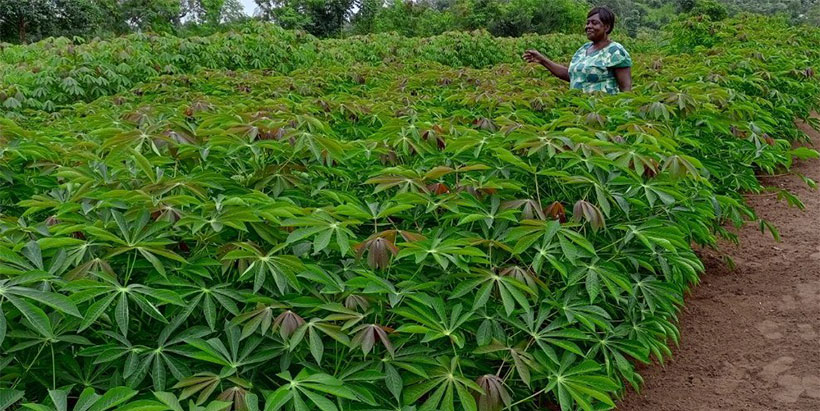
A cassava farmer showcasing the improved Migyera cassava variety.
This study highlights these ongoing threats to cassava production in western Kenya, but there is good news. The extensive adoption of improved varieties like MM96/4271 shows promise in reducing the impact of these diseases. Scientists believe they can reduce crop losses and ensure cassava’s future as a reliable food source by developing disease-resistant strains and promoting better seed systems, thereby expanding the adoption of improved varieties, developing IPM strategies, and enhancing cassava’s resilience to both pests and climate-related stressors. Combining these efforts with integrated pest management will further protect cassava against its relentless enemies.
IITA Plant Health Scientist James Legg, who provides oversight for IITA’s cassava pest and disease research in East Africa, was encouraged to see how improved varieties, jointly developed by IITA, KALRO, and Uganda’s National Agricultural Research Organisation (NARO), have been widely adopted by farmers in western Kenya. Legg noted, “Teams of researchers from IITA, KALRO, and NARO put a huge effort into introducing cassava virus-resistant varieties from Uganda to Kenya in the late 1990s. This was when an epidemic of severe CMD was spreading through western Kenya like wildfire. It is wonderful to see now that several of these varieties have been so widely adopted by Kenyan farmers and are clearly helping them to produce abundant food as well as earning extra income.”
The outcomes demonstrated by the new study have far-reaching implications for food security in Kenya and across sub-Saharan Africa, and with climate change adding pressure to African agriculture, safeguarding cassava is more important than ever.
Contributed by Uzoma Agha
Workshop participants from West, East, and Central Africa .
On 23-25 September, CGIAR RTB Cassava and Yam WCA Network brought together breeders, researchers, and stakeholders from across West, East, and Central Africa to tackle one of the most pressing issues in the region’s agricultural landscape—how to better align yam and cassava breeding programs with the diverse needs of regional markets. The meeting focused on consolidating country-specific market segments and target product profiles for these staple crops, which play a crucial role in human consumption across regions.
Their deliberations highlighted a solid need to review, develop, and adopt new breeding schemes that cater to regional market segmentation and the targeted products for regional consumption. The high-level meeting also focused on consolidating country-level market segments and target product profiles for yam and cassava for human consumption in West and Central Africa with continuous improvement of products to ensure competitiveness and relevance in the regional market.
Cassava Scientist, Dr Mercy Diebiru Ojo, explaining the importance of cassava SAH to the participants.
The Cassava group identified key consumption, yield, and agronomic traits critical to different market segments—fresh white, processing white, industry white, and biofortified products. Traits such as root shape, lodging, root flesh color, plant type, and plant height were unanimously recognized for improvement. Disease resistance traits were considered essential to achieving the meeting’s objectives.
The Yam group also identified important consumer and agronomic yield traits critical to different market segments, urban and rural preferences, harvest, post-harvest, and tuber quality traits for both instrumental and sensory traits. Their discussions were centered on diseases, nematodes, mealybugs, and termites affecting yam production and seed systems. All these challenges were highlighted and reviewed for improvement,
The collaborative efforts aimed to ensure traits align with consumer preferences and regional market demands, ensuring the continued competitiveness of cassava and yam products across the regions.
IITA Molecular Breeder Dr Agre Paterne taking participants through the yam screen house.
The RTB (Roots, Tubers, and Bananas) West and Central Africa (WCA) Network has increasingly turned to genotyping and molecular breeding as pivotal tools for improving yam and cassava varieties, two staple crops critical to the region’s food security and economic stability. These advanced breeding techniques aim to accelerate the development of high-performing varieties that address agronomic challenges and market demands.
The RTB WCA Network emphasizes the importance of collaborative research and capacity building in deploying genotyping and molecular breeding technologies. Research institutions, breeders, and agribusinesses work together to share knowledge, resources, and tools, ensuring that breeding advancements benefit farmers across the region.
The NARS partners agreed to a 3000 – 20000 Seedlings Nursery Benchmark to standardize and harmonize the breeding scheme and breeding bible that will constitute a mode of operations (a breeding manual) for the Global community.
Contributed by Onasanya Emmanuel
To fulfill the IITA Youth Agripreneurs’ (IYA) mandate to drive youth participation in agriculture for improved food systems and job creation, many beneficiaries of the various projects in the unit have continued to make significant contributions to agricultural productivity through their various enterprises.
Mariam Abass and her colleagues at their 2,000 bird capacity poultry.
In addition to training in the value chains of various commodities, including poultry, aquaculture, livestock, horticulture, cassava, maize, yam, and groundnuts, beneficiaries have also been supported to start or scale up their enterprises.
Many beneficiaries in over 17 countries have thriving enterprises in fish production and processing, cassava production and processing, livestock farming, poultry farming, and groundnut production and processing, among many others.
Since the program’s inception in 2012, success stories of young farmers strengthening food security and creating wealth through their businesses abound across the continent.
For example, in the bustling Nigerian city of Lagos, the CEO of Farm2Fill Enterprises, Evelyn Areo, stands as a testament to the transformative power of determination, innovation, and the potential of a meager NG₦10,000 (US$11) seed capital invested with the right knowledge and mentoring.
CEO of Farm2Fill Enterprises, Evelyn Areo, preparing a batch of cat fish for smoking.
Areo, a young agribusiness owner, has, since the commencement of her business in 2021, contributed to the availability of processed foods nationally and internationally. As of 2023, her once modest startup has blossomed into a thriving business, generating an impressive ₦28,000,000 (about $17,000) in revenue.
Farm2Fill, which has provided full-time and part-time employment for four youths and six women, produces spicy kulikuli, tasty smoked fish, processed snails and rabbits, and several other products in local stores across Nigeria and other locations abroad. Meanwhile, her venture into the value-addition component of the value chain has helped reduce food wastage and made options available to many, including Nigerians living abroad.
With a monthly revenue of ₦2,000,000 ($1,250), Areo’s business sustains itself and has become a channel for empowering others. She has gone beyond the conventional bounds of entrepreneurship by actively assisting ten youths in building their unique brands using Farm2Fill products. Areo’s mentorship has also ignited a spark of entrepreneurship in these individuals, allowing them to carve their respective paths in agribusiness.
Similarly, in Zaria, Kaduna State, Mariam Abass has become a beacon of hope and resilience for women in agriculture. At IYA’s agribusiness park, Mariam and her cooperative members have transformed a 2,000-bird (layers) capacity into a thriving enterprise contributing significantly to the local economy.
Operating seamlessly within the agribusiness park, Mariam and her team distribute an impressive 322 crates of eggs weekly, meeting the demands of local retailers and establishing themselves as key players in the region’s poultry industry. Their enterprise has helped to bridge the demand for eggs in their locality while creating job opportunities for retailers and marketers.
In Ibadan, Oyo State, Nurudeen Farayola, who rears turkeys, chickens, goats, rams, rabbits, and ducks, also contributes to the availability of eggs and these varieties in the local market.
Rather than stay on one breed of livestock, Farayola, who benefitted from the training by one of the projects in the unit, said he decided to diversify so that the wealth of knowledge he had gained would not be lost and he could increase his income.
Since the creation of the IYA, there have been more than one million participants, while youth-led agribusinesses created, spanning the entire value chain, especially production and processing, are over 12,500, all contributing to food security in their various locations. In addition, the innovations by some of the beneficiaries are improving food systems, including safe processing and distribution.
Cassava harvest from Ipao-Oke Ako and Irele in Ekiti State, Nigeria.
IITA has developed and released 400 high-quality cassava varieties across Africa for four product profiles, namely industry, fresh market, biofortification, and granulated and paste products, with 56 of these varieties released in Nigeria, the largest cassava producer in Africa. Introducing these new varieties can potentially rejuvenate the declining cassava value chain.
IITA has had a significant impact through its outreach, capacity development, and empowerment initiatives. Farmers have gained access to the newly released cassava varieties and have received training on production technologies and good agronomic practices (GAP) for efficient cassava farming in several Nigerian states.
The Demand Creation Trials (DCT) is a powerful decision-making tool developed by the IITA Cassava Breeding Program in collaboration with Sahel Consulting. Processors identified by Sahel Consulting are conducting DCT activities and making crucial product decisions by selecting preferred varieties and establishing production plans. The DCT approach involves a large trial of 3-5 pre-released and released varieties established in the processor’s fields.
IITA-CBU launched the DCT as part of an information and decision support tool developed to help farmers propagate IITA’s newly released resilient cassava varieties with increased yield and productivity. Smallholder farmers, processors, and in-grower and out-grower partners were engaged to directly co-design solutions to address real challenges facing farmers. This approach, particularly the DCT, has significantly improved field performance and variety selection, leading to increased acceptance, adoption, food production, and sustainability. This uptake and production has greatly increased income and improved farmers’ livelihoods.
Farmers from Mbaikyaan, Benue State, showcasing their harvest.
IITA-CBU, with Sahel Consulting, organized Farmers Field Day events at Promise Point Itakpaji, Ekiti State, Agbeyewa in Ekiti State, Gidigidi Farm in Benue State, and Brieljeco farm in Delta State, to increase production, reduce food insecurity, and promote sustainability. The initiative helped boost awareness and adoption of high-quality cassava varieties among farmers and processors in the states.
Contributed by Onasanya Emmanuel
From August 19th to 30th, the Brazil Africa Institute (IBRAF) will host the inaugural class of the Youth Technical Training Programme for 2024/2025. In collaboration with the Brazilian Agricultural Research Corporation (Embrapa), the training will be conducted at the Embrapa Cassava and Fruits unit in Cruz das Almas, Bahia.
Originally launched by IBRAF in 2017, this technical training program is designed to empower young Africans across diverse sectors such as agriculture and rural development, health, information technology, education, infrastructure, sports, communication, entrepreneurship, and the creative industries. In this edition, 10 young professionals from Sierra Leone will receive specialized training in cassava management.
The president of IBRAF, João Bosco Monte, gives the welcome lecture to the group of professionals from Sierra Leone.
Over the course of two weeks, participants will engage in hands-on activities, learn advanced techniques, connect with Brazilian professionals, attend expert-led lectures, and gain access to state-of-the-art processing machinery. The program aims to enhance their skills and foster entrepreneurship, enabling them to apply their newfound knowledge to their professional lives.
“This initiative underscores IBRAF’s dedication to showcasing effective Brazilian practices to the African continent. The logic is simple: if it works in Brazil, there’s a strong possibility it can also be successful in Africa, with due respect for local specificities,” says Professor João Bosco Monte, founder and president of the Brazil Africa Institute.
The first class of the YTTP 2024/2024 is receiving training in cassava cultivation at the Embrapa Cassava and Fruits unit in Cruz das Almas, Bahia.
This program is being organized in collaboration with Sierra Leone’s Ministry of Agriculture, the International Institute of Tropical Agriculture (IITA), and the African Capacity Building Foundation (ACBF). With a target of training 1,000 young African professionals across various disciplines by 2025, this initiative is poised to make a significant impact on the continent’s development.
IITA Director General Dr Simeon Ehui with some of IITA scientists during discussions with the Angola delegates in Ibadan.
Angolan delegates from the Institute for Agrarian Development (IDA) visited IITA-CGIAR headquarters in Ibadan, Nigeria, from 5 to 9 August. The visit was strategically aimed at bolstering partnership with IITA to deliver proven technologies and support to smallholder farmers in Angola.
The World Bank-funded Smallholder Agricultural Transformation Project (MOSAP 3), which is currently running in Angola, seeks to increase smallholder farmers’ productivity per hectare. Hence, it is seeking collaboration with IITA to deliver all-round solutions for farmers in their Farmer Field Schools.
IDA Director General Felismino da Costa said the various crop improvement solutions, capacity development, and technological packages available in IITA meet the aspirations of the Angolan government, especially for youths and women involved in crop and livestock farming in Angola. Some of their identified intervention directions are maize, sorghum, millet, cassava, beans, and livestock.
Responding to the team’s need to improve seed production for smallholder farmers in Angola, Mercy Diebiru Ojo, IITA Cassava Seed Systems Specialist, said IITA has developed models that combined technology packages for seed production, value addition, and digital technologies for monitoring different crops. These aim to improve productivity, food security, and climate solutions in agriculture.
The team’s visit to Niji Farms and Psaltry Factory exposed the delegates to user-friendly technology solutions suitable for smallholder farmers. Chrysantus Akem, the TAAT Coordinator at IITA, said: “We are already engaged in Angola through the TAAT program—an all-inclusive package for technology deployment covering a wide range of crops and collaboration with sister institutes. The TAAT model can also be adopted in Angola. Your interests in other food components will also be well attended to through our sister partners, riding on the TAAT delivery system.”
Following their weeklong visits to cassava-producing and processing stations within and outside IITA, da Costa said, “We are developing our approach in two ways: we count on IITA’s support to rehabilitate our farmer field schools and replicate the IYA model of youth empowerment in agriculture in Angola.”
For quick take-offs, the team requested IITA deliver technological packages to their field farmers, who will be deployed to replicate these technologies in their fields in September. Consequently, a tripartite agreement between IITA, IYA, and IDA was agreed upon as the first step to implementation preceding host country agreements.



 Workshop participants from West, East, and Central Africa .