
As part of efforts to realize IITA’s Zero Hunger initiative (ZHI) partnership with FGN/IFAD-VCDP on cassava value chain development in Benue State, the IITA Zero Hunger Project team were in Benue State in February on an assessment and training visit. FGN/IFAD-VCDP Benue State Programme Coordinator, Emmanuel Igbaukum, led the Zero Hunger Project team comprising the Project Monitoring, Evaluation and Learning Manager Oyewale Abioye, Project Training Manager Bolanle Olorode, and IITA Post-Harvest Specialist Peter Kolawole on a courtesy visit to the Benue State Commissioner for Agriculture and Natural Resources, Hon. Kester Kyenge to familiarize and brief him on the Project and its collaborations with FGN/IFAD-VCDP.
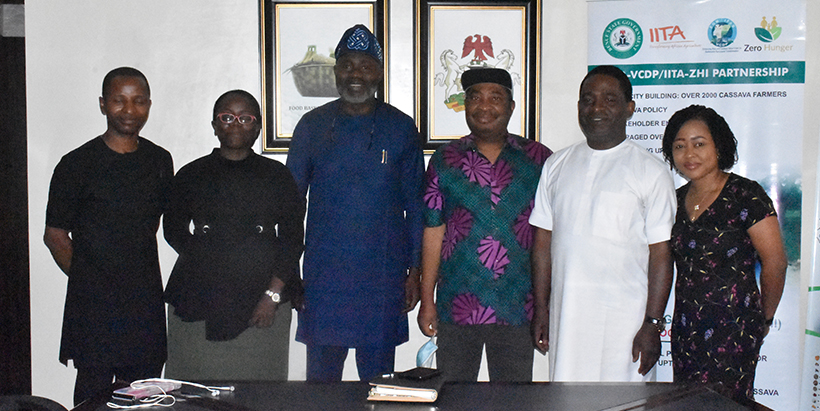
Speaking on behalf of Project Lead Debo Akande, Abioye congratulated Hon. Kyenge on his appointment and thanked him for receiving them on short notice. He briefed the Commissioner on programs and the team’s efforts to achieve zero hunger in Benue in close collaboration with VCDP. The implementation will align with the initiative’s three components: Policy Assessment, Productivity Enhancement, and Capacity Development, with a strong focus on women and youth inclusion. He applauded Benue State’s relationship with IITA, which he described as “fantastic and productive” based on the number of IITA interventions and projects in the State. He also commended the State’s Policy Assessment with IITA Zero Hunger Project, evident in a meeting with the then Commissioner of Agriculture, VCDP, and other stakeholders last year.
Abioye highlighted several IITA Zero Hunger Project capacity development interventions in the State, particularly sourcing for seed funding and training some seed entrepreneurs in partnership with FGN/IFAD-VCDP. He also noted that, in collaboration with FGN/IFAD-VCDP, the program has trained some extension agents on Good Agronomic Practices (GAP) and introduced them to digital agriculture tools, such as the Herbicide Calculator and Akilimo. These extension agents also learned to build and collect correct data using Open Data Kit (ODK) software.
According to Abioye, the program has designed, developed, and remolded some agricultural production machinery that they are introducing to farmers and agripreneurs in the State to enhance production. The IITA team would train seed entrepreneurs on best practices on this visit. Some metal fabricators would learn how to produce a wet hammer mill that can process fresh cassava tubers and dry cassava chips for food and cassava peels for animal feed. He disclosed that this model would be installed at the FGN/IFAD-VCDP Assisted Cassava Processing Centre in Kwande Local Government, in Benue State.
In his address, Kolawole reiterated the need for mechanization in agriculture production and processing to maximize output and profit. He noted that the referenced mechanization does not necessarily mean tractorization but rather basic handheld tools and light machinery, one of which is the wet hammer mill.
Training Manager Olorode emphasized the potential along the cassava value chain, hoping that embracing it would significantly reduce insecurity, unemployment, and youth restiveness. She added that the focus of this visit was to train extension workers and seed entrepreneurs on the production of high-yielding National Agricultural Seed Council (NASC) certifiable seed.
The Project team members charged the Benue State Government to absorb some of the trained extension workers and employ more to increase the chances of achieving zero hunger in the State.
In his remarks, Hon. Kyenge counted the State privileged to be a beneficiary of both the FGN/IFAD-VCDP and the Zero Hunger Initiative, focusing on enhancing the cassava value chain. He noted that Nigeria is prioritizing agriculture to make it the country’s mainstay, and Benue, as its food basket, has a major role in the agricultural transformation plan.
The Commissioner promised the State’s support to assist VCDP and IITA scale up their intervention in the State while assuring the team that the issue of engaging extension workers was being looked into with the urgency it requires. He also commended the program’s focus on youth and women, charging IITA to sustain their partnership with IFAD-VCDP to achieve zero hunger in the State in light of the imminent global population explosion for improved and sustainable agriculture.
Contributed by Oyewale Abioye
Contributed by
Recent stories