
Genetic purity is one of the utmost requirements for quality seeds. In bananas, the penalty of growing the wrong varieties is high because of the long cycle of the crop. Mixing up of the planting material is noticed at least a year after planting. The economic loss is even greater, considering the cost and time of multiplying banana planting material in the laboratory using tissue culture techniques.

To address this issue, IITA, in collaboration with Tanzania Agricultural Research Institute, organized a two-day workshop on using molecular markers for quality assurance and quality control (QA/QC) in bananas from 17 to 18 April in Arusha, Tanzania. The workshop was led by IITA Banana Molecular Breeder Brigitte Uwimana and head of banana research at TARI Dr Mpoki Shimwela, and attended by 21 participants comprising seed certification policy influencers and policymakers, technicians, and quality controllers in research and commercial tissue culture laboratories in Tanzania.
The objective of the workshop was to create awareness about the importance of the genetic purity of banana planting material, to encourage the incorporation of molecular markers as a quality control measure in seed certification, and to equip the technicians to use molecular markers designed for bananas to track the purity of the banana hybrids under field evaluation and throughout the banana seed system chain, starting from the mother gardens, through the tissue culture labs, to the distributing nurseries. The participants were reminded about using molecular markers and introduced to the newly developed Kompetitive Allele-Specific Polymorphism (KASP) markers for QA/QC in bananas. In a hands-on session, the technical participants practiced the process of leaf sampling and handling, placing a genotyping order, processing the genotyping data, and interpreting the results.
Molecular markers not only ensure the genetic purity of the planting material through fingerprinting, but they also improve breeding efficiency. “We made significant progress in developing Matooke and Mchare hybrids that are high-yielding and resistant to pests and diseases. Four Matooke hybrids developed in Uganda by IITA and National Agricultural Research Organization (NARO) were released.
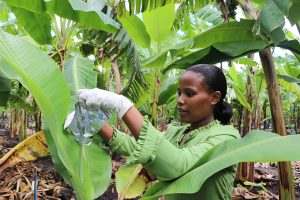
“The first improved Mchare hybrids that are resistant to Fusarium wilt are currently being evaluated by TARI. This work took us nine years. But we need to accelerate our breeding efforts using molecular markers, which will speed up the integration of the desired traits,” narrated IITA Banana Breeder Allan Brown. Uwimana highlighted that molecular markers shorten breeding cycles by identifying the necessary DNA in the breeds at the initial stage, making the process cost-effective. “The markers reduce breeding cost and enhance efficiency. They enable us to discard unwanted hybrids at an early stage of evaluation rather than waiting for years of field trials,” explained Uwimana.
During the workshop, the participants gained insights into the breeding process of Matooke and Mchare bananas and the on-farm testing, release, and promotion of banana hybrids. The participants appreciated the efforts put into the whole process and the importance of evaluating, releasing, and distributing the correct genetic material.
The training was timely as the Tanzania Official Seed Certification Institute (TOSCI) recently released improved cooking banana hybrids developed by IITA and the Ugandan research institute, which TARI later evaluated under different agroecological conditions.
In his workshop reflections, Head of Plant Breeder’s Rights at TOSCI, Twalib Njohole, noted that the training was well timed as the institute has just approved the banana seed certification guidelines. Using molecular markers in quality assurance and control will help the institute and stakeholders prepare fingerprinting of the already released banana varieties for easy, assured, and fast identification of the hybrid plantlets produced by banana commercial tissue culture companies.
The participants expressed the importance of collaboration among breeding centers and companies working on crop variety quality control and assurance. This includes mutually understanding each other’s work and cooperation in sending their samples to a trusted genotyping platform to reduce operational costs, following the proven working model adopted by the One-CGIAR.
With the establishment of the East African Breeding network on Banana Breeding to accelerate the evaluation and release of the cooking banana hybrids, such training should be extended to all member countries to ensure the genetic purity of the planting material as they are distributed within their respective country seed systems.
Contributed by Gloriana Ndibalema
Contributed by
Recent stories